
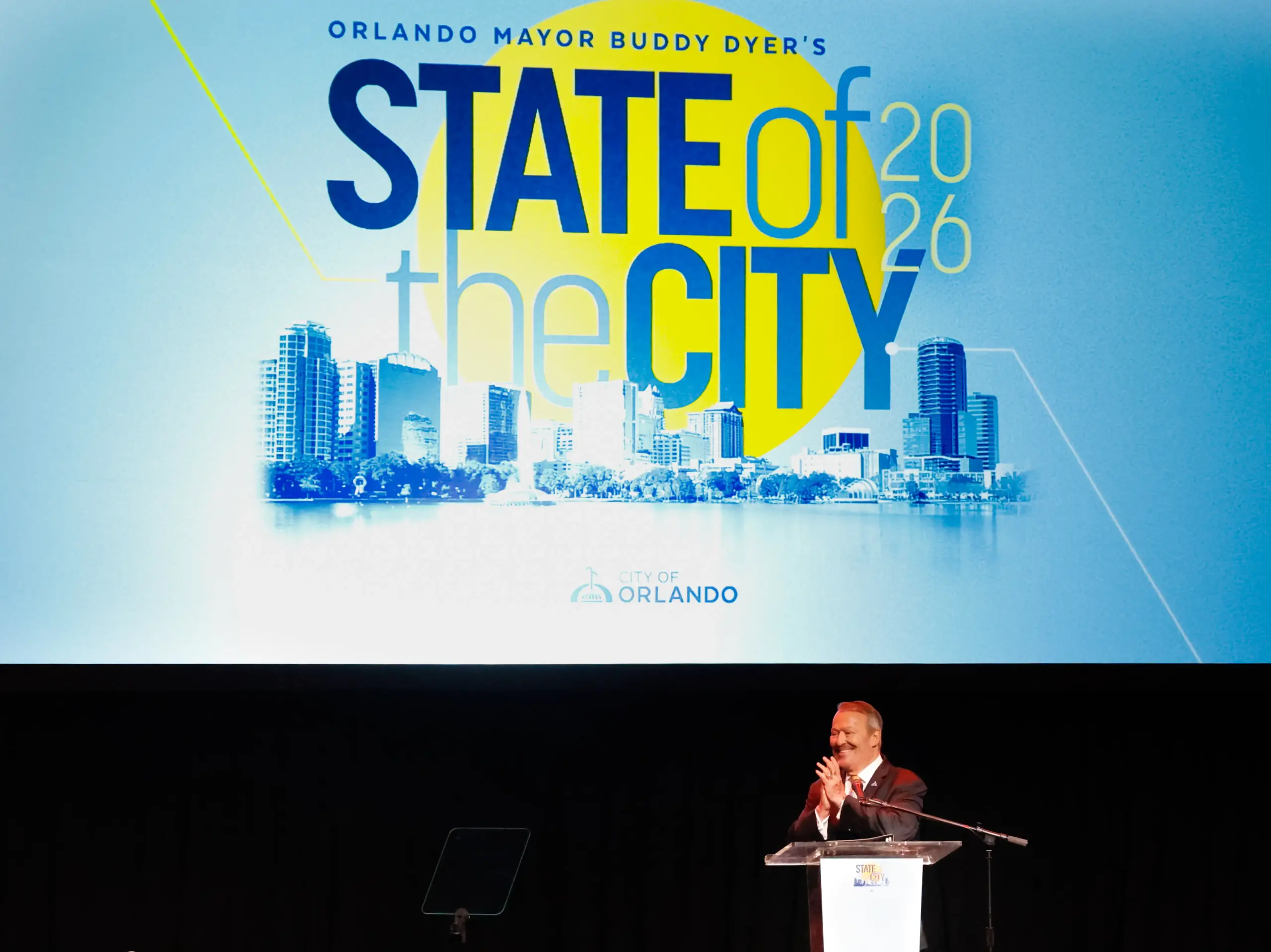
Orlando Mayor Buddy Dyer sought to persuade a room full of business, community and political leaders Friday that their property taxes are spent efficiently and are a wise investment in local services.
Read more Former mayor Kelley, longtime teacher Schwalbach face off in Lake schools race
His annual State of the City speech came amid the backdrop of Amendment 3, a referendum before Florida voters in November that would begin rolling back taxes on primary homes – an effort that would save homeowners thousands of dollars, but Dyer warned would come at a cost.
“Now would be an appropriate time to boo,” he joked as he referenced the initiative, before laying out what property taxes pay for.
“For fewer than $7 a day …. you spend it on 24-hour police and fire protection and emergency medical response, construction and maintenance of 900 miles of roads, 1,200 miles of sidewalks and more than 500 traffic light signals. Access to more than 120 parks, 60 sports fields, 55 playgrounds and 19 neighborhood centers.”
Should the tax-cutting measure pass with 60% of state voters’ approval, Dyer warned new fees could be levied to help offset losses or taxes on commercial properties could be increased.
The city projects to rake in about $381 million in property tax revenue next year, which flows into its general fund to cover core government services. But Orlando would stand to lose roughly $30 million in 2028, $50 million in 2029 and $80 million each year after, should the amendment pass.
“If funding is reduced, cities will face difficult choices about the services that residents expect every day,” Dyer said. “It could lead to slower 911 response times, parks and neighborhood centers being open fewer hours, a reduction in programs and services that residents value, like repaving roads, summer camps for kids or simply cutting the grass along our streets.”
Read more Luigi Mangione pleads guilty to federal stalking charges in the killing of UnitedHealthcare CEO
Last month Dyer said the city was implementing a hiring freeze and creating a stabilization fund – essentially setting aside budget surpluses – to help offset initial impacts, should Amendment 3 pass.
Dyer also recently joined the fight financially. Campaign finance records show his political committee contributed $10,000 last month to the “No On 3” committee, which hopes to defeat it.
If approved, the property tax amendment would create a $150,000 homestead exemption in 2027 and a $250,000 exemption in 2028. Such a tax break would mean thousands of dollars in annual savings for homeowners – for instance, an Orlando homeowner with a property assessed at at least $300,000 would be in line for $2,500 in annual savings once the $250,000 exemption kicks in.
The amendment doesn’t address the portion of a property tax bill that goes toward public schools.
Gov. Ron DeSantis and his allies have pushed for Florida to fully eliminate property taxes on primary homes. Chief Financial Officer Blaise Ingoglia has alleged that cities and counties up and down the state are overtaxing and overspending and that relief was needed for taxpayers.
Read more Miami Hurricanes running back Jordan Lyle arrested in Broward County