
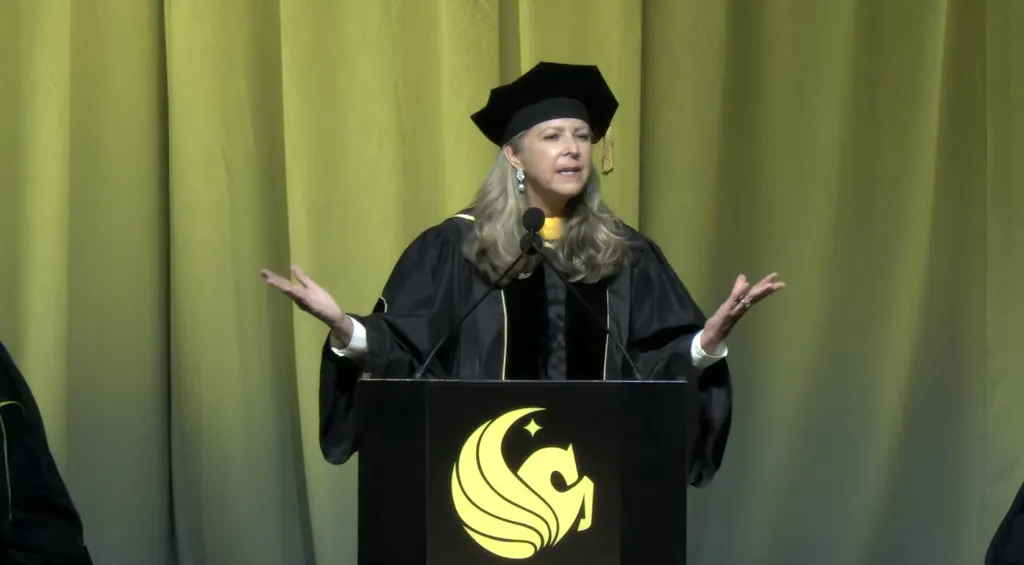
There is a surprising amount of hype about that University of Central Florida commencement speech in which students audibly booed when the speaker, a real-estate executive, praised the rise of AI as the “next industrial revolution.” This clear mismatch between student sentiment and commencement speaker message reminds me of another Florida commencement speech that made headlines: New College of Florida in 2024. After Gov. Ron DeSantis took over and attempted to transform New College (a quirky liberal arts college) into what I consider the prototype for fascist higher education, President Richard Corcoran selected as commencement speaker TD Ameritrade founder Joe Ricketts. Students, many of whom chose the college for its liberal values and culture, held their own “alternative commencement” with Russian anti-authoritarian Masha Gessen. The next day, they drowned Ricketts out with chants of “Free Palestine.”
Read more Chris Perkins: Dolphins’ veterans have a valuable role in this rebuild
I argue that indoctrination is the new role of higher education under fascism, and higher education is being retooled to become a factory producing new minions for an authoritarian system. It would make sense for Florida public universities to be especially out of touch with students’ concerns and beliefs given their intentional politicization as a petri dish for patriotic indoctrination, towards which there has been an ongoing hostile effort to ideologically transform colleges in Florida for years.
It makes sense that Florida commencement speakers, a prestigious and potentially political position, reflect the administration’s priorities, not the students’. Who do you think they chose for New College’s commencement speaker in 2025? It was Alan Dershowitz, alleged Epstein victim trafficker and lawyer for Jeffrey Epstein, Donald Trump and O.J. Simpson, which has to be the most tone-deaf or intentionally antagonistic selection possible.
This brings me back to the students who booed the real-estate developer praising AI. Casey Fiesler, a professor at the University of Colorado, defended students against allegations that they were “afraid of AI” supposedly because they do not know how it works or how to use it. She noted in a social-media post that the students in the audience were probably very AI-literate, and that their objections were probably moral. This is consistent with the words of students themselves, such as journalism student Don Strouble who, in an interview with KnightNews.com, acknowledged the threat AI poses to journalism and shared his concern that pro-AI people are attempting to “force a state of acceptance about something hostile to not only our livelihood but the environment and the livelihood of people living near data centers.”
I would not be surprised if the fearful allegations Fiesler referred to were actually from bots delivering a credibility attack. As someone who has focused on corruption for years, I recognize the “poor ignorant students who just don’t understand” script as one of the most irritating public-relations strategies used by corrupt actors to belittle, dismiss and discredit student opponents.
Read more Daily Horoscope for May 19, 2026
By explaining the corrupt process, bad actors can misrepresent the problem as failure to grasp “how the system works,” not the fact that it does not work for anyone except those bad actors. The “explaining” also has the benefit of making bad actors look sympathetic for “helping” the poor, scared students. The worst part is that the resources of the powerful who are being criticized get all the platforms and megaphones, and what remains of an independent press is often afraid of getting targeted if they publish the counter-narrative. This leaves students without a way to even correct the record on their own behalf.
For the record, those students are not stupid. It makes sense that AI supporters and beneficiaries want you to think they are, but this mundane public university commencement speech would not be garnering international headlines if the dissent students expressed was not relatable. AI puts a lot of money into P.R. and apparently unholy alliances with higher education, incubating it and, getting researchers to whitewash its harms to support a false sense of security.
AI relies on an image of trustworthiness (precluding regulation), economic value and public good, and students saw through that. The public-relations crisis AI is presently having gives me hope because it means the mask is falling off, and there must be a lot of people who do not like what they see underneath.
Hope Loudon is a whistleblower with a master’s degree in Public Policy from Central European University.
Read more Walt Disney World’s new president started as Jungle Cruise skipper