
Floridians should see fewer tropical cyclones than average form in the Atlantic Ocean during this year’s hurricane season, which begins June 1, thanks to a strong El Niño weather phenomenon on the other side of the world, according to the National Oceanic and Atmospheric Administration.
Read more WWE star Ludwig Kaiser charged in battery of Orlando neighbor over PDA
The federal weather agency on Thursday predicted “a below normal” season with between 8 and 14 named storms in the North Atlantic Basin through Nov. 30. Of those, NOAA experts predict between three and six will be hurricanes, with between one and three major hurricanes of Category 3 or higher.
Still, officials urged residents to be ready.
“Don’t let words ‘below average’ change the way you prepare,” said Ken Graham, director of the NOAA’s National Weather Service, during a press conference in Lakeland. “All it takes is one [catastrophic storm]. ….You can’t let your guard down. Even in ‘below average’ seasons, there can be big ones. And we’ve got to be ready.”
NOAA’s first forecast follows other weather institutions’ prognostications — including from Colorado State University and AccuWeather — for a below average hurricane season because of an overbearing El Niño warming pattern expected to form in the Pacific Ocean in the coming weeks.
NOAA’s forecast is closely watched because it taps into the federal agency’s vast resources — including data from upgraded computer modeling, meteorologists, drones and satellites. While weather predictions are uncertain at best, the agency is known for its accuracy.
NOAA Administrator Neil Jacobs pointed out the agency has started this year to use AI, or artificial intelligence, to enhance its weather models.
An “average” or “normal” season has 14 named storms with seven hurricanes and three major ones, according to NOAA. A Category 3 or higher tropical storm has sustained wind speeds of at least 111 mph.
Specifically, NOAA researchers gave a 55% probability of a “below normal” hurricane season this year, a 35% near normal and a 10% above normal.
The NOAA forecast does not contain landfall predictions, such as the probability of hurricanes hitting Florida or landing along the Mid-Atlantic or Northeast.
Matthew Rosencrantz, NOAA’s lead hurricane forecaster and a climate scientist, said the last time the agency predicted a “below normal” hurricane season in its May forecast was more than a decade ago, in 2015.
Its prediction was correct. That year, 11 total storms formed in the Atlantic, including four hurricanes, of which two were major. But one of those was Hurricane Joaquin, a Category 4 storm which devastated a portion of the Bahamas.
It may seem odd that what happens in the middle of the Pacific Ocean — nearly half a world away — affects the tropical storms Floridians see during a hurricane season.
During an El Niño year, the waters in the central and eastern Pacific near the equator become warmer, increasing the chances for stronger storms in that region. NOAA forecasts an “above normal” hurricane season in the Eastern Pacific, with only a 20% chance of a near normal season, and a 10% chance of below normal.
But that pattern, in turn, leads to sinking air and higher pressure in the Atlantic, along with stronger upper level wind shear, factors that hinder hurricanes here.
This year’s bully El Niño is on track to become one of the strongest on record, according to NOAA researchers.
In a more moderate El Niño, temperatures in the central Pacific would rise to about 1.8 degrees above average. But this year, many forecasts show the water temperatures soaring to a whopping 5.4 degrees.
Last year, a relatively mild Atlantic hurricane season saw 13 named storms, including five hurricanes, four of which were major. NOAA in May 2025 had predicted between 13 and 19 named storms — including up to 10 hurricanes, with three to five of them major.
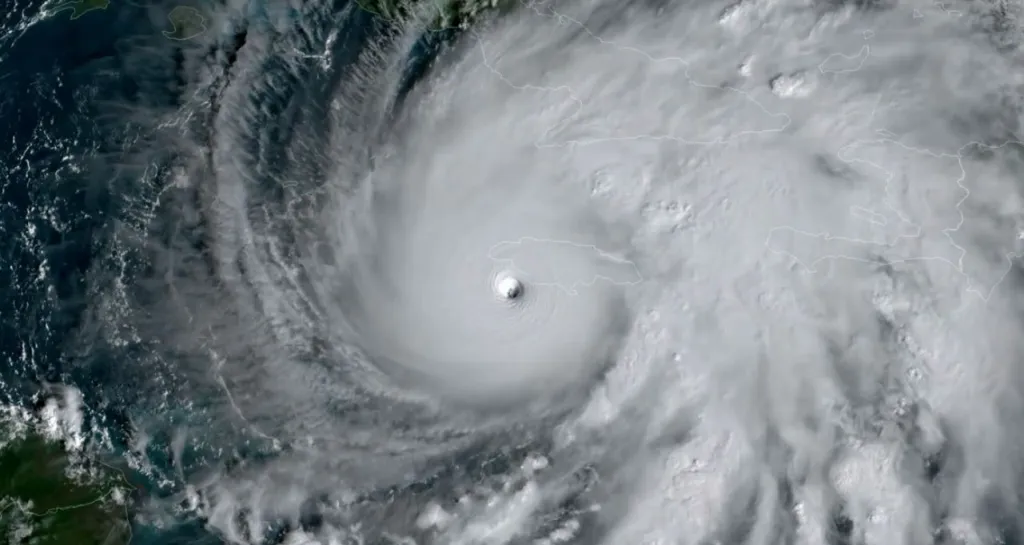
Hurricane Melissa in late October was the most powerful storm in 2025 with maximum sustained winds of 190 mph. In all, it caused 95 fatalities and more than $12 billion in damage. Most of the destruction occurred in Jamaica after the Category 5 storm plowed into New Hope.
NOAA’s Atlantic season outlook will be updated again in early August, just ahead of the hurricane season’s peak, which extends from mid-September through October.
Read more Halloween Horror Nights plans ‘Sinners’ haunted house for 2026