
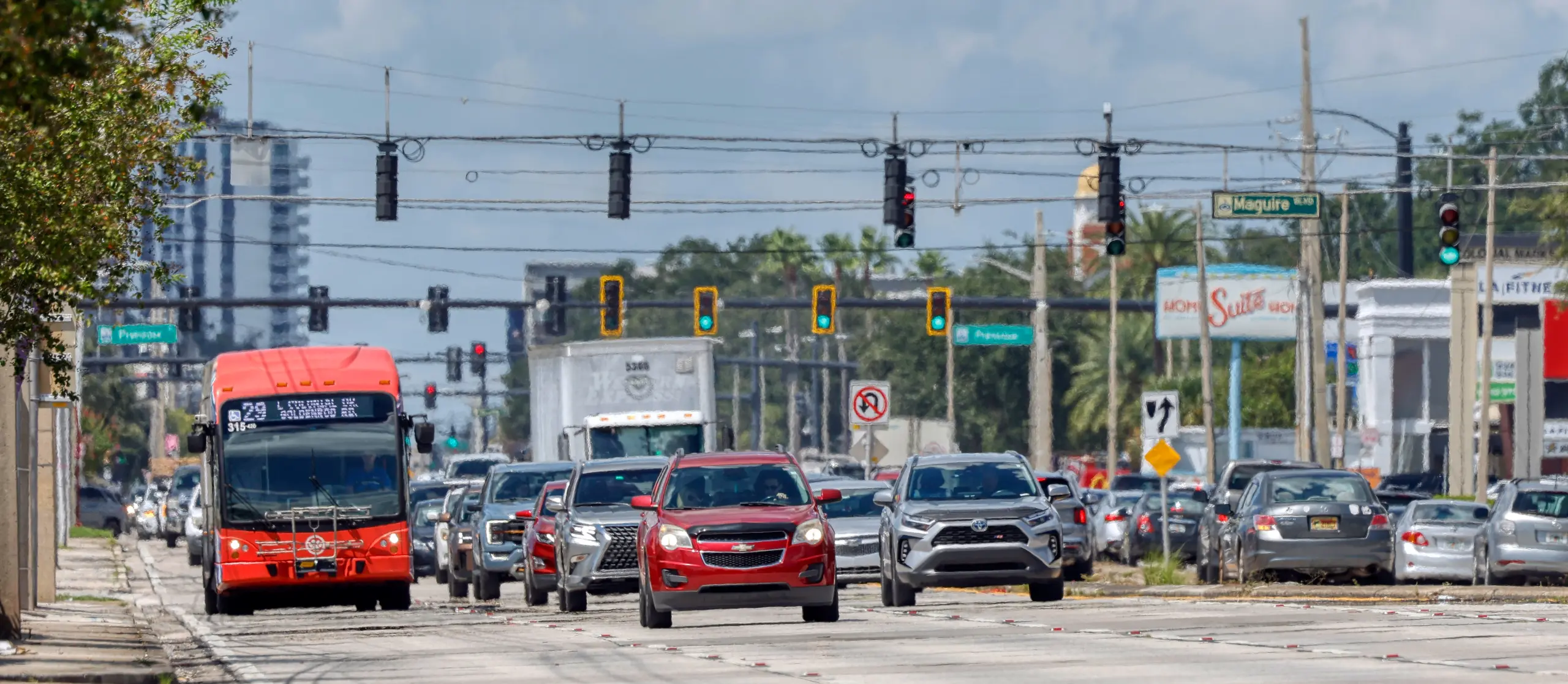
A grassroots group has devised a plan for speedy transit routes along some of Orange County’s biggest roads — and key political leaders are hopping on board.
Read more DeLand historian searches for a permanent home for storied WWII tugboat ‘Tiger’
The so-called STAR Plan, an acronym for Sunshine Transit Advancement Resolution, aims to create rapid transit lines across vast stretches of the county, including along most of Colonial Drive as well as Semoran Boulevard and the Orange Blossom Trail.
The plan requires that routes are serviced by buses that arrive every 15 minutes, operate in designated lanes separated from vehicle traffic, or could be used by light rail, commuter trains or other transit options.
The notion of dedicated bus lanes is particularly intriguing because they could be far cheaper to build and operate than rail lines. But the biggest cost advantage comes if existing lanes are used for the buses, and that would take road capacity away from cars, a tradeoff that has proven controversial elsewhere in the country when it has been tried.
The Board of County Commissioners is set to discuss the STAR plan on Sept. 29 as a discussion item, meaning it’s not up for a formal vote. The advocates at the youth-led Sunrise Movement Orlando, however, hope a majority will direct staff to study it further.
The group, a branch of the national progressive organization focused on climate action, devised the plan based on a similar one in Miami after disappointment that Orange’s transit woes hadn’t been fixed, despite widespread acknowledgement the system was lacking.
“We saw both in 2022 and 2024 the county put all its eggs in one basket with the transportation sales tax … and that failed,” said Giancarlo Rodriguez, the group’s Hub Coordinator. “A lot of people have been very excited about this plan because it creates a vision.”
Its website lists a slew of endorsers, including incumbent commissioners Nicole Wilson and Kelly Semrad, as well as Tiffany Moore Russell, a candidate for mayor, and Patricia Rumph, a candidate for the District 7 seat.
It’s also backed by U.S. Rep. Maxwell Frost, D-Orlando, and state Rep. Anna Eskamani, a candidate for mayor of Orlando next year.
As with any transit expansion proposal, dollars and cents will certainly be a factor.
The plan is focused on creating eight transit corridors with transit access at least every 15 minutes, with dedicated lanes and traffic signal priority. Such improvements would be funded by a mix of federal, state and local dollars, with a special taxing district created within a half-mile of each to help fund the needed improvements.
The districts would peel off a portion of increases in property taxes that come from new development or rising property values and divert that money to transit over 25 years. Under the proposal, the money could only be spent on train and bus, bicycle and pedestrian improvements near stations and studies, operation and infrastructure costs.
The STAR ordinance also calls for creating a Citizens’ Rapid Transit Trust Fund, managed by an oversight committee of appointed citizens.
In recent months, however, the Miami SMART Plan, which the Orange pitch is based on, has bumped up against funding concerns.
A May memo from Miami-Dade County Mayor Danielle Levine-Cava said the five remaining corridors outlined in its plan “cannot be implemented under the current financial trajectory,” and the county would need to pursue higher taxes in order to cover a $7.6 revenue gap over 20 years to build and operate the six new major transit lines, the Miami Herald reported.
A key difference is that Miami’s plan is focused on rail routes, which are generally more expensive, and the STAR Plan may lean more on rapid bus routes, Semrad said.
Read more What to know about Europe’s push to compete in space
“We’re Carlando,” she said. “We need a traffic solution. We have to do something.”
Moore Russell said if she’s elected Mayor, she’d like the proposal to be a part of her overall transportation plan, which includes expanding SunRail to seven-day-per-week service with trains running later at night.
The STAR Plan, she said, would help improve transit access east and west, while SunRail travels North and South.
“That plan is attractive because it connects major communities where the large workforce is and gets them to where the jobs are,” she said.
Her opponent, Chris Messina, favors shifting Lynx to smaller vehicles with point-to-point service similar to Uber or Lyft, like the Scout program used in Seminole County.
The full slate of proposed corridors are: Colonial Drive from Ocoee to UCF, Silver Star Road from Ocoee to Lynx Central Station, Orange Blossom Trail from Zellwood to Lynx Central Station, from Lynx Central Station to Vineland Outlets, Semoran Boulevard from Orlando International Airport to University Boulevard, Kirkman Road from Colonial Drive to the Vineland Outlets, as well as SunRail and the proposed Sunshine Corridor.
Wilson said she supports the plan because it emphasizes designated bus lanes, a transportation option she strongly prefers over adding highway lanes.
“We need bus rapid transit,” she said, adding it promises to serve people who need a better way to commute.
At the Sept. 29 meeting, discussion could include directing county staff to study how such a plan could come together in a county where the bus system has been underfunded for decades and its commuter rail service doesn’t usually operate on nights and weekends.
Semrad said the funding districts were selected in part by looking at election precincts that voted in favor of the 2022 transportation sales tax at the highest numbers.
“We have a transit issue in Orange County, we have an affordability crisis in Orange County and we hope this is a solution that can provide taxpayers with some relief in terms of cost of living in Orange County,” she said. “We hope that it helps protect our tourism economy.”
If the Sunrise Movement is successful in swaying county leaders to pursue the plan, it could feature more than just buses if county leaders decide they want to pursue trains, cable cars, or other modes. Two of the routes included are the existing SunRail line and the proposed Sunshine Corridor rail connection to the airport.
On its website, the group shows a drawing of an elevated rail line down the center of Colonial Drive at the Milk District, which Rodriguez says is something they think is possible.
“We believe that it’s something that could happen here,” he said. “It may seem daunting, but just because something is hard doesn’t mean we can’t do this.”
Read more Little Mercury may be shrinking faster than scientists expected
Stephen Hudak of the Sentinel staff contributed.