
Two more locally aquired cases of dengue fever in Orange County have prompted county officials to step up efforts to fight the pesky insects and the Florida Department of Health to issue an alert about mosquito-borne diseases.
Read more Sheriff: Clermont man offered fellow inmate $5K to kill witness
The first advisory about dengue fever was issued Sept. 2 by state officials after a case was confirmed in Pine Hills. The additional cases announced Friday are in the Apopka area and prompted another state alert.
The culprits are Aedes aegypti, primarily daytime biters that thrive in urban and suburban areas and breed in flowerpots, buckets and other smaller containers, said Steve Harrison, manager of Orange County Mosquito Control.
“We have a robust population of those,” he said of the species, sometimes called yellow fever mosquitos. “If residents go out in their yards and find containers holding water, more than likely there will be Aedes aegypti larvae in them.”
Empty them, he advised.
If larvae are in the containers, adult mosquitoes are around the property, too, Harrison said.
The mosquitoes are homebodies, typically flying no more than 200 yards from where they emerged as larvae.
Florida leads the nation in dengue cases this year with 270 reported so far.
Mosquito-borne dengue fever is commonly found in tropical and subtropical regions. Typical symptoms are a high fever, severe headache, pain behind the eyes, muscle, bone or joint pain, nausea and vomiting, swollen glands, and skin rash.
While many species of mosquito inhabit Florida, only two transmit dengue: Aedes aegypti and Aedes albopictus. Recognizable by their dark bodies and distinct white-striped legs, these biters peak just after sunrise and before sunset. They also can transmit Zika, yellow fever, and chikungunya.
Aedes aegypti are native to north Africa and considered an invasive species here.
Last month, the Florida Department of Health in Orange County advised residents of an increase in mosquito-borne disease activity in the area. Several sentinel chickens have tested positive for West Nile virus.
Sentinel chickens are healthy birds placed in outdoor coops and monitored by public health departments in the hopes of detecting potentially dangerous, mosquito-borne viruses before they spread to people.
Though 2026 has been the 15th driest year in Central Florida since record-keeping began over a century ago, regular and sometimes heavy afternoon downpours this month have provided good conditions for Aedes aegypti.
“Small containers — their breeding habitats — are filled nearly daily with rainwater, and that’s a problem,” Harrison said.
He said mosquito control follows the guidance of the Centers for Disease Control and Prevention, focusing their initial response within about 200 yards of the area of concern.
Read more “A black box”: Watchdog hopes to pry loose Hope Florida court records
“Our crews inspect properties yard-to-yard for mosquito breeding sites, particularly containers and other sources of standing water where Aedes aegypti mosquitoes can develop, and treat those sites as necessary,” he said.
County crews also apply “larvicide treatments” using truck-mounted air-blast equipment.
“These treatments are designed to reach water-holding containers and other mosquito-breeding habitats throughout the surrounding community and control mosquitoes while they are still in the larval stage,” Harrison said.
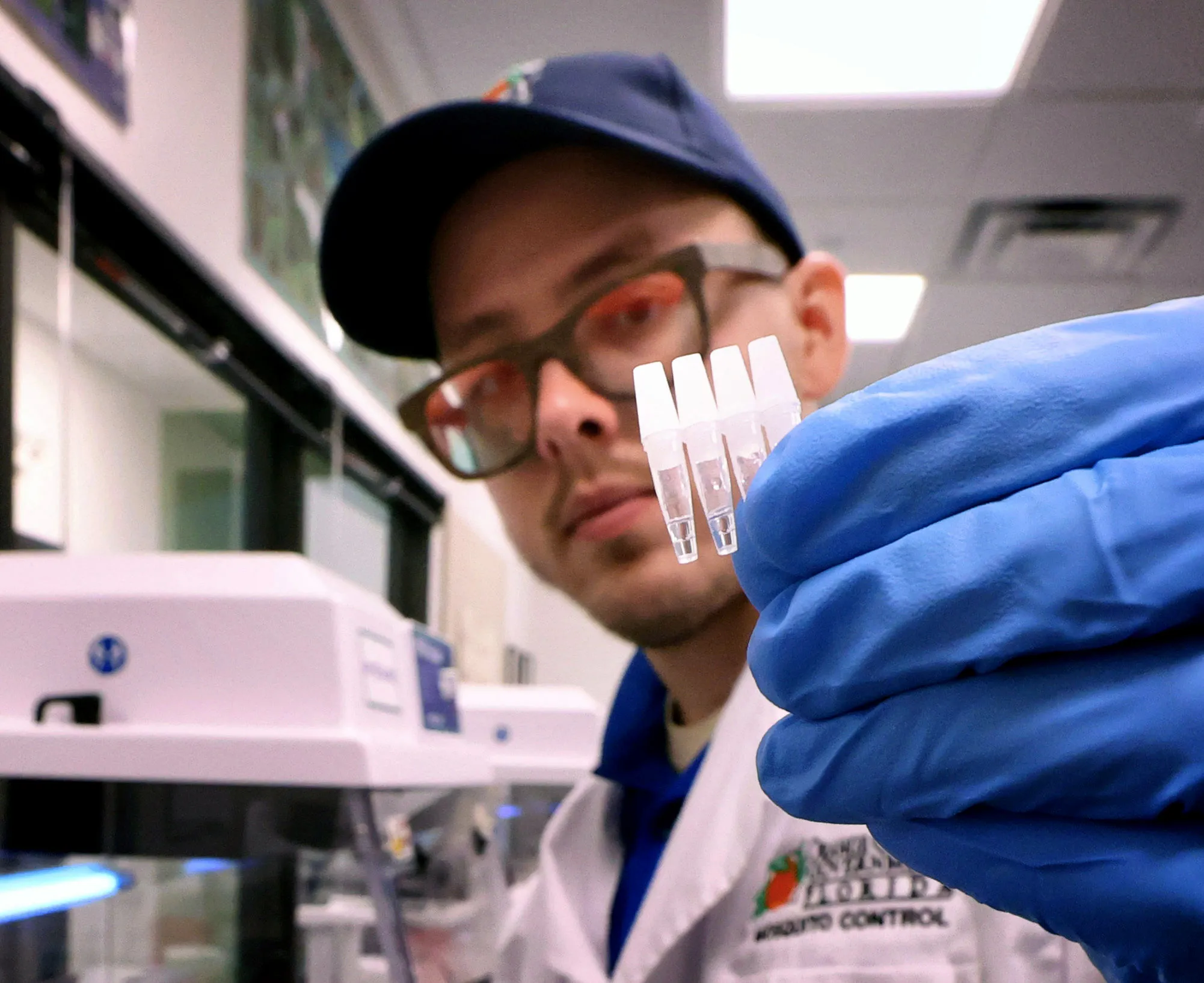
Orange County Mosquito Control recently added new technology to its laboratory, allowing the agency to detect mosquito-borne illnesses, like dengue fever, more rapidly. The new molecular testing uses technology to look for genetic material of specific viruses within mosquito samples.
Previously, samples were sent to outside laboratories.
Harrison said the county can now get same-day results, which lead to faster responses and mitigation efforts.
As many as 111 people as of early September have contracted locally acquired dengue in six Florida counties this year, according to state data. While eight of these cases were in Miami-Dade and Palm Beach counties, a striking 95 occurred in Hillsborough County, where mosquito control teams are working overtime and ramping up spraying.
The death of an 80-year-old South Tampa woman may be linked to a dengue infection.
Frequent global travel significantly drives case numbers. So far this year, about 160 Floridians contracted dengue after traveling to endemic areas — most frequently Cuba. Mosquito experts point to hotter summers and increased rainfall as additional contributing factors.
A common dengue symptom is a sudden high fever starting four to 10 days after a bite, followed by a skin rash a few days later. Treatment is limited to rest, fluids, and pain relievers.
“There is no cure or antiviral medications for dengue,” said Dr. Rana Chakraborty, division chief in Pediatric Infectious Diseases at the University of Miami.
Many infected individuals remain completely unaware.
“A lot of people can get bitten, acquire dengue, and nothing happens to them,” Chakraborty said. “Only a fraction have symptoms.”
For about 1 in 20 people, dengue progresses to a severe level — triggering repeated vomiting, nosebleeds, stomach pain, and organ failure — often requiring hospitalization.
Read more Florida jobless rate falls for third consecutive month