
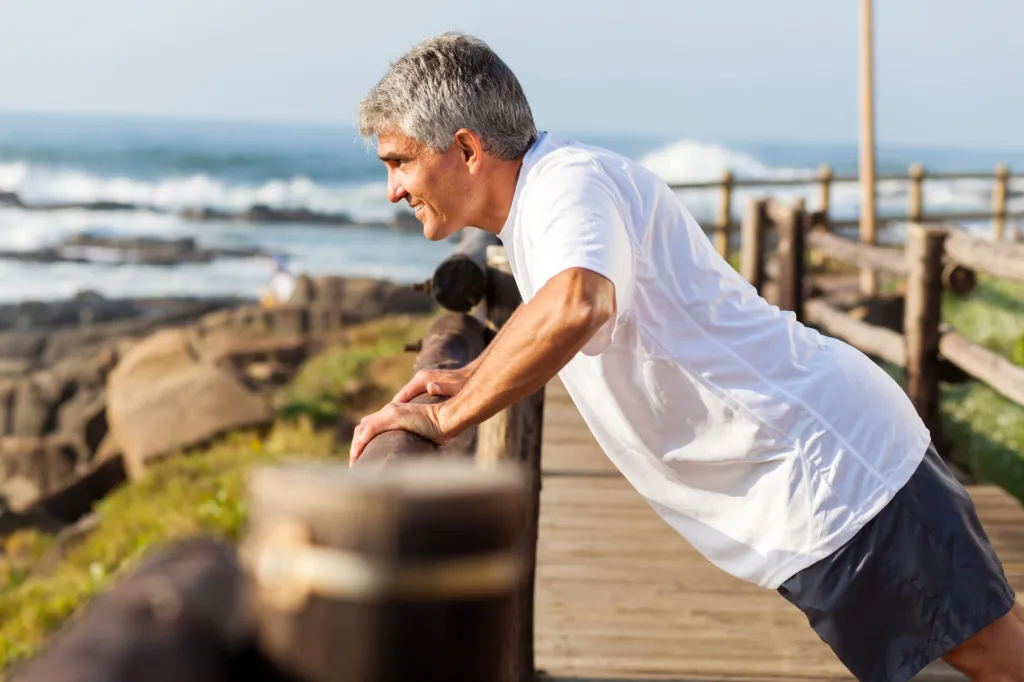
Jay Campbell, a Tampa author, says he has a biological age of about 30, while his chronological age is 55.
Read more DeSantis signs South Florida representative’s bill to strengthen domestic violence laws
Scientists have discovered that people’s biological age, which is how old their cells, tissues and organs are, often differs from their chronological age, the number of years they have been alive.
Campbell, co-founder of Biolongevity Labs, attributes his low biological age to a daily cocktail of 7 to 10 peptides for more than a decade.
“My lab work is the best it’s ever been in my entire life. It’s like I am getting younger cellularly and through my biomarkers. So, I know that these things do work,” he said. “Of course, it’s all within the context of living the correct lifestyle.”
As researchers study ways to slow down or reverse a person’s biological age, Florida is now considered a hotbed for clinics, treatments, trials and supplements.
University of Miami researchers are studying biological age to predict who’s at risk for developing colon polyps, a known risk factor for colorectal cancer. Dr. John Lewis, a voluntary associate professor at the University of Miami, has led multiple clinical studies on cellular repair and biological aging. Lewis has looked at how a plant-based diet could reverse your biological age and whether certain supplements — including aloe polymannose — can help, too.
“This isn’t just about ‘good genes,’ it’s about cellular health that can be measured,” Lewis said.
University of Florida researchers are pioneering the reversal of biological age by specifically focusing on “brain age.” Their studies have shown that lifestyle choices can cause the brain to age faster or slower than the body, and that healthy habits — including regular exercise — can make the brain appear up to eight years younger.
At the same time, longevity clinics are popping up across the state, where patients can receive comprehensive assessments, peptides and other therapies aimed at slowing aging. These Florida clinics charge anywhere from a few hundred dollars to more than $150,000 a year for scans, customized treatments, and diets to identify health risks, track how fast your cells are aging, and build an optimization plan.
For now, individuals can test their biological age with a commercial at-home blood or saliva test that costs $200 to $500. Different testing methods examine cellular, chemical or physical markers in your body and analyze them using certain biological-age clocks. But companies, researchers, and the federal government are racing to develop more accurate and reliable ways to measure biological age, including a possible test based on brain scans.
“All these things will tell us not only what our biological age is but why it is a certain level. That is what is going to be all the rage over the next three to five years,” Campbell said.
Longevity researchers also are looking to use artificial intelligence to identify which biomarkers are most predictive of disease, and they are examining the potential of various drugs or therapies to delay aging — or even reverse it.
Dr. Edward Schwartz, director of the Osher Center for Integrative Health at the University of Miami Health System, said stress, poor sleep, poor nutrition, a sedentary lifestyle, and heavy alcohol use can contribute to a higher biological age. “Lifestyle issues are important factors in slowing down or speeding up the aging process,” he said.
Every lifestyle intervention, medical therapy, or physical reset that successfully lowers your biological age is effectively buying you more time to enjoy life and move without pain. That concept is driving increased marketing of anti-aging supplements and extensive screenings in Florida.
“Even people in their 30s, 40s, and 50s are interested in longevity,” Schwartz said. “We want to live as long as we can, but we want to live healthy.”
Women with thinning hair wanted for clinical trial
South Florida women with hair loss or thinning hair are wanted for a new clinical trial of a novel oral extended-release minoxidil formulation. Veradermics is testing its product, VDPHL01, at five Miami locations as part of a phase 2 and 3 clinical trial. The company says if all goes well, this could become the first FDA-approved oral prescription for female pattern hair loss.
“There is really an unmet need,” said cosmetic dermatologist Adriane Pompa with Mayoral Dermatology in Miami. “It would be great to have something to offer my patients.”
While oral low-dose minoxidil is available, it is used off-label and peaks after one hour, so it is short-acting, Pompa said. The trial is for an extended-release formulation. “It stays in the bloodstream and has the potential for fewer side effects. If the medication is there longer, it creates an environment for hair follicles to get more nutrients,” Pompa said.
The previous clinical trial with men experiencing pattern hair loss showed that Veradermics’ VDPHL01 medication achieved consistent hair growth. For now, the extended release formulation is not available outside the trial. Women can enroll at https://phlstudy.com/female/.
Read more Maxwell: Readers sound off on ‘Bro-flakes,’ pickleball and ‘Alligator Alcatraz’
Holy Cross opens its new Deerfield Emergency Care Center
The Holy Cross Health Center & Emergency Care in Deerfield Beach is now open.
The outpatient health center and emergency department at 340 S. Federal Highway represents a $41 million investment and brings together a freestanding emergency department and a full outpatient health center.
The 24/7 emergency department has 14 private exam rooms, a dedicated ambulance bay, advanced imaging such as CT, X-ray and ultrasound, and an on-site lab. The outpatient component allows patients to see their primary care provider, visit a specialist, attend physical therapy and complete lab work without leaving the building.
Transplant news
South Florida Donor Network has officially launched operations to serve the region’s six counties and the Bahamas.
Tyre Gray, chief administrative and legal officer of the South Florida Donor Network, who is himself a transplant recipient, said the office will bring new leadership and expertise to the region’s organ donation and transplantation system. It is actively building a South Florida team, with 80 open positions across clinical, operational, and community-facing roles.
The local network will operate in partnership with the high-performing Nevada Donor Network and work closely with local hospital systems, transplant centers, and community partners. The goal is to strengthen coordination, increase community awareness, and maximize donations. For more information, visit SFLDonor.org.
Explant surgery, the opposite of implants
Years after breast implants became the rage, many women want them out. Two Miami mothers whose implants made them ill will get them removed this month — free of charge. It’s part of an annual A.L.L. For Moms Charity Surgery Day hosted by Aventura plastic surgeon Dr. Joshua Lampert. The two South Florida mothers won the free surgery after being selected through a competitive application process. The surgeries will be performed by Lampert on the birthday of his late mother, the inspiration behind the charitable initiative.
The 2026 recipients are Dagne Monagas, 28, a mother caring for a young daughter who required a liver transplant at just 14 months old while navigating her own painful breast implant complications and ongoing health challenges, and Precious Jones, 37, a mother of a 7-year-old son who wants her implants removed after years of chronic physical pain and emotional distress related to prior breast augmentation complications.
New partnership for a healthcare high school
A new high school in Miami aims to address the healthcare needs in South Florida.
Miami Dade College and Jackson Health System are partnering to open the Health Science Collegiate Academy in August 2027.
The high school will focus on preparing students for careers in healthcare and train them in nursing, healthcare administration and other medical fields.
Dancing toward health
Patients at the Baptist Health Miami Cancer Institute can now participate in dance classes through a partnership with Dimensions Dance Theatre of Miami.
The dance and wellness program includes ongoing classes and bi-monthly mini-performances for patients, families and staff, bringing professional live performance and artistic engagement into the healthcare environment.
The program also includes two larger public-facing performance events in early Spring 2027. The collaborative program to help with cancer patients’ recovery through dance will run through the end of December.
Life-saving chair in the Delray Medical Center lobby
A publicly available chair in the lobby of Delray Medical Center, available throughout May, offers an interactive experience to help individuals recognize stroke signs.
A person sits in the chair, puts on headphones, and pulls the iPad close. A program on the iPad guides the user through an immersive experience to let them see and feel what it’s like to have a stroke.
The goal is to raise awareness of stroke symptoms and encourage anyone experiencing them to call 911.
South Florida Sun Sentinel health reporter Cindy Goodman can be reached at [email protected].
Read more One Epic year: New theme park deals with lines, capacity, popularity