
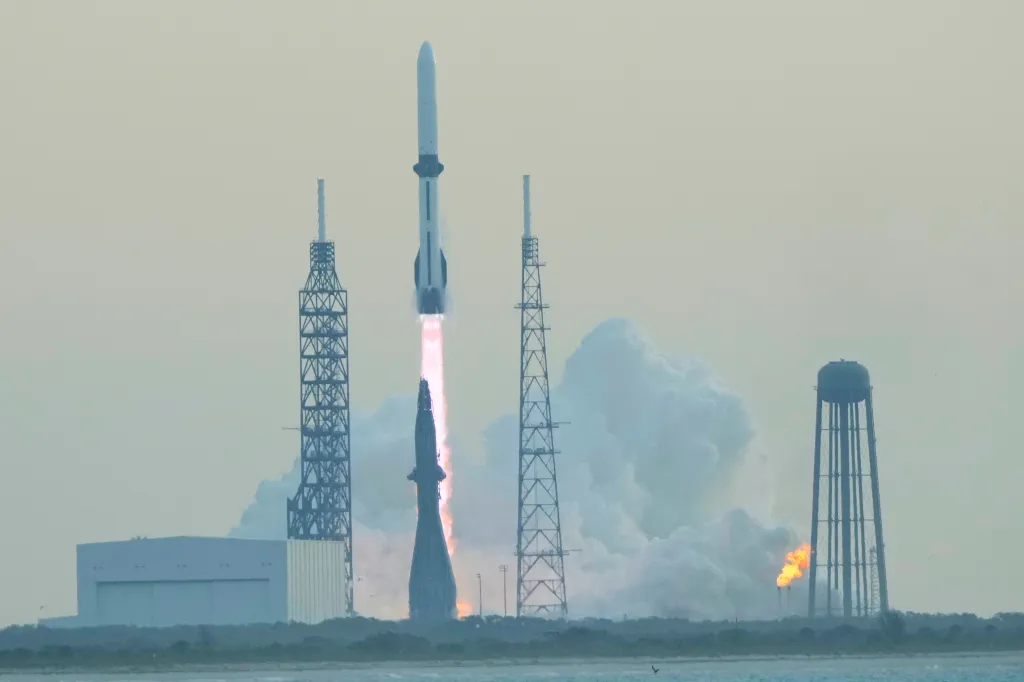
It took just over one month for the Federal Aviation Administration to close the book on an investigation that had grounded Blue Origin’s New Glenn rocket.
Read more 3 Florida beaches make Dr. Beach annual Top 10 list
The company announced Friday on X that the FAA had approved its report about what went wrong with an April 19 launch when the rocket’s upper stage had an engine issue and ultimately lost its customer’s payload.
“Prior to our second (upper stage) burn, we experienced an off-nominal thermal condition, and, as a result, one of the BE-3U engines didn’t achieve full thrust to reach our target orbit,” the company stated.
Blue Origin said “corrective measures have been implemented,” meaning it can get back to the business of launching rockets from the Space Coast.
The NG-3 mission, which lifted off from Cape Canaveral Space Force Station’s Launch Complex 36, was only the third New Glenn launch ever following two missions in 2025.
The FAA labeled the mission a “mishap” and grounded New Glenn for what was feared by some to be a monthslong process.
With a quick resolution, though, NASA can breathe a sigh of relief. The agency is counting on Jeff Bezos’ company to potentially be part of next year’s Artemis III mission.
Artemis III looks to send a crewed Orion spacecraft on a mission to low-Earth orbit, during which Orion would dock with one or both of the pathfinder versions of lunar landers being developed by Blue Origin and SpaceX. That mission is planned for no earlier than mid-2027.
Read more UCF has no answers for UCLA’s offense in Game 1 of Super Regional
NASA will then choose either Blue Origin’s Blue Moon Mark 2 lander or SpaceX’s Starship for the Artemis IV mission, which aims to return humans to the moon for the first time since Apollo 17 in 1972.
The NG-3 mission wasn’t a complete failure, either, despite the loss of the customer’s payload. It marked Blue Origin’s first reflight of a previously flown first-stage booster. That booster, dubbed “Never Tell Me The Odds,” was able to stick its second landing after launch on the company’s recovery ship in the Atlantic and make its way back to Port Canaveral.
The booster on New Glenn’s debut launch was destroyed when it missed the recovery vessel, but a third first-stage booster, dubbed “Yes, It’s Necessary” has since been manufactured at the company’s massive rocket factory in Merritt Island.
That booster was transported to LC-36 recently as it prepares for an integrated hot-fire test.
It could be the booster used on the NG-4 mission, which could be the moonbound flight for the Blue Moon MK 1 lunar lander, an uncrewed vehicle that is a smaller version of the MK 2 to be used on future human missions to the moon.
Before the mishap investigation, Blue Origin had been touting a potential launch attempt before the end of summer.
Blue Origin has other missions it could potentially fly on NG-4, though, including its first launch for the Amazon Leo constellation.
Read more ‘They were underage girls’: How Jeffrey Epstein brought victims from Brazil to Palm Beach
Just what will fly and when, though, remains uncertain.
“NG-4 preparations continue — updates coming soon,” the company stated.