
KENNEDY SPACE CENTER — The Artemis III mission that aims to launch next year remains on target for a summer 2027 launch despite having so many uncertain pieces in the air, NASA Administrator Jared Isaacman said at a Friday press conference.
Read more Self-described ‘witch doctor’ sentenced to life in murder of young mother
Those pieces are still lining up to allow for a 2028 follow-up Artemis IV mission to return humans to the moon.
“This is an achievable pathway we’re on right now. This makes sense,” Isaacman said. “We have the mandate, we have the resources, the support from our stakeholders to execute and that’s what we intend to do.”
But he said that does not mean there won’t be challenges.
“I don’t think you heard from anyone that it’s all an easy road downhill from here,” he said, still calling the Artemis missions a “monumental effort.”
Artemis III looks to fly close to Earth with its four crew, with a primary goal of testing out docking capabilities with lunar landers from Blue Origin and SpaceX.
NASA astronauts Randy Bresnick, Frank Rubio, Andre Douglas and European Space Agency astronaut Luca Parmitano will spend 14 days in space in the Orion spacecraft after launching from KSC’s Launch Complex 39-B atop the Space Launch System rocket.
 The Artemis III astronauts pose for a group photo on the front porch before conducting hoist training with U.S. Navy Helicopter Sea Combat Squadron (HSC) 23 and Explosive Ordnance Disposal Group (EODGRU) 1 in San Diego, Sep. 24, 2026. In preparation for NASA’s Artemis III crewed mission, which will send four astronauts in low earth orbit to demonstrate critical systems needed for future lunar landings, NASA and the Department of Defense will conduct training evolutions to demonstrate and evaluate the processes, procedures, and hardware used in recovery operations for crewed lunar missions. As DoD manager for human space flight support operations, USSPACECOM coordinates global DoD support for testing, training, development, and operational mission events associated with NASA’s Artemis missions. (Mass Communication Specialist 2nd Class August Clawson/U.S. Navy)
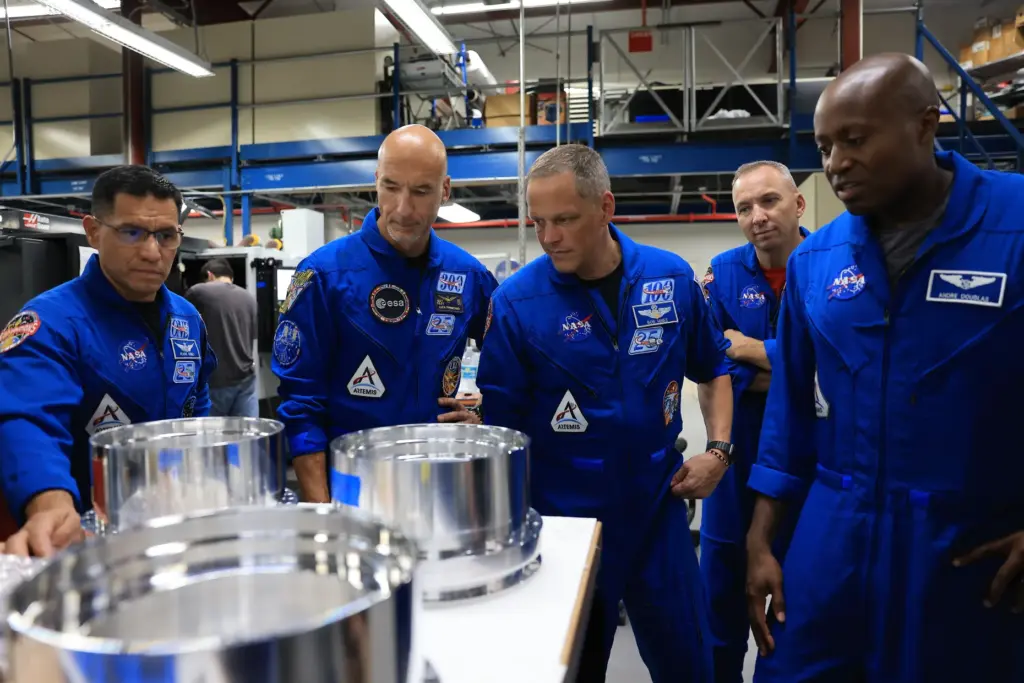 From left, NASA astronaut Frank Rubio, ESA (European Space Agency) astronaut Luca Parmitano, and NASA astronauts Bob Hines, Randy Bresnik, and Andre Douglas visit the Prototype Development Laboratory at NASA’s Kennedy Space Center in Florida on Wednesday, Sept. 2, 2026. The Artemis III primary and back-up crew members visited multiple facilities at Kennedy and viewed the work progress on Artemis III hardware, marking their first joint visit to the spaceport. Artemis III will launch four crew members aboard the Orion spacecraft to carry out a series of objectives in low Earth orbit designed to demonstrate critical systems needed for future lunar landings, beginning with Artemis IV. (Kim Shiflett/NASA)
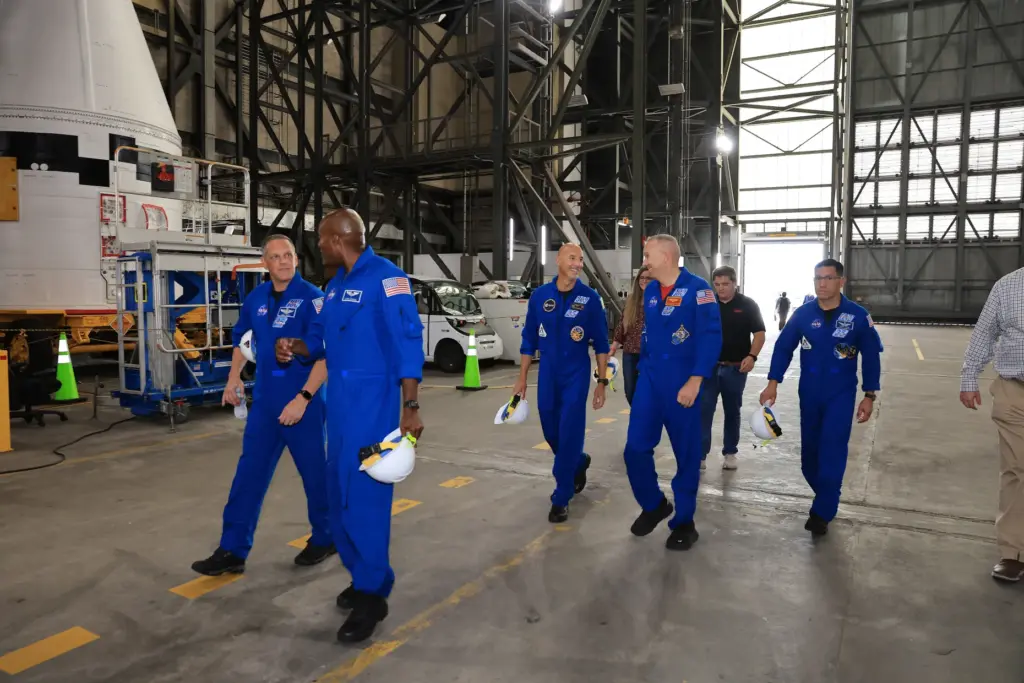 The Artemis III primary and back-up crew members visit the Vehicle Assembly Building at NASA’s Kennedy Space Center in Florida on Wednesday, Sept. 2, 2026. From left, NASA astronauts Bob Hines and Andre Douglas, ESA (European Space Agency) astronaut Luca Parmitano, and NASA astronauts Randy Bresnik and Frank Rubio viewed the work progress on the Artemis III SLS (Space Launch System) rocket core stage inside High Bay 2 and the solid rocket booster integration inside High Bay 3. This marked the first visit to Kennedy by the entire crew and backup crew members. Artemis III will launch four crew members aboard the Orion spacecraft to carry out a series of objectives in low Earth orbit designed to demonstrate critical systems needed for future lunar landings, beginning with Artemis IV. (Kim Shiflett/NASA)
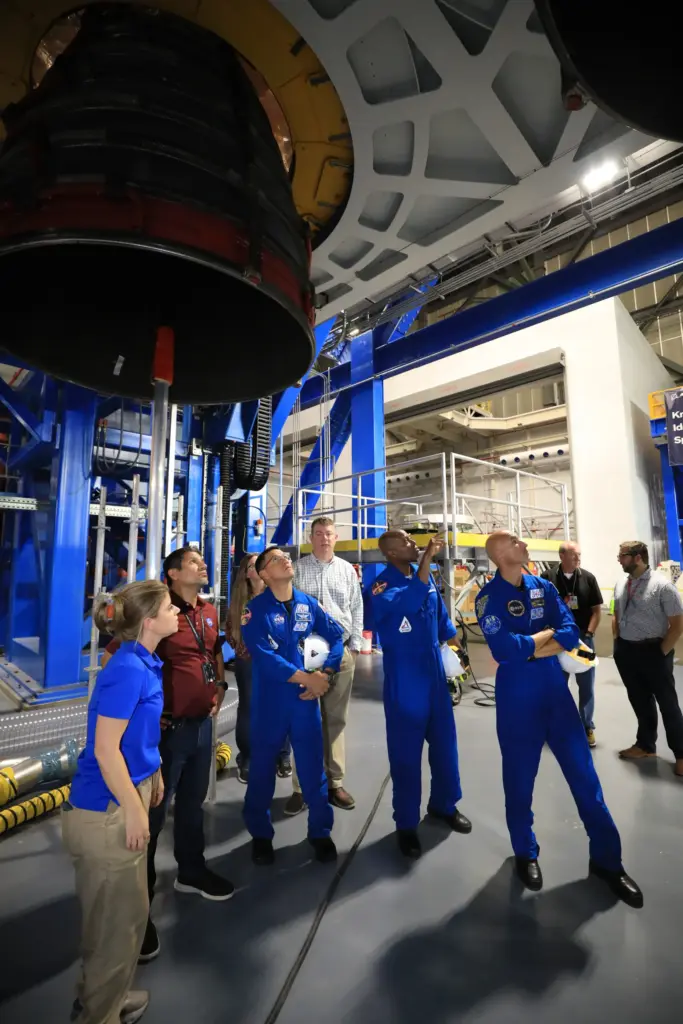 The Artemis III primary and back-up crew members view the work progress on the Artemis III SLS (Space Launch System) rocket core stage inside High Bay 2 of the Vehicle Assembly Building at NASA’s Kennedy Space Center in Florida on Wednesday, Sept. 2, 2026. Dressed in blue flight suits, NASA astronauts Frank Rubio and Andre Douglas, as well as ESA (European Space Agency) astronaut Luca Parmitano view the four RS-25 engines on the work stand for integration with the core stage. This marked the first visit to Kennedy by the entire crew and backup crew members. Artemis III will launch four crew members aboard the Orion spacecraft to carry out a series of objectives in low Earth orbit designed to demonstrate critical systems needed for future lunar landings, beginning with Artemis IV. (Kim Shiflett/NASA)
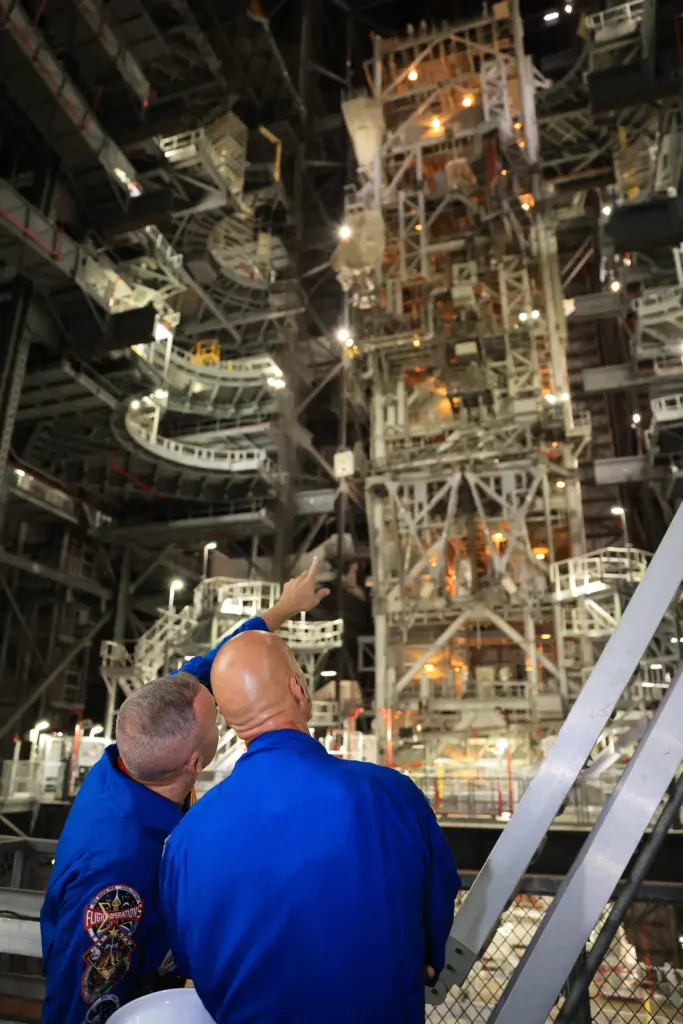 NASA astronaut Randy Bresnik (left) and ESA (European Space Agency) astronaut Luca Parmitano view progress on the solid rocket booster integration in High Bay 3 inside the Vehicle Assembly Building at NASA’s Kennedy Space Center in Florida on Wednesday, Sept. 2, 2026. Bresnik, Parmitano, as well as NASA astronauts Andre Douglas, Frank Rubio, and Bob Hines made the first visit to Kennedy by the entire crew and backup crew members of Artemis III. The mission will launch four crew members aboard the Orion spacecraft to carry out a series of objectives in low Earth orbit designed to demonstrate critical systems needed for future lunar landings, beginning with Artemis IV. (Kim Shiflett/NASA)
Concurrently, SpaceX will launch a pathfinder version of Starship from KSC’s Launch Complex 39-A where its launch tower is nearing completion, and Blue Origin will launch a pathfinder version of the Blue Moon MK2 lunar lander atop a New Glenn rocket from Cape Canaveral Space Force Station’s Launch Complex 36.
“As a rocket nerd, it’s going to be pretty awesome,” said Artemis Program Manager Jeremy Parsons.
Blue Origin’s path also faces the hurdle of getting LC-36 repaired after a massive explosion during a rocket test in May devastated the pad. The company has said it is still on pace to be launch ready by the end of the year.
Parsons said both Blue Origin and SpaceX have been impressive in the work put into their launch sites this year, and the organization to fly all three so close to one another is already laid out.
“You have literal armies that are just constructing away, and you’re seeing massive progress,” he said. “I think they’re getting really close to being ready.”
Isaacman added he has huge confidence in Blue Origin especially, playing catchup since the pad explosion.
“They’re exceeding everyone’s expectations,” he said. “They are so far proving a lot of people wrong in terms of how fast they are recovering their pad. It’s impressive.”
Read more Extra police to guard Harmony High School football game after fake threat
And Parsons expect there will be several launches of both New Glenn and Starship from the Space Coast before they are needed for the Artemis III mission.
Parsons said the primary delay, which had led to Isaacman earlier this year stating in an internal memo to NASA employees that Artemis III was about 90 days behind schedule, had to do with supply chains for both SpaceX and Blue Origin’s test landers.
“Blue Origin has moved incredibly aggressively,” Parsons said in an effort to get back on track. “They’re investing in the actual company to accelerate that build.”
But NASA has put their workforce on the task as well. It’s one that has recently grown as they bring back jobs that had been farmed out to contractors back within the agency.
“This is how we’ve been operating for most of the year right now,” Isaacman said, getting NASA agents embedded with the commercial companies.
It’s helped solve problems in hours, and not days, Parsons said.
“Anywhere we can, we’re injecting to just bring those timelines back. It is a daily fight, though,” he said.
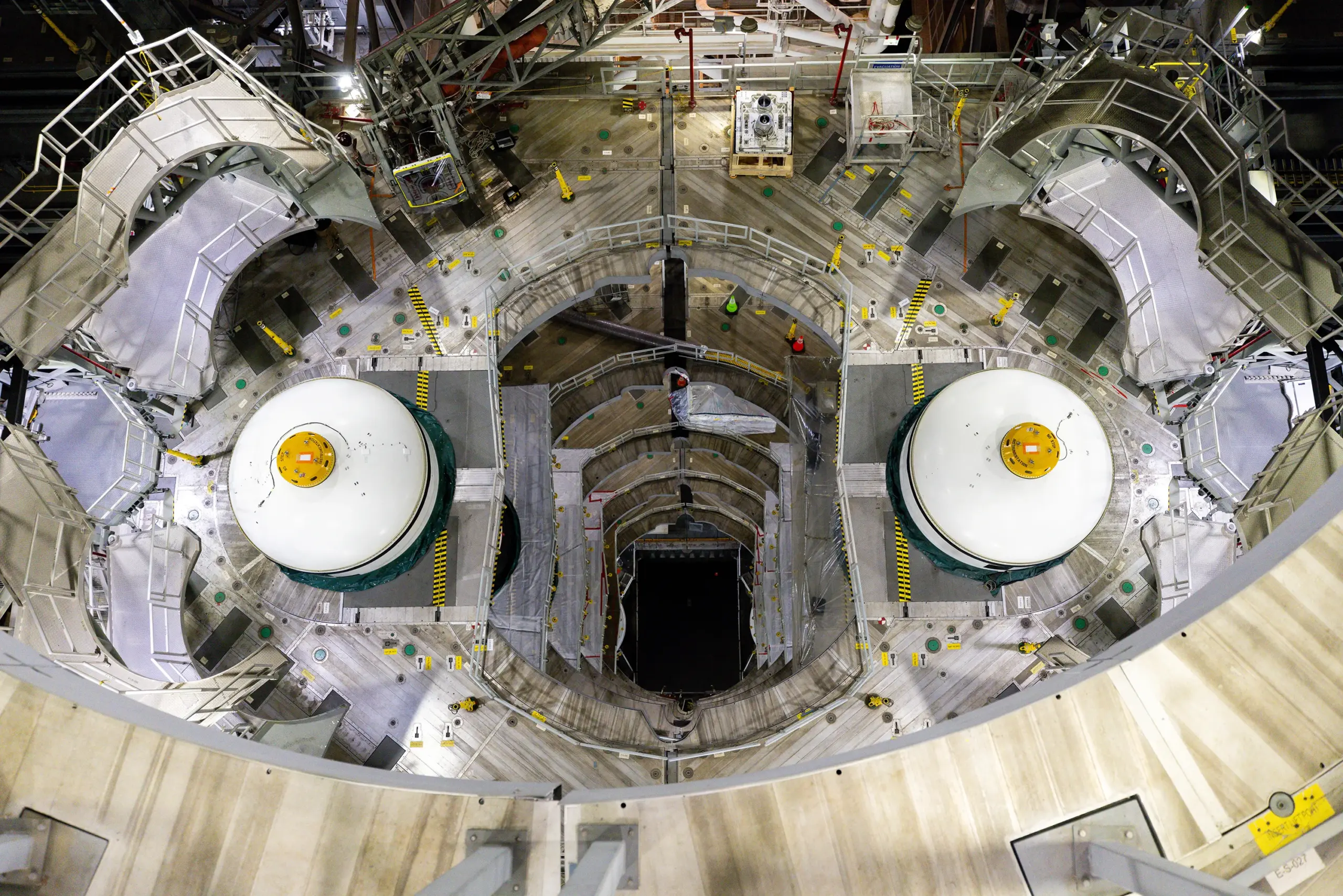
NASA recently completed the the stacking of SLS’s two solid rocket boosters and attached the four RS-25 engines to the bottom of the core stage within the Vehicle Assembly Building. The rocket is missing one component it will need on launch day, a spacer that is being manufactured at Marshall Space Flight Center in Huntsville, Alabama, that is taking the place of a stage that was used on the Artemis I and II missions.
Since this rocket isn’t leaving low-Earth orbit, NASA is hanging onto their last Interim Cryogenic Propulsion Stage (ICPS) for a future SLS mission that would be moonbound.
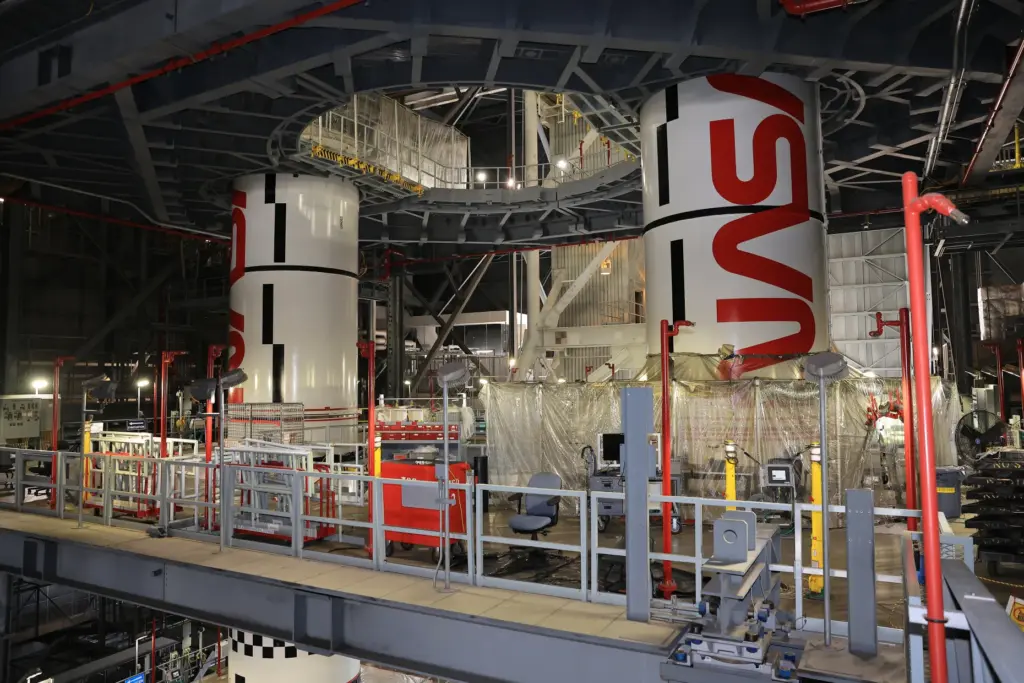 Technicians inside the Vehicle Assembly Building at NASA’s Kennedy Space Center in Florida complete integration of the left and right center center solid rocket booster segment onto the left and right aft center booster segment for the Artemis III SLS (Space Launch System) rocket on the mobile launcher inside High Bay 3 on Friday, Aug. 28, 2026. The twin boosters, comprising of five segments each manufactured by Northrop Grumman in Utah, will provide more than 75 percent of the SLS rocket’s total thrust at launch. (Kim Shiflett/NASA)
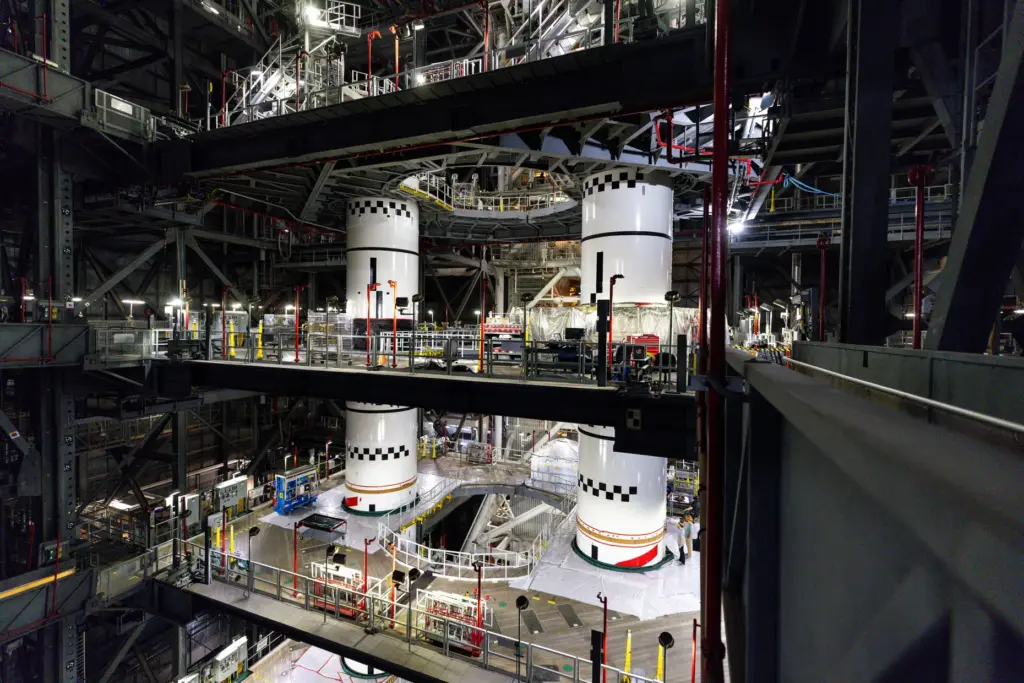 In High Bay 3 of the Vehicle Assembly Building at NASA’s Kennedy Space Center in Florida, the final left and right forward solid rocket booster motor segments for Artemis III are integrated onto the mobile launcher for the SLS (Space Launch System) rocket on Thursday, Sept. 24, 2026. The twin boosters, consisting of five segments each manufactured by Northrop Grumman in Utah, will provide more than 75 percent of the SLS rocket’s total thrust at launch. (Frank Michaux/NASA)
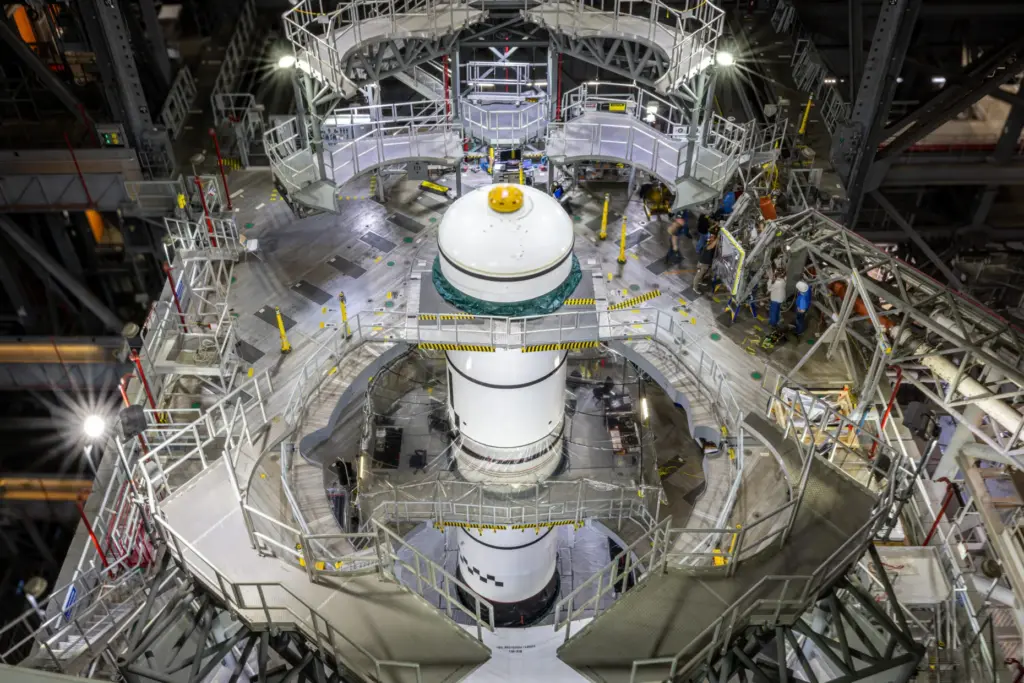 Technicians integrate the left forward booster segment for NASA’s Artemis III SLS (Space Launch System) rocket onto the left booster segments atop the mobile launcher in High Bay 3 of the Vehicle Assembly Building at NASA’s Kennedy Space Center in Florida on Thursday, Sept. 17, 2026. The SLS rocket’s twin boosters, each made up of five segments manufactured by Northrop Grumman in Utah, will provide more than 75 percent of the rocket’s total thrust at launch. (Frank Michaux/NASA)
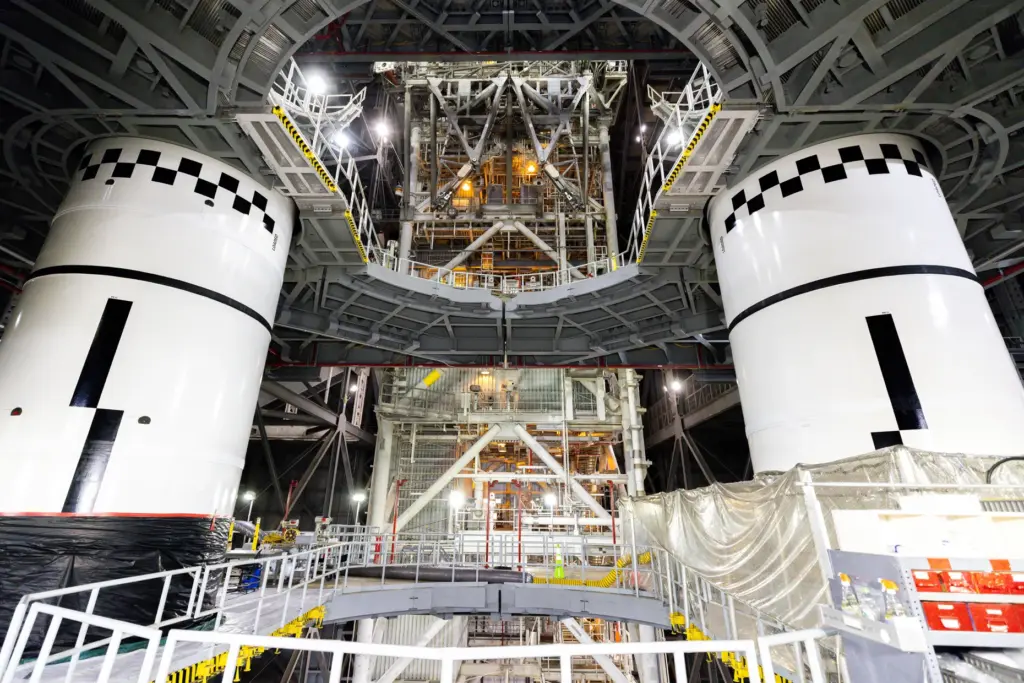 In High Bay 3 of the Vehicle Assembly Building at NASA’s Kennedy Space Center in Florida, the final left and right forward solid rocket booster motor segments for Artemis III are integrated onto the mobile launcher for the SLS (Space Launch System) rocket on Thursday, Sept. 24, 2026. The twin boosters, consisting of five segments each manufactured by Northrop Grumman in Utah, will provide more than 75 percent of the SLS rocket’s total thrust at launch (Frank Michaux/NASA)
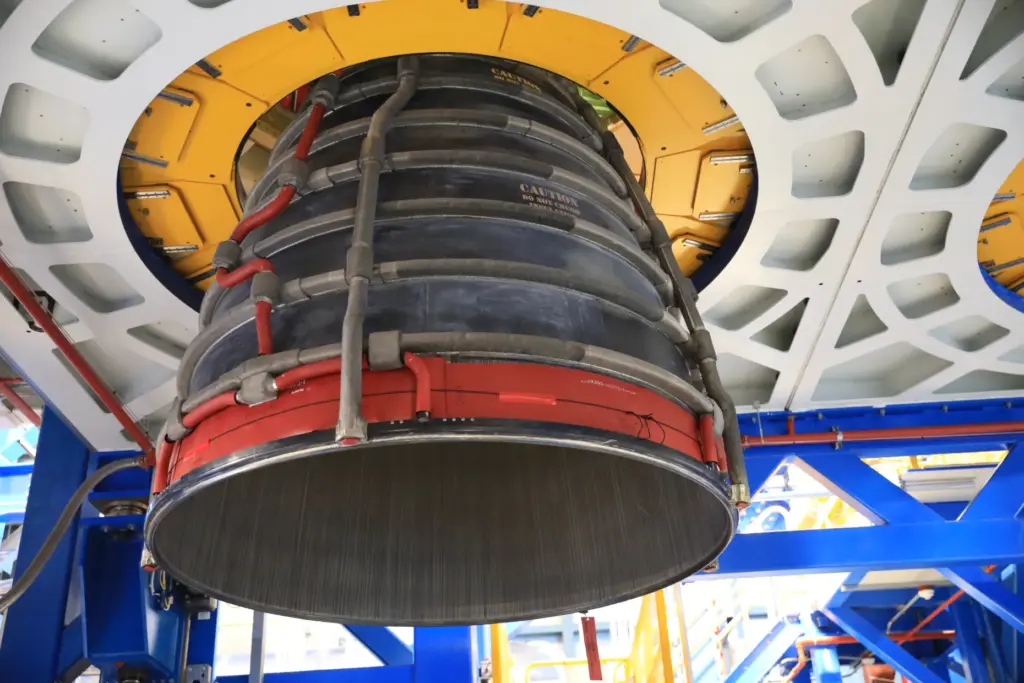 The first of four RS-25 SLS (Space Launch System) rocket engines, is installed on the work stand and integrated with the Artemis III core stage rocket on Tuesday, Aug. 25, 2026, inside the Vehicle Assembly Building at NASA’s Kennedy Space Center in Florida. (Clayton Rougelot/NASA)
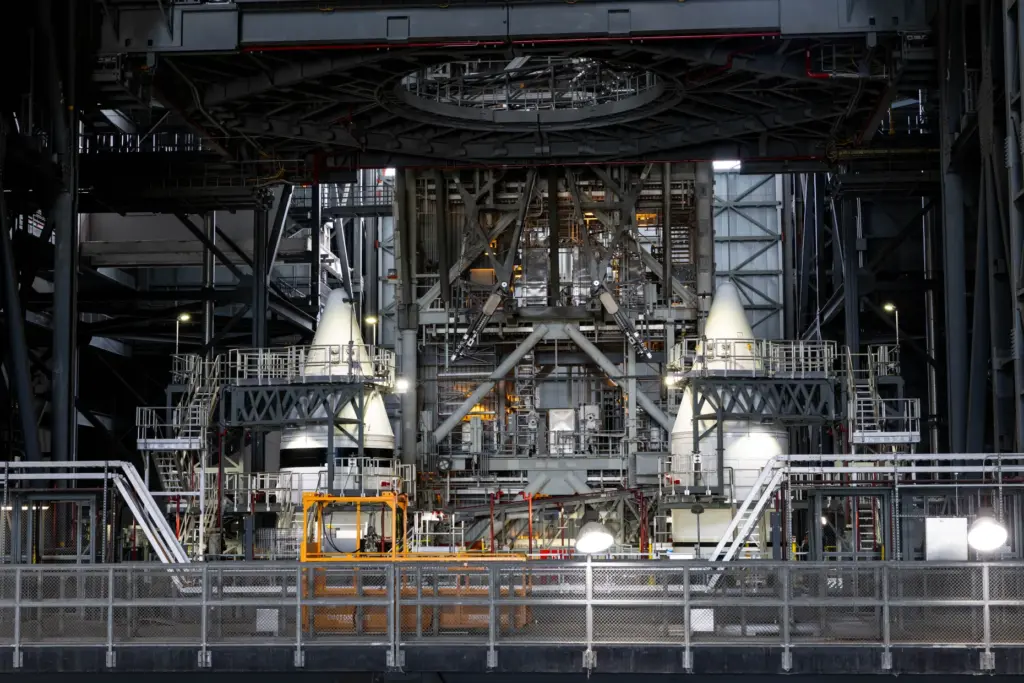 Engineers with NASA’s Exploration Ground Systems completed integrating the aerodynamic nose cones onto the left and right forward assemblies on the twin SLS (Space Launch System) solid rocket boosters, finishing their stacking operations for Artemis III inside the Vehicle Assembly Building’s High Bay 3 at NASA’s Kennedy Space Center in Florida on Wednesday, Sept. 30, 2026. Each forward assembly contains an aerodynamic top, a forward skirt housing avionics, and frustum housing motors that allow the boosters to separate from the SLS core stage after launch. The twin solid boosters will help support the remaining rocket components and the Orion spacecraft during final assembly of the Artemis III rocket and provide more than 75 percent of the total SLS thrust during liftoff from NASA Kennedy’s Launch Pad 39B. (Cory S Huston/NASA)
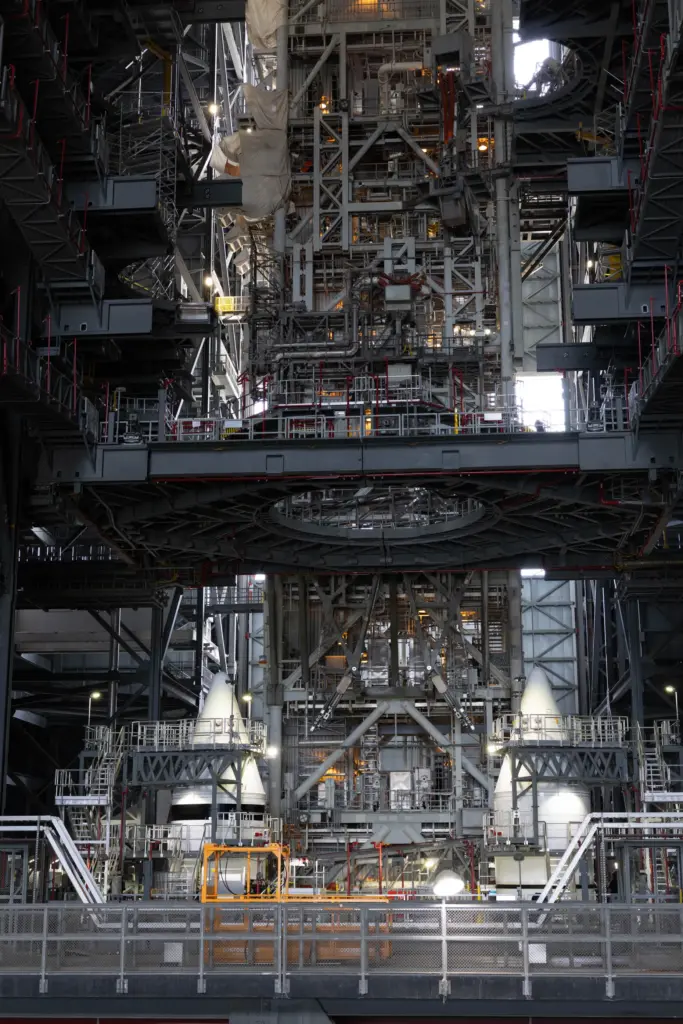 Engineers with NASA’s Exploration Ground Systems completed integrating the aerodynamic nose cones onto the left and right forward assemblies on the twin SLS (Space Launch System) solid rocket boosters, finishing their stacking operations for Artemis III inside the Vehicle Assembly Building’s High Bay 3 at NASA’s Kennedy Space Center in Florida on Wednesday, Sept. 30, 2026. Each forward assembly contains an aerodynamic top, a forward skirt housing avionics, and frustum housing motors that allow the boosters to separate from the SLS core stage after launch. The twin solid boosters will help support the remaining rocket components and the Orion spacecraft during final assembly of the Artemis III rocket and provide more than 75 percent of the total SLS thrust during liftoff from NASA Kennedy’s Launch Pad 39B. (Cory S Huston/NASA)
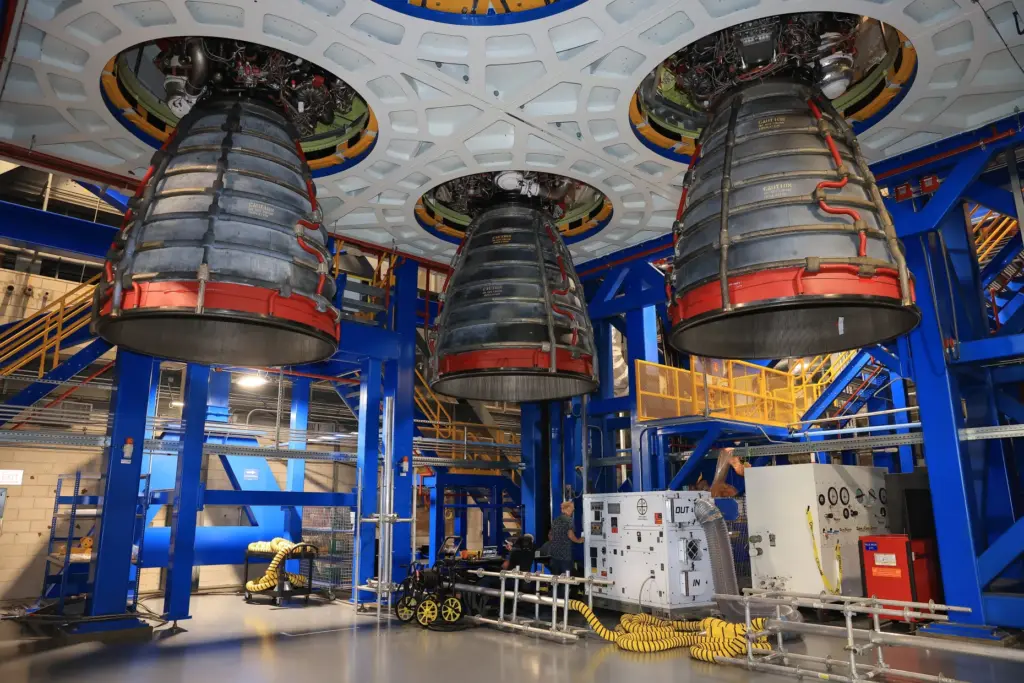 Technicians install three of four RS-25 SLS (Space Launch System) rocket engines on the work stand for integration with the Artemis III core stage rocket on Friday, Aug. 28, 2026, inside the Vehicle Assembly Building at NASA’s Kennedy Space Center in Florida. During Artemis III, the four RS-25 engines will launch the Orion spacecraft and its crew of four into low Earth orbit, generating more than two million pounds of thrust at liftoff. (Kim Shiflett/NASA)
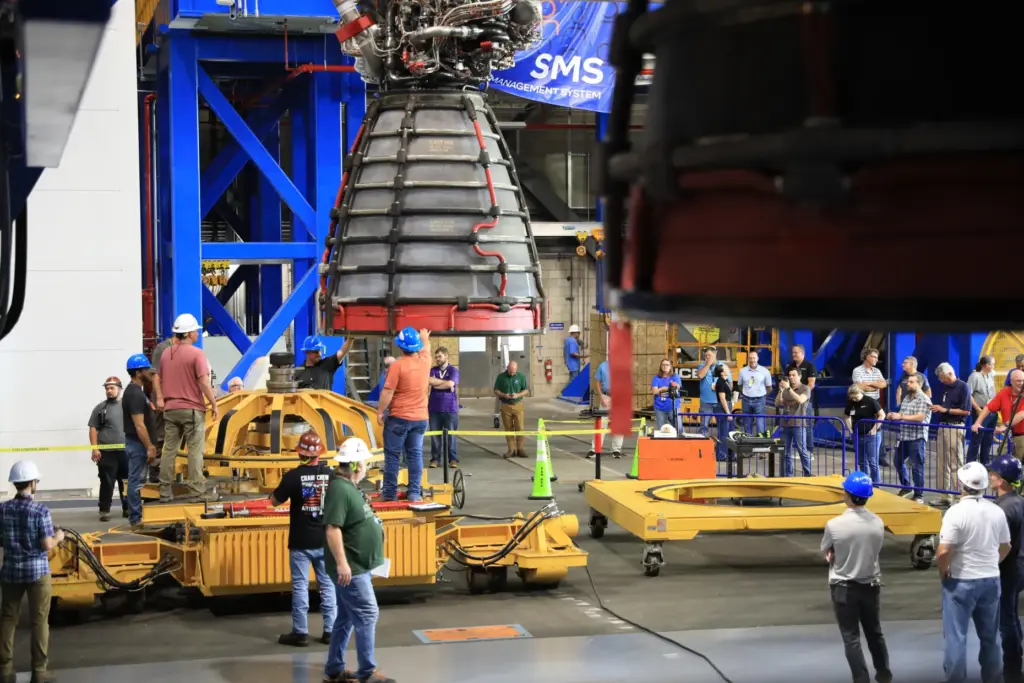 Technicians lift and transfer the #2 RS-25 SLS (Space Launch System) rocket engine (back) to the work stand. Visible in the foreground is the #3 engine already integrated with the Artemis III core stage rocket on Tuesday, Aug. 25, 2026, inside the Vehicle Assembly Building at NASA’s Kennedy Space Center in Florida. (Clayton Rougelot/NASA)
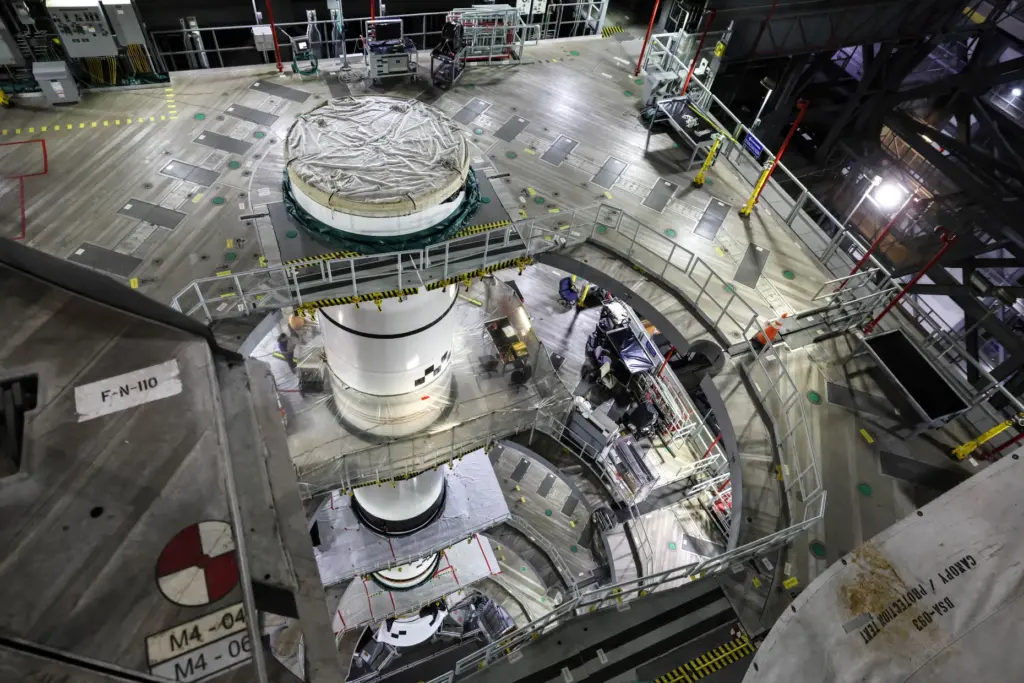 In High Bay 3 of the Vehicle Assembly Building at NASA’s Kennedy Space Center in Florida, the right forward center booster for Artemis III is integrated onto the right booster segments on the mobile launcher for the SLS (Space Launch System) rocket on Friday, Sept. 11, 2026. The twin boosters, comprising of five segments each manufactured by Northrop Grumman in Utah, will provide more than 75 percent of the SLS rocket’s total thrust at launch. (Cory S Huston/NASA)
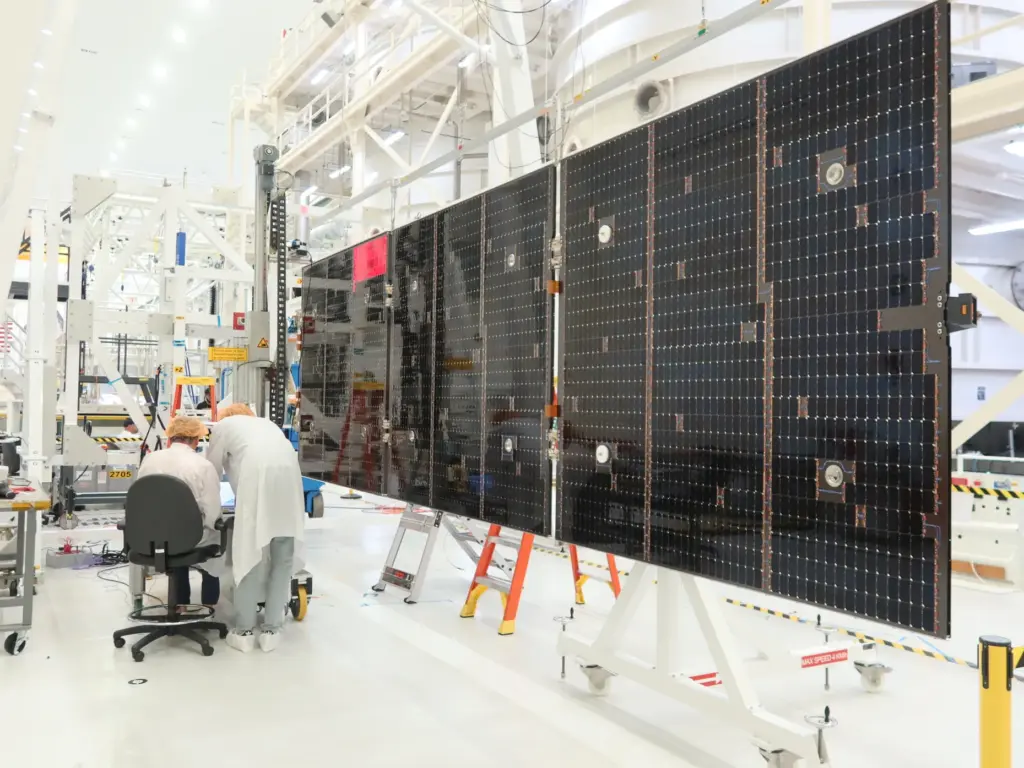 Technicians extend and inspect one of the solar array wing panels that will attach the Orion service module for Artemis III inside the Neil A. Armstrong Operations and Checkout Building high bay at NASA’s Kennedy Space Center in Florida on Tuesday, Aug. 18, 2026. Each solar array panel, provided by the European Space Agency and built by Airbus, generates 11 kilowatts of power and spans about 63 feet to supply Orion’s power, propulsion, air, and water through low Earth Orbit.
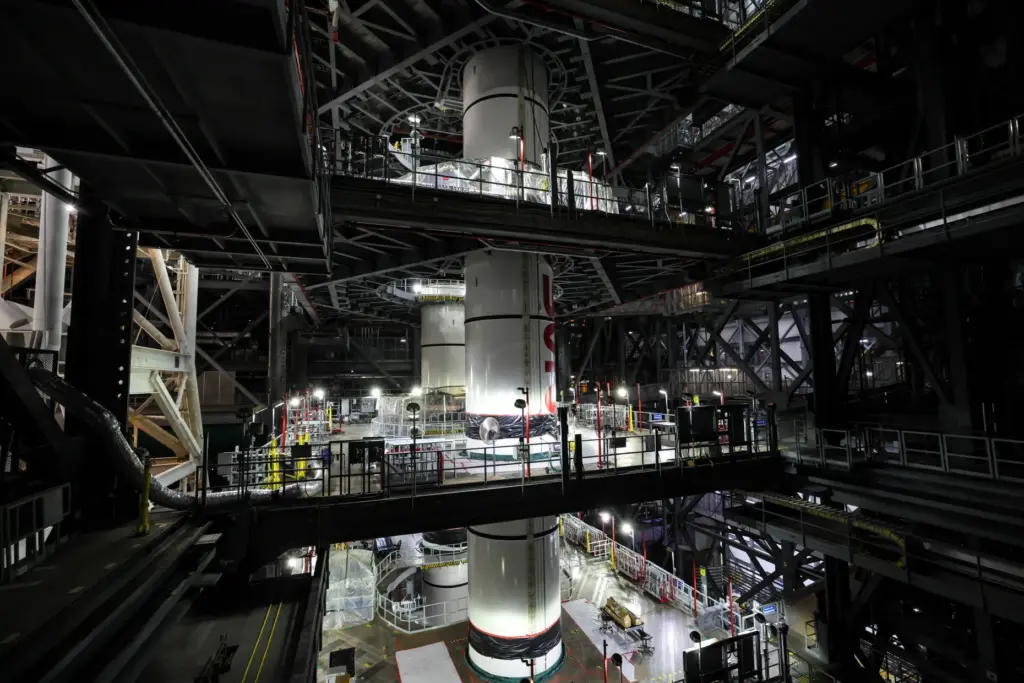 Technicians inside the Vehicle Assembly Building at NASA’s Kennedy Space Center in Florida complete integration of the left forward center solid rocket booster segment onto the left center center booster segment for the Artemis III SLS (Space Launch System) rocket on the mobile launcher inside High Bay 3 on Tuesday, Sept. 1, 2026. The twin boosters, comprising five segments each and manufactured by Northrop Grumman in Utah, provide more than 75 percent of the SLS rocket’s total thrust at liftoff. (Cory S Huston/NASA)
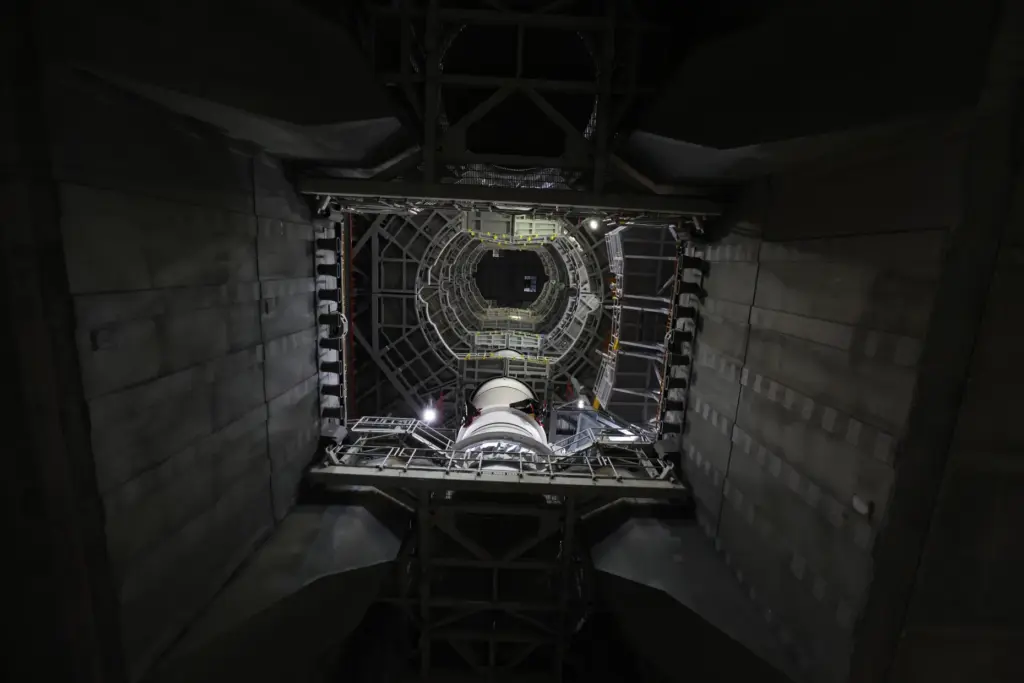 In High Bay 3 of the Vehicle Assembly Building at NASA’s Kennedy Space Center in Florida, portions of the solid rocket booster right forward center booster for Artemis III is integrated onto the right booster segments on the mobile launcher for the SLS (Space Launch System) rocket on Friday, Sept. 11, 2026. The twin boosters, comprising of five segments each manufactured by Northrop Grumman in Utah, will provide more than 75 percent of the SLS rocket’s total thrust at launch. (Cory S Huston/NASA)
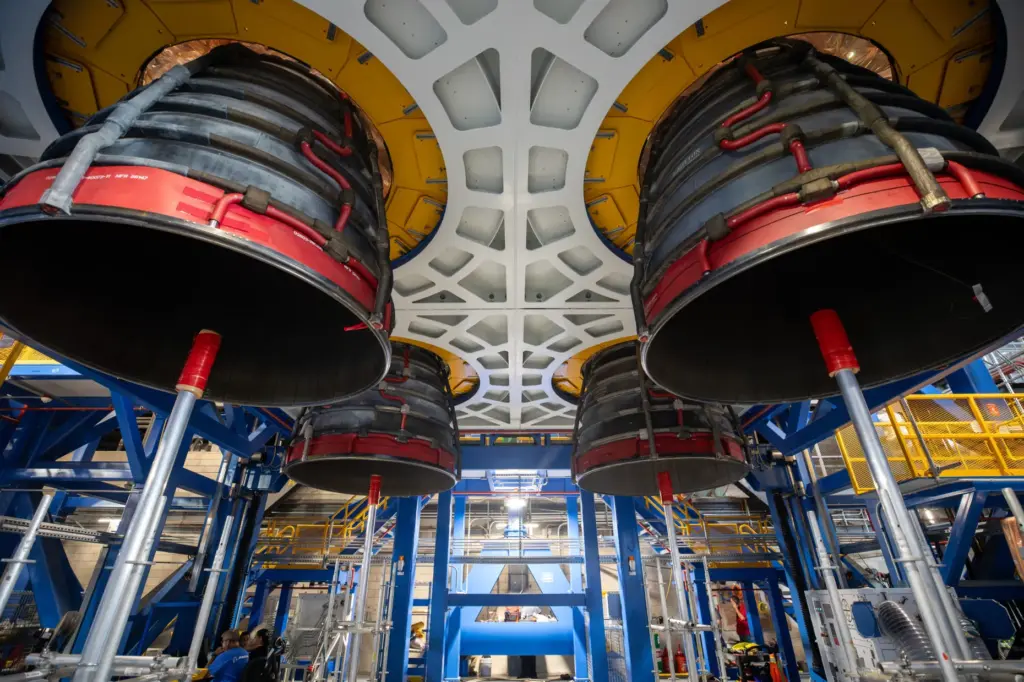 Technicians complete installation of all four RS-25 SLS (Space Launch System) rocket engines on the work stand for integration with the Artemis III core stage rocket on Tuesday, Sept. 1, 2026, inside the Vehicle Assembly Building at NASA’s Kennedy Space Center in Florida. (Clayton Rougelot/NASA)
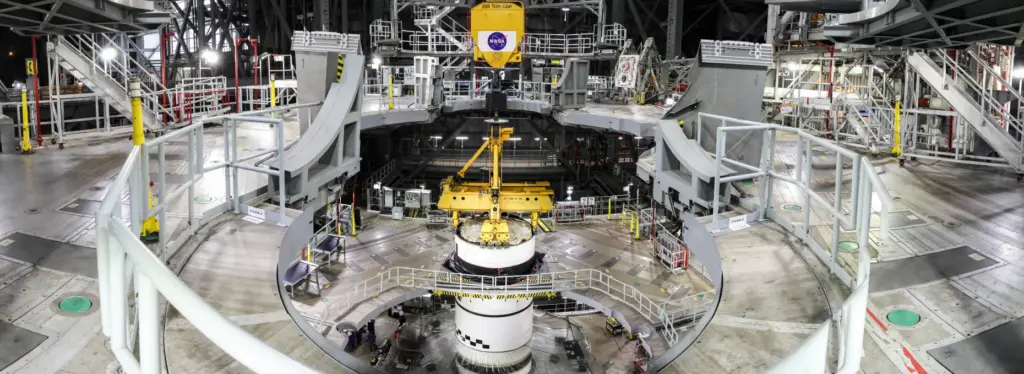 Technicians inside the Vehicle Assembly Building at NASA’s Kennedy Space Center in Florida complete integration of the left forward center solid rocket booster segment onto the left center center booster segment for the Artemis III SLS (Space Launch System) rocket on the mobile launcher inside High Bay 3 on Tuesday, Sept. 1, 2026. The twin boosters, comprising five segments each and manufactured by Northrop Grumman in Utah, provide more than 75 percent of the SLS rocket’s total thrust at liftoff. (Cory S Huston/NASA)
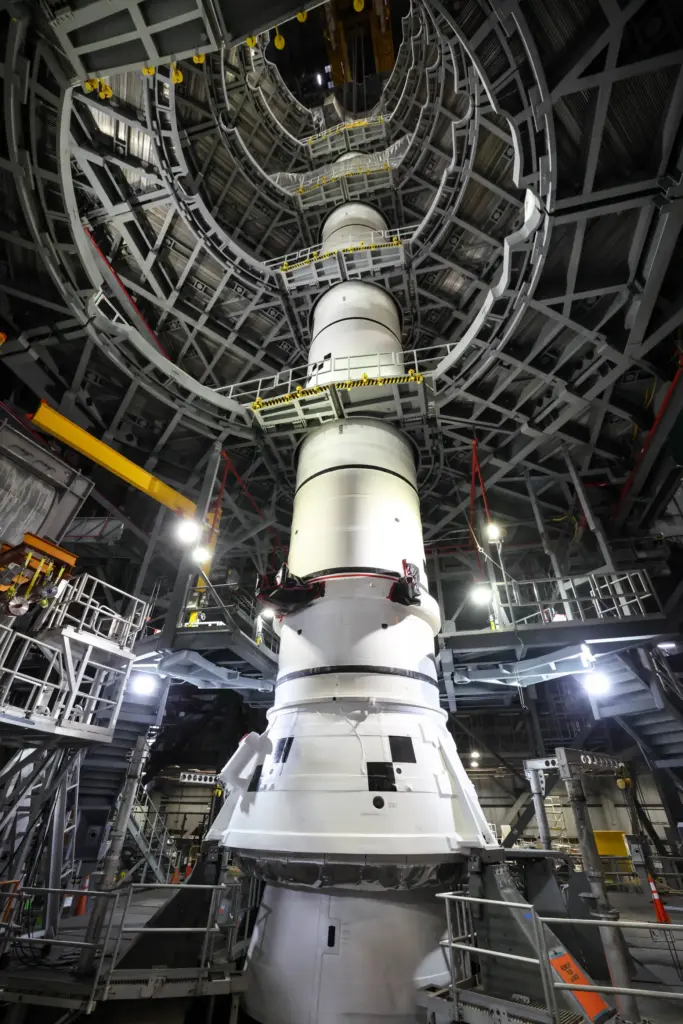 Technicians inside the Vehicle Assembly Building at NASA’s Kennedy Space Center in Florida complete integration of the left forward center solid rocket booster segment onto the left center center booster segment for the Artemis III SLS (Space Launch System) rocket on the mobile launcher inside High Bay 3 on Tuesday, Sept. 1, 2026. The twin boosters, comprising five segments each and manufactured by Northrop Grumman in Utah, provide more than 75 percent of the SLS rocket’s total thrust at liftoff. (Cory S Huston/NASA)
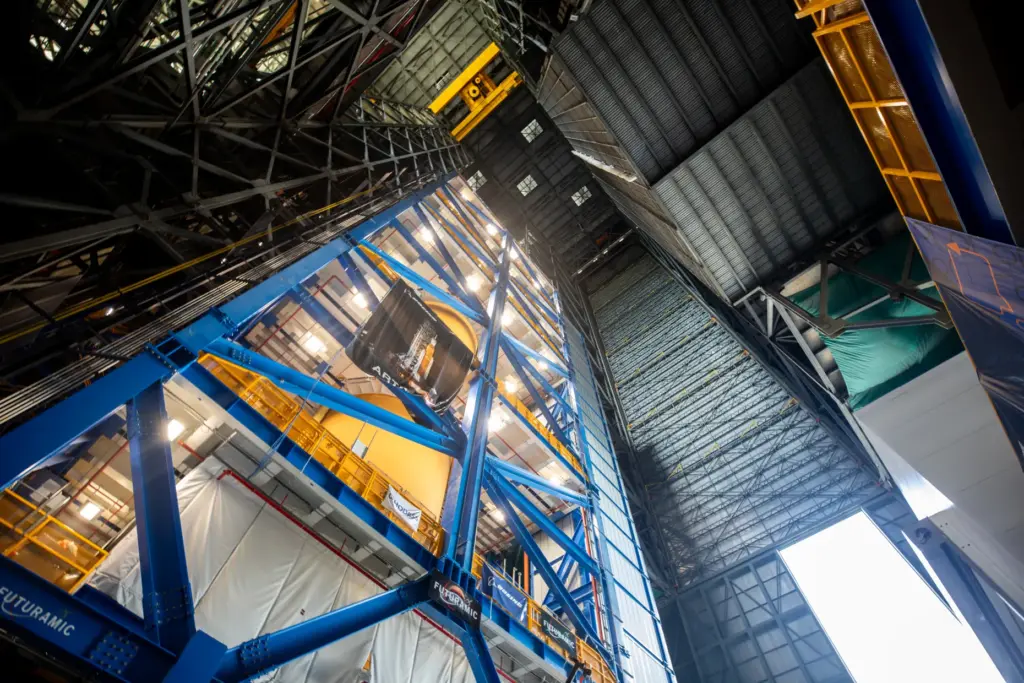 Inside High Bay 2 at NASA’s Vehicle Assembly Building at Kennedy Space Center in Florida, the SLS (Space Launch System) core stage rocket is secured in a vertical position as technicians prepare to install the last RS-25 engine to the SLS. During Artemis III, the four RS-25 engines will launch SLS, the Orion spacecraft and its crew of four into low Earth orbit, generating more than 2 million pounds of thrust at liftoff. (Clayton Rougelot/NASA)
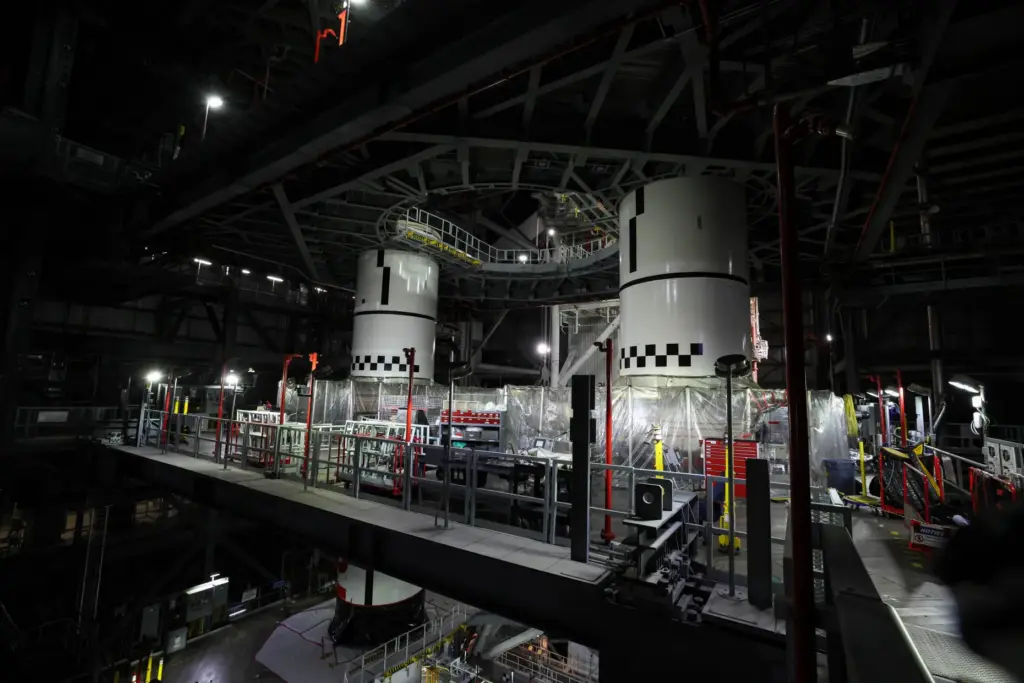 In High Bay 3 of the Vehicle Assembly Building at NASA’s Kennedy Space Center in Florida, the left and right forward center boosters for Artemis III are integrated onto the booster segments on the mobile launcher for the SLS (Space Launch System) rocket on Friday, Sept. 11, 2026. The twin boosters, comprising of five segments each manufactured by Northrop Grumman in Utah, will provide more than 75 percent of the SLS rocket’s total thrust at launch. (Cory S Huston/NASA)
Even without the spacer, though, NASA plans to roll the rocket out to the launch pad before the end of the year in what they’re calling the “short stack” configuration for a tanking test.
That test will include propellant loading and the four crew testing out an emergency exit from the launch tower.
The whole mission is designed to pave the way for Artemis IV, which would return humans to the moon’s surface for the first time since Apollo 17 in 1972. NASA is in a race with China, however, which is also aiming to send its taikonauts to the moon.
Both are coveting landings on the lunar south pole, where the most valuable asset is in the form of lunar ice, frozen for ages in the dark crevices of craters that never see the light of the sun. The frozen water could be converted into both air to breath and rocket fuel that could make the moon a starting point for missions to Mars and beyond.
Read more Government watchdog wants expungement of Hope Florida report overturned