
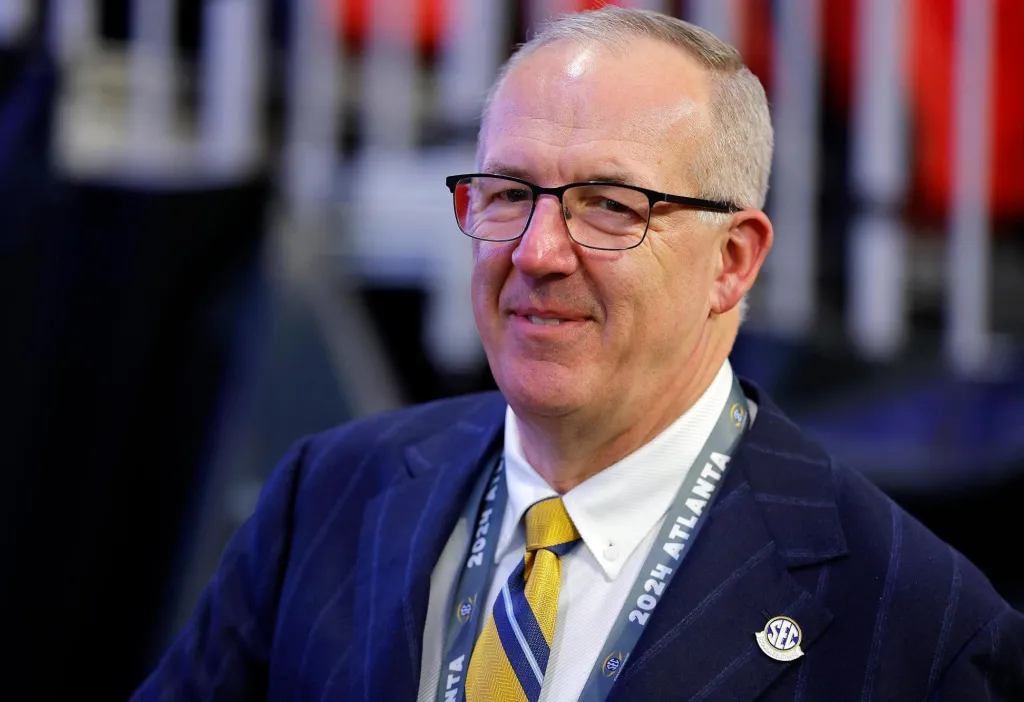
GAINESVILLE — The relaxed atmosphere at the SEC Spring Meetings once offered a welcome retreat from college football’s pressure cooker.
Read more Dying star resembles a billowing crystal ball in new telescope photo
Not anymore.
Lately, the annual meetings held in an seaside resort on Florida’s Panhandle have provided little escape following Memorial Day. This week’s gathering in Destin could prove even more consequential as college football’s future will be on the table.
Football coaches earning upward of $13 million will trade headsets for flip-flops, golf shirts and shorts. Athletic directors will arrive on private planes. Wives and children will enjoy the white-sand beaches while their husbands spend long hours in meeting rooms at the Sandestin Hilton debating the sport’s most pressing issues.
“The topics that have to be discussed when schools get together, right now, are kind of exhausting and tiring because there’s no simple solutions,” Florida athletic director Scott Stricklin told the Orlando Sentinel. “It just takes a lot of draining conversations. I’m sure people will be happy to be at the beach and be happy to have their families play around.
“But we’ll all be sitting in conference rooms all day dealing with some really significant issues.”
Athlete compensation in the age of NIL, rampant transferring and tampering, and the unwieldy football calendar are ongoing concerns. A gambling investigation involving Texas Tech quarterback Brendan Sorsby recently spotlighted risks for any program.
Still, the debate over College Football Playoff expansion beyond 12 teams is expected to dominate discussions.
The issue has become a power struggle between the sport’s two most influential leagues.
The SEC, led by longtime commissioner Greg Sankey, publicly favors limiting expansion to 16 teams, while the Big Ten’s Tony Petitti is aggressively pushing for a 24-team format.
At stake is the balance between preserving high‑stakes Saturdays at the heart of college football’s appeal and generating desperately needed revenue.
The House v. NCAA antitrust settlement required schools to share $20.5 million with athletes beginning July 1, 2025, a figure expected to rise to $21.3 million in 2026.
“For those of us investing at the highest level, we’re really interested in being in a playoff,” Stricklin said.
Further playoff expansion, however, could eventually eliminate the SEC championship game, an event reportedly worth $80-$100 million annually, or roughly $5 million per school.
Read more SpaceX tries to launch a bigger version of Starship but hits a series of last-minute problems
A CFP berth currently delivers about $4 million to a conference, with payouts reaching $20 million for teams advancing to the national title game.
An expanded playoff would increase access for SEC schools but would not guarantee the steady revenue generated by the league championship game.
Five of 16 SEC schools reached the 2025 playoff, up from three in 2024. Meanwhile, the conference dominates other postseason sports, sending a record 14 teams to the 2025 NCAA men’s basketball tournament and 13 to the baseball tournament.
Ten SEC teams participated during March Madness in 2026. A record-tying 12 SEC softball teams qualified for the 2026 NCAA Tournament that is in progress.
“We all want the appropriate number of sports to have access to the meaningful postseason opportunities,” Stricklin said. “We have that on a really good balance in every sport we sponsor, except the one that gets the most attention, which is football.”
Coaches have anticipated expansion since the SEC adopted a nine-game conference schedule to strengthen future media rights negotiations. Schools subsequently softened their non-conference schedules to offset the demands of an additional league game improve their playoff chances — and the financial rewards attached to them.
Another looming issue involves NIL oversight.
The independent College Sports Commission, created by the Power Four conferences to oversee enforcement of the $2.8 billion House settlement, now reviews third-party NIL deals that can exceed revenue-sharing caps by millions of dollars.
The CSC is tasked with determining whether those payments reflect legitimate market value or function as disguised recruiting inducements exploiting legal loopholes.
Yahoo Sports reported that the 68 Power Four schools submitted more than $250 million in NIL deals for review since Jan. 1, with many high-value agreements still awaiting decisions.
“How are people going to continue to be paying these third-party and NIL deals above the cap, and will they be able to?” Stricklin asked. “Is there a better approach to monitoring that?”
Weighty issues await SEC coaches and decision-makers in Destin, where the days of casually debating conference legislation and squeezing in 18 holes are long gone.
“It’s indicative of where college athletics is right now,” Stricklin said. “We’ve undergone dramatic change in such a short period of time. The traditional rules are out the window, and everyone’s trying to figure out what all that means. We’ll have a lot of in-depth conversations, and won’t be focused on a couple conference policies like it might have been focused on the past.”
Read more SpaceX launches its biggest, most beefed-up Starship yet on a test flight
Edgar Thompson can be reached at [email protected]