
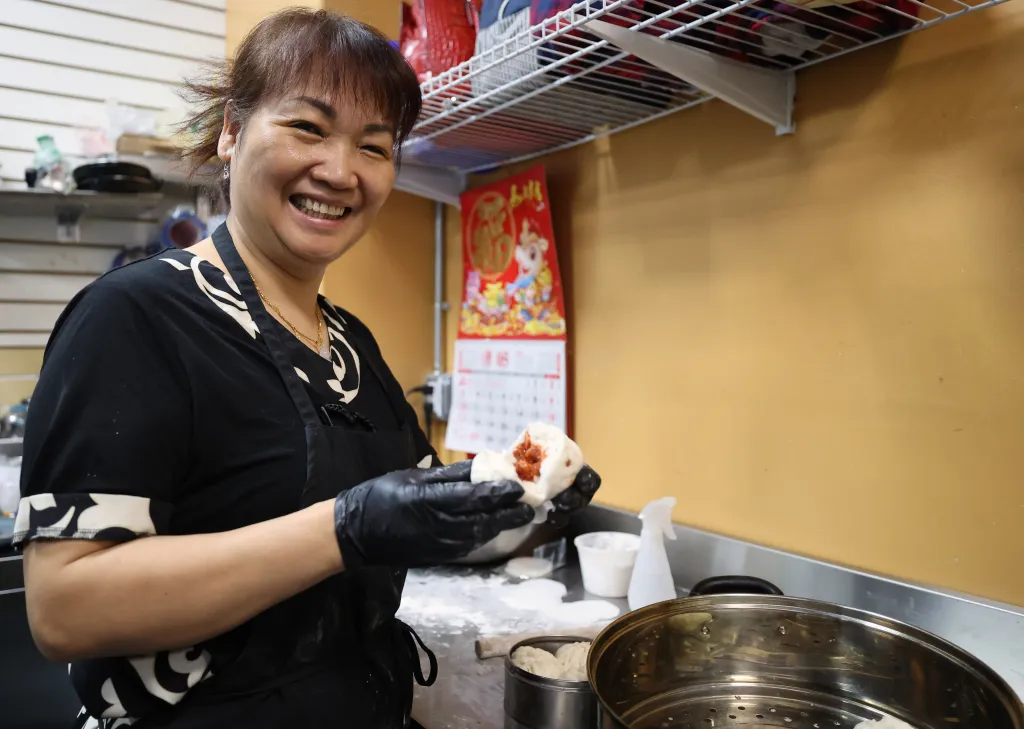
Jackie Lau’s been making char siu buns for a long time, beautiful round pillows, stuffed with the honey-barbecue pork, rich and red, the color of joy and prosperity, that her husband, Jerry, has been making for an even longer time.
Read more FAA update grounds SpaceX Starship labeling failed booster landing as ‘mishap’
But the buns themselves? They go back centuries in China, beginning with mantou.
“It was just plain steamed dough,” Jerry Lau tells me. “People would make it to eat with things like congee for breakfast, with nothing inside.”
It was some time later, though, that a stuffed version took Northern China by storm.
There are legends surrounding their invention, but Jackie Lau says it was an enterprising chef who crafted the modern version, sometime in the 19th century.
“He had a barbecue shop, making char siu much like we make it,” she says.
“He ate one bite of the char siu, then one bite of the bun and he thought, ‘Why don’t I stuff this in the bun and steam it?’” her husband adds. “After that, people really loved it, and he began to sell it on the street.”
Wheat was a staple crop where the dish has its origins, and it is primarily wheat flour in bao’s signature fluffy buns, though the Laus incorporate a mix of other flours, as well. There is yeast to make it rise, a little sugar for a touch of sweetness. After proofing, they are broken into small servings, stuffed with pork and steamed. Served in threes on Moon Wok’s dim sum menu, they are wholly satisfying, in particular at happy hour.
Though they’re lovely to enjoy while sitting, bao are eminently portable, a factor that helped the dish proliferate and evolve in the many nations where Chinese immigrants landed.
“It’s beautiful that all these countries folded it into their own cultures,” says Jerry Lau of the humble dish’s formidable international bloodline. “And there is always so much satisfaction, every time, to watch customers bite into the bun and see them enjoy it.”
Read on for some of the different takes and where you can find them.
Moon Wok Kitchen & Lounge: 11701 International Drive in Orlando, 407-778-1700; instagram.com/moonwokkitchen)
Bánh Bao (Vietnam)
Mills Market’s Cecilia Nguyen remembers making bánh bao with her mother. This is the Vietnamese evolution of the classic, traditionally filled with ground pork, wood ear mushroom, onion, Chinese sausage and a quail egg. (At Mills Market, sometimes it’s a 1/4 chicken egg instead.)
“We’d go all out,” she says. “I still remember doing all different designs and flower shapes, and I’d put the sausage in the petals.”
Years later, when she and restaurateur Johnny Tung married, she brought it to the table at a gathering with his Taiwanese family.
“Everyone had a blast, and it is a really special memory.”
So, too, is the bánh bao they sell daily at Mills Market, a holdover from when the space belonged to Tien Hung Market, each bun lovingly crafted by the very same matriarch who sold them both here, and in her bakery up the road, for decades.
“When they sold the market to us,” Nguyen remembers, “she wanted to keep that tradition going, and so did I. We get them from her fresh almost every day and steam them around 10 a.m.”
That means if you want one straight from the basket, you should show up around 10:30 a.m. If you can’t, fear not. These big, fluffy buns are available out of the grab-and-go case all day long. And they are quite popular.
“It’s a perfect, quick, hearty snack,” she says. “It’s not messy to eat. It’s a great go-to when you are hungry and busy.”
And a beautiful tradition.
“Even though we all fall under the umbrella of Asian and we all know bao, the way I was taught to make it, the way it was passed down to me, is different,” Nguyen says, referencing the feel-good scenes in films where people get together and make dumplings and bao.
Why is that always a part of the movie? Because *it’s a thing!* Making a new memory with an old tradition. It’s special.”
Mills Market: 1110 E. Colonial Drive in Orlando; mills-market.com
Gua Bao (Taiwan)
These Taiwanese “tacos” might be the first thing Americans think of when they hear the word bao, but they, too, are an evolution from the Northern Chinese original just the same, one that transformed in China’s Fujian Province — where that distinct, clam shell bun was created to allow for larger cuts of protein — and then took off in Taiwan as a wildly popular street food.
Read more Bucs’ Egbuka will command more attention with Mike Evans gone. Is he ready?
Hot Asian Buns is a slow-grown hit in Sanford
In the Orlando metro, popular spots like Bao King, The Bao Spot and Hot Asian Buns sell all manner of fusion-filled fare to eager customers. From Korean kalbi to Cuban lechon to Florida-man fried grouper, gua bao might be the most international of a sensational snack that’s already circumnavigated the globe.
The Bao Spot: 54 W. Church St. in Orlando, 407-286-2225; baospotorlando.com
Hot Asian Buns: 204 S. Sanford Ave. in Sanford, 321-363-3075; facebook.com/HotAsianBunsFoodTruck; instagram.com/hot_asian_buns
King Bao: 710 N. Mills Ave. in Orlando, 407-237-0013; king-bao.menu-world.com
Manapua (Hawaii)
Oh, Hawaii, there are so many reasons to love you. Beautiful beaches, breaching whales and blazing volcanoes aside, the melting pot of cultures amid your enchanting islands has certainly created the most delicious one.
Immigrants from China are just one facet of Hawaii’s culinary compendium, but it is to them that we owe thanks for manapua, bao’s big, bold Polynesian cousin. One that Sydney Nguyen fell hard in love with during her many visits.
Moa Kai brings the ono nui to its Hawaiian-style diner | Review
“Manapua is a true Hawaiian staple with roots in Chinese plantation history,” she says. Nguyen, in fact, makes the manapua for Moa Kai Hawaiian Diner in Orlando’s Mills 50 neighborhood fresh every morning. “It’s sold from bakeries to gas stations.”
In Hawaii, baozi grew larger, slightly denser and, with the region’s bread as an influence, a bit sweeter, too. Sesame oil sometimes adds richness.
At Moa Kai, it’s stuffed with slow-cooked char siu and, not surprisingly, ample.
Moa Kai Hawaiian Diner: 2217 E. Colonial Drive in Orlando, 407-270-7916; moakaidiner.com
Nikuman (Japan)
In Japan, I spied adorable nikuman in shop after shop while visiting Yokohama’s Chinatown: pandas filled with sesame paste, pigs filled with (you guessed it) pork. While you won’t find kawaii versions at JINYA Ramen Bar, with locations in Orlando’s Thornton Park neighborhood and Oviedo, you will find a tasty, traditional take on this Japanese take on baozi.
“The nikuman bun is a savory steamed bun filled with seasoned pork and wrapped in pillowy-soft, fluffy dough. Each bite offers warmth, heartiness and the unmistakable comfort of a handcrafted bun steamed to perfection,” says Tomo Takahashi, CEO and founder of JINYA Ramen Bar.
The fiery ‘POW’ of Indo-Chinese manchow
“Typically seasoned with ingredients including garlic, scallions, soy sauce and sesame oil, the pork is savory and aromatic. The slightly sweet dough helps balance the richness of the filling, making the bun both hearty and approachable.”
JINYA Ramen Bar: 8 N. Summerlin Ave. in Orlando, 407-704-1825 and 34 E. Mitchell Hammock Road in Oviedo, 321-765-7077; jinyaramenbar.com
Siopao (Philippines)
There are more than a few Filipino spots around the metro that serve siopao, this 7,000-island nation’s adaptation of the Chinese classic. Much like Hawaii and Vietnam, the Philippines is well known for culinary delights born of colonization.
The Chinese came here around the same time as the Spanish, and their char sui bao flourished.
Here, they grew a little in size, and the fillings became more Filipino in flavor. Sweet pastes, too, like ube or bean, are popular.
At The Baker’s Son in Kissimmee, they’re made fresh each morning, when the dough and starter come together, then rest for 30 minutes, which helps build flavor and texture.
“After mixing the dough, we cut, round and fill it with our housemade pork and chicken adobo filling,” says Arvin Valerio. “We then let it proof for two to three hours and steam it. This is the process to get the soft, pillowy siopao everyone is looking for.”
You’ll find them in the cooler in packs of three to grab and go.
The Baker’s Son: 797 W. Irlo Bronson Memorial Highway in Kissimmee, 689-610-1965; thebakersonusa.com
Find me on Facebook, TikTok, Twitter or Instagram @amydroo or on the OSFoodie Instagram account @orlando.foodie. Email: [email protected], For more foodie fun, join the Let’s Eat, Orlando Facebook group.
Read more DeSantis wants to end most property taxes, calls special session for Nov. ballot question