
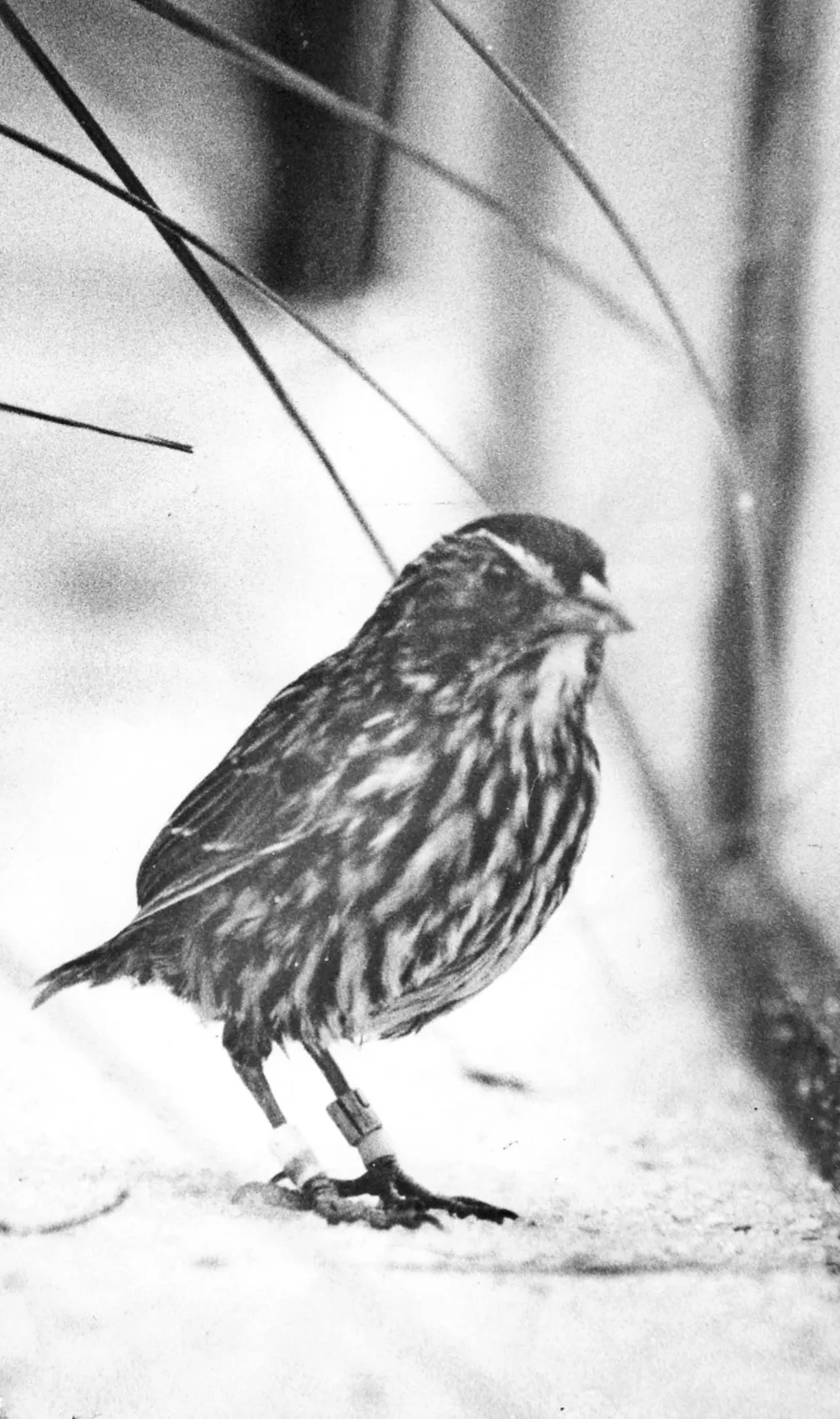
The dusky seaside sparrow was once common in Merritt Island’s marshes. But when more humans arrived in the area, efforts were made to control the mosquito population, and those efforts ultimately led to the elimination of the little bird’s species.
Read more Tabernacle Choir organist’s Orlando concert rescheduled for fall
Here’s Orlando Sentinel reporter Charlie Jean’s story on the death of the final dusky from June 17, 1987:
The last dusky seaside sparrow is lonely no more.
The aging, half-blind sole survivor of its kind died at Walt Disney World on Tuesday in an elaborate imitation of its native marshlands along the St. Johns River in Brevard County.
“It was just a little late for an uphill battle,” said Charles Cook, curator of Disney’s Discovery Island, a Garden of Eden wildlife refuge and the final abode of the duskies.
“I think they will now declare [it] extinct,” said Dr. Herb Kale, Florida Audubon Society ornithologist who led a 20-year battle to save the fragile, canary bird.
“It too little, too late,” Kale said. “Apparently old age caught up with him. He was at minimum 10 years old and could have been several years older.”
Cook said the dusky was found dead in a food dish.
Some of the bird’s tissue was sent to the University of Georgia where it will be frozen in anticipation that some future technology may allow a pure strain of the dusky to be resurrected through genetic cloning.
No decision has been made on where the bird’s preserved remains will be sent, Cook said. The Smithsonian Institution and several universities have expressed interest.
The last dusky’s hospice was one of four 8-by-10 screened cages where it was sheltered like a Rembrandt, glimpsed by only a few scientists and others with extraordinary reasons. So tender was the care that handlers dipped their feet in disinfectant before entering the cage of marsh grass planted in sand, where the dusky fed on crickets, enriched seeds and insect larvae.
Sprinklers producing little rain showers contributed to the princely life the dusky led under Disney’s care.
But part-duskies remain, the fruits of a prodigious effort by the Audubon Society and Disney World to propagate hybrid offspring and perhaps one day return them to their native marshes.
Read more Asking Eric: Should I tell our aunt why the family has become exhausted with her?
Four years ago, four surviving duskies, all males, shared the Discovery Island cages, where a desperate program sought to mate them with their close cousins, Scott’s seaside sparrows. Five part-duskies now scamper about the cages. One is a male, 75 percent dusky. The others are females, 25, 50, 75 and 87½ percent dusky.
Thousands of the birds once flourished along the St. Johns and among Merritt Island’s marshes. They were driven to extinction by land development, land drainage, pesticides, highways and fires that destroyed their habitat, Kale said.
In 1979 and 1980 biologists and volunteers searched the St. Johns to capture the birds that remained. They found only five males.
The U.S. Fish and Wildlife Service refused to participate in the “backcross” program to mate the duskies with their cousins, the first such breeding attempted with songbirds. The federal officials objected because they said that only purebred duskies would be recognized as an endangered species eligible to be released on federal land, where they would be protected.
Because of this “bureaucratic bungling,” Kale said Tuesday, “when we tried to take action it was too late.”

The remaining duskies first were taken to the Santa Fe Community College Teaching Zoo in Gainesville, where backcrossing began with Scott’s seaside sparrows, which abound in the western Everglades. The breeding produced one chick that was 75 percent dusky.
One of the purebred duskies found in the swamp died there. In 1983 Cook, who is also a member of the Audubon Society, brought the duskies to Discovery Island to continue the breeding experiment. In the years since then all the other purebreds died.
More stories and features from the Orlando Sentinel’s 150 years of covering Central Florida can be found at OrlandoSentinel.com/150. Sign up for our free history newsletter at OrlandoSentinel.com/newsletters
***
Want more Orlando history? Buy a copy of the Orlando Sentinel’s 150th anniversary book with 150 front pages from our 150 years. Get it OrlandoSentinel.com/150yearsbook and see more anniversary merchandise at OrlandoSentinel.com/150yearsmerch
Read more Trump is facing a new inflation warning from the bond market, adding to his midterm challenges