
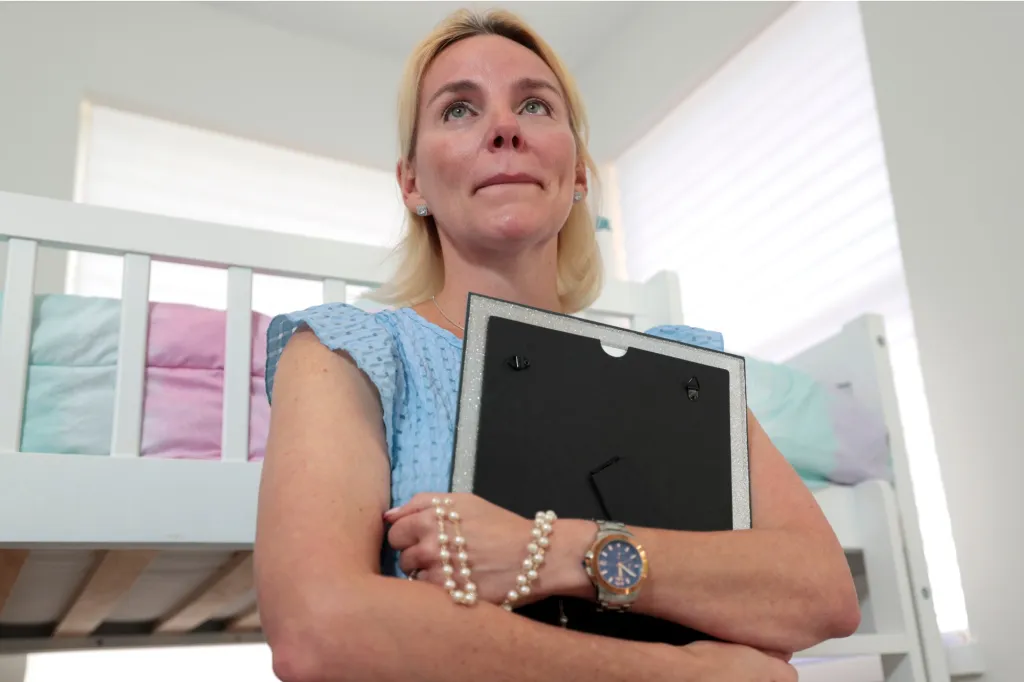
The boy was 13 when he met with the judge keeping him from his mother, an opportunity rarely granted to children in family court.
Read more Pride month brings colorful cocktails to Disney Springs and Kings
“I want to be with my mom,” he told the judge over Zoom from the military school in Georgia the court had ordered him to attend, a sentiment he would repeat throughout the conversation. “Not only do I want to find out why I’m in this place and why I cannot see my mom, I want to see her because I have not seen her in almost two years.”
It was the spring of 2024, close to two years since a series of Florida family court officials determined that the boy’s mother, Michelle Saenz, should be forbidden from seeing or speaking with her son, referred to in court documents as B.M.S., and her two younger daughters. But the first-grade teacher has never been charged with abusing, abandoning or neglecting them.
Her son is 15 now, his sisters 12 and 10. Almost four years after it was issued, the court order remains in place. Should Saenz violate it, she could be sent to jail. The children are also restricted from seeing or speaking with their half-siblings, grandparents, cousins, and everyone else on Saenz’s side of the family.
The no-contact order between Saenz and her children represents one of the most extreme outcomes of something that occurs routinely in Florida’s family courts. In dozens of custody cases identified by the South Florida Sun Sentinel, judges separated parents from their children not because of physical abuse, abandonment or neglect but rather because court professionals determined the parents had mental health issues, engaged in a behavior known as parental alienation, or acted defiantly during custody proceedings.
The decisions typically came after the involvement of court-appointed professionals, including guardians ad litem and psychologists. But Florida’s family court guardians ad litem are not required to have any training in mental health or domestic abuse, while experts have long questioned the extent to which judges should rely on psychologists’ recommendations.
Some attorneys and advocates say that Florida’s family courts are essentially stripping parents of their rights to their children without any oversight, circumventing state law. Under Florida law, the termination of parental rights is supposed to take place in dependency court — the juvenile division intended for determining guardianship of abused, neglected or abandoned children — where judges have to meet a much higher threshold in order to permanently remove children from their parents.
Saenz doesn’t understand how the family court system could decide her children are better off without her. For years, she said, she devoted her life to her son and two daughters, staying home to raise them while their father worked as a lobbyist. She took her son to soccer practice and her daughters to figure skating lessons. She made them snacks and helped them with their homework after school. Whenever she brought her son to the barbershop, his little sisters came, too, and when she took the girls for manicures or to the hair salon, their older brother was dragged along, making fun of them.
“We were always together,” Saenz told the Sun Sentinel.
But that changed when the family entered a fraught custody battle in Miami-Dade family court. Saenz and her son accused the children’s father, Roberto Sanchez, of domestic violence, allegations he denied. He argued that Saenz had invented allegations about him as part of an effort to retaliate against him in court and remove him from his children’s lives.
After hearing from a series of attorneys, psychologists, and a guardian ad litem, a judge ruled against Saenz, concluding that she had defied court orders and undermined the relationship between her kids — particularly her son — and their father, a behavior known as parental alienation.
The judge gave Sanchez full custody and forbade Saenz and her children from speaking.
Judges, attorneys, guardians and other court professionals have repeatedly used custody as a cudgel, according to some family court attorneys and advocates, punishing parents for their conduct by limiting their access to their children. Many times, those parents include desperate mothers trying to protect their children from abuse, according to Yanina Hecker, a paralegal and advocate who works with FACTs, or Families Against Court Travesties, a group dedicated to observing and documenting perceived family court injustices in Florida.
“These circumstances appear more as a punishment to the protective parent,” Hecker said. “It’s got to a point where women are not reporting abuse, not disclosing stuff because they’re terrified their kids will be taken away, because it’s happening.”
Saenz’s judge criticized her for making faces in court in the same order that denied her contact with her kids. In Palm Beach County, a mother who said her ex-boyfriend strangled her in the hospital while she was holding their newborn daughter was called “spoiled” in a judge’s order that sent their daughter to live with him in Michigan. An appeals court later overturned the decision. A third mother, upon asking a Miami judge why she was being stripped of contact with her 11-year-old son, was simply told “because I said so.” And a fourth was informed by the same Miami judge that the “punishment best fitting” her failure to follow court orders would be to deny her all access to her 7-year-old daughter, before ordering that she only see her daughter during supervised visits.
Some professionals used parents’ distress over the proceedings — such as their defiance of orders, outbursts in the courtroom and posts about what was happening to them on social media — as evidence that they were unstable. The Sun Sentinel identified multiple cases in which judges ordered parents to undergo intensive psychological treatment as a condition of regaining access to their children.
“I keep telling clients or callers, you have to play the game,” Joan Meier, a professor at George Washington University Law School who runs the National Family Violence Law Center, told the Sun Sentinel. “You have to be respectful, you have to be deferential, you have to never get upset with any of the professionals. The problem is they go into these things thinking the court is going to help them, then go berserk when it’s the opposite.”
Those who have argued in favor of using no-contact orders in cases without physical violence say they protect children from unstable parents and further alienation, which many psychological experts consider to be a form of emotional abuse.
Some South Florida attorneys also told the Sun Sentinel that false allegations of abuse are a serious problem in the family court system. Nancy Brodzki, a family attorney and guardian ad litem in Broward County, said that she often sees parents, particularly mothers, who are paranoid and overzealous about keeping their children from their fathers.
“If we erred on the side of protecting the child for every woman that claimed there was a problem, no men would have timesharing with their children,” Brodzki said.
To report this article, the South Florida Sun Sentinel spoke to dozens of people, including parents, their adult children, advocates, attorneys, guardians ad litem, psychologists and family court scholars and reviewed thousands of pages of court filings, police reports and lawsuits.
The Sun Sentinel located 15 orders issued in South Florida over the last 15 years that completely forbade parents and children from speaking due to alleged alienation or defiance of court orders, rather than physical or sexual abuse. Strikingly, 12 of those orders were issued since 2019, and 11 of them severed contact between mothers and their children.
There are likely others. But it is unknown how many total orders have been issued or are currently in place in South Florida because the practice is unmonitored. No statewide agencies track the orders, and the Broward and Miami-Dade county clerk’s offices, in response to public records requests, said they were not able to locate specific orders.
The orders frequently arise during lengthy legal battles that cost parents upwards of millions of dollars while funding a costly network of attorneys, guardians, evaluators and therapists. Some of the orders last for months; others have stretched on for years.
A bitter divorce
Saenz and Sanchez had a tumultuous relationship. Their divorce was no different.
The two first met at a lounge in Coconut Grove in 2008. They began an on-again, off-again relationship, eventually having three children together before marrying in 2018.
In some ways, the children had a typical childhood. They enjoyed playdates, sleepovers, visits with their grandparents and trips to Disney World, Saenz recalled. The girls loved playing with Barbies and getting bright colors braided into their hair. Their older brother was like a sponge, learning everything he could about topics ranging from sharks to flags, later becoming obsessed with politics and world affairs.
But Saenz later claimed in court that their father was often not around during those years, leaving her and the children at home when he went out drinking. Sanchez was arrested, twice, for allegedly driving under the influence prior to 2013, according to court records, charges prosecutors later dropped, and did a stint at a rehab center in Naples in 2019.
Saenz argued in court filings that drinking made Sanchez violent; when he came home inebriated, she said, her son was in charge of shutting his sisters away in a room.
“All they would hear is screaming,” she told the Sun Sentinel.
The police got involved a few times. In 2012, Saenz reported to the police that Sanchez, who was 6-foot-1 and weighed over 220 pounds, had hit and choked her while she was holding their son, B.M.S. Saenz — who was 5-foot-4 and slight — later said in court that his size made her fear for her life. Her bruises were photographed, though she didn’t pursue charges. The Department of Children and Families investigated and concluded that alleged domestic violence perpetrated by Sanchez posed a threat to the children. A year later, police arrested Sanchez after Saenz said he grabbed her arm during an altercation while she was pregnant, leaving a mark. Prosecutors dropped the charges after Saenz declined to cooperate; she told the Sun Sentinel that she wanted Sanchez to be there for their new daughter. B.M.S. later reported to court officials that he and his sisters either witnessed their father abusing their mother or were themselves victims of his violence.
Sanchez declined to speak to the South Florida Sun Sentinel and did not respond to a request to interview the children. The Sun Sentinel is not identifying the Saenz-Sanchez children.
Sanchez argued in court that Saenz was trying to destroy his relationship with his children, that her allegations were false and that she was physically abusive to him at times. Saenz had her own past of turbulent relationships, including an arrest in 2008 after police said she threatened to kill an ex-boyfriend. Prosecutors declined to file charges and Saenz was later granted a permanent restraining order against that ex-boyfriend, according to court records, after he was convicted of battering and strangling her.
In 2019, less than a year into her marriage to Sanchez, Saenz filed for divorce and obtained a restraining order that kept Sanchez from the children for about two years. The contentious custody battle has now stretched on for seven years over multiple court cases and cost the parents hundreds of thousands of dollars.
About the time the divorce started, Sanchez had also begun dating a new woman. Saenz told the Sun Sentinel that upon learning of their relationship, she reached out to the woman’s ex-husband, George Muniz, hoping to commiserate. They ended up falling in love and had two children of their own, boys now ages 4 and 5.
Because of the complicated nature of the custody case, a judge appointed a guardian ad litem to determine what was best for Saenz’s and Sanchez’s son and two daughters.
Guardians ad litem
A child’s fate in a Florida custody case often hinges on the opinion of a single, court-appointed guardian ad litem.
Guardians ad litem are appointed in both dependency and family court. In family court, guardians are typically attorneys tasked with determining the best interests of the children during custody battles. The “best interest of the child” is the guiding principle that governs custody arrangements under Florida law.
Family court guardians are intended to act as neutral investigators. But parents, attorneys, and even some guardians themselves argue that judges rely too heavily on their conclusions. Because family court dockets are heavily backlogged, critics say a guardian’s recommendation often becomes the final word, despite the grueling and complex nature of the disputes they are tasked with untangling.
And though they play a central role in determining the best interests of children in cases involving allegations of mental illness and physical, emotional and sexual abuse, the guardians in Florida’s family courts are not required to have special training in psychology, social work, domestic violence or child welfare. Under Florida law, any attorney in good standing is eligible to serve as a guardian ad litem in family court without any further requirements. Those who are not attorneys must be certified either by the Statewide Guardian ad Litem Office or a legal aid organization.
Compounding the outsized authority of guardians is a glaring lack of oversight. While Florida maintains a state office to oversee guardians in dependency cases, no such regulatory body exists that specifically licenses, disciplines, or monitors the guardians operating in high-stakes divorce and custody battles. Sometimes guardians have personal biases or are friends with the people involved in the cases they are working on, according to family attorneys.
While dependency court guardians are typically unpaid volunteers, in family court, most guardians ad litem are private attorneys appointed by judges, often charging hundreds of dollars an hour. Parents must foot the bill for these guardians, and split the cost based on their income. Some guardians in family court cases reviewed by the Sun Sentinel have charged parents over $200,000.
Attorneys who have worked as guardians told the Sun Sentinel that the family court system should have higher standards for the guardians they appoint to investigate serious claims regarding abuse or mental health.
“There should be training,” said Susan Brown, a Broward family attorney who has worked as a guardian. “There should be mandatory requirements, there should be continuing education like how lawyers and doctors have to do continuing education. There should be oversight, rules, regulations … I have seen cases where the results of the guardian ad litem’s maybe well-intentioned investigation is that children’s lives are ruined.”
An emergency hearing
The Saenz no-contact order arose out of a last-minute court hearing and has now been in place for almost four years.
At first, the guardian ad litem, a family lawyer named Katushca Grass, was concerned that the children had witnessed the domestic violence alleged by their mother. She recommended to the court that the three children attend trauma-based therapy by themselves as well as therapy with their father to repair their relationships.
Sanchez, meanwhile, filed multiple motions seeking to have time with his children again. A few months after the children began attending therapy with him, the court ordered that they spend half their time with him under a new 50-50 custody arrangement.
But when the children were with their father, the guardian said in reports, they would often act out, sometimes accusing him of being an alcoholic. Their son, in particular, was reluctant to reconcile with his father, she wrote, and continued to say that Sanchez was abusing him. The guardian concluded Saenz was to blame for their behavior. In her reports, she noted that Saenz would inspect her children for bruises when they came home from visits with their father, and encouraged them to report any abuse, even though investigators did not find bruises or other evidence.
In August 2022, the guardian asked the judge to hold an urgent, last-minute hearing. At the emergency hearing, court records show, she said that Sanchez had reported that B.M.S. and one of his sisters had kicked and scratched him shortly after returning from a visit with Saenz.
The judge at the time, David Young, ordered their son to immediately enroll in a military school in Georgia. And he forbade Saenz from speaking to or seeing all three of the children.
The judge also recommended that both Sanchez and the guardian report the son and daughter, who were 11 and 8 years old at the time, to the police for battery, according to court records, though it is unclear if they ended up doing so. Grass did not return calls or emailed requests for comment.
Saenz appealed the ruling and won a partial victory. A higher court agreed that the judge had violated her due-process rights, sending the case back for a new hearing. But the court kept the no-contact order in place as the case proceeded.
‘The Wife needs a little time to realize that her actions have consequences’
As Saenz and Sanchez awaited the new hearing, a psychological evaluation created a new hurdle for Saenz.
Dr. Miguel Firpi, one of South Florida’s go-to family court experts, had been ordered to evaluate Saenz, following a motion from Sanchez’s attorneys. Psychological evaluations are a common tool in high-conflict custody battles. They often cost parents tens of thousands of dollars and can be used as evidence for or against someone’s parenting capabilities.
Firpi has appeared as either a psychological evaluator or guardian ad litem in numerous contentious custody battles. He initially agreed to be interviewed for this article, but later declined, citing his direct involvement in ongoing cases.
The psychologist’s review looked at Saenz’s past relationships, some of which included police involvement, as well as her conduct during the custody case, concluding that she had “problems with relationships, choices of partners, and impulsive behaviors.”
Firpi wrote that Saenz’s “propensity for impulsive and emotionally dyscontrolled behavior” creates an “emotional burden” for her children, and that, among other recommendations, she needs to “develop a more stable and internal strong sense of self so that she does not depend on the validation and acceptance of others for her sense of security and self-worth.”
The psychologist also wrote that Sanchez’s alleged alcoholism might have contributed to Saenz’s problems and recommended that the court order a more thorough social investigation into him and the children, but due to a protracted disagreement on who should pay for it, the family was never evaluated.
Firpi concluded that Saenz should receive dialectical behavioral therapy, or DBT, an intensive therapy originally developed for self-harming women with borderline personality disorder that is now also used to treat PTSD, eating disorders and substance use. He said it should be administered by a therapist specifically certified by the Linehan Board of Certification, a national credentialing body with rigorous requirements. Only a select group of therapists in Florida have the certification.
His evaluation became crucial evidence that Saenz was too unstable to regain contact with her children. In 2023, close to a year after the appeals court sent the case back, a new judge determined that the no-contact order should remain in place.
Judge Veronica Diaz wrote in her final ruling that, while “both parents are failing,” “the Husband is working on his issues.”
The judge relied heavily on Saenz’s demeanor in court and Firpi’s psychological evaluation. She said Saenz must receive DBT therapy, as Firpi had recommended, in order to talk to her children again.
“While the Wife did not believe the Court was doing so, the Court was observing the Wife very, very closely,” Diaz wrote. “If the Wife did not need help, the Wife would not have had the demeanor that she did. Wife presented in a way where she was combative. The Court believes the Wife can be the rock star mom she has been in the past. The Court believes that with the necessary mental health therapeutic assistance, Wife can be that rock star again. The Wife needs a little time to realize that her actions have consequences. The word ‘hate’ should never be used when referring to the father of her children. The Court believes the Wife will get there.”
As part of her justification for keeping Saenz from her children, Diaz wrote that the mother was organizing papers and “making faces” in court while the judge was announcing her ruling.
Saenz told the Sun Sentinel that she was trying not to cry.
‘An exercise in human lie detection’
Several cases reviewed by the Sun Sentinel involved parents who lost custody or contact with their children after psychological evaluations, even without findings of physical abuse, abandonment or neglect.
Despite the immense power of these evaluations, judges, attorneys and researchers have spent decades questioning the validity of psychologists’ determinations in custody disputes.
“I am increasingly concerned about the proliferating and extensive use of psychologists in these family law cases and the extreme reliance trial courts appear to place on their opinions,” one Florida appeals court judge said in a concurring opinion from 1996 that has been cited elsewhere, adding that “psychological evaluations in many cases amount to no more than an exercise in human lie detection.”
In 2013, a mother filed a lawsuit against multiple psychologists, a guardian ad litem and others involved in her Broward custody case after the judge, acting on their recommendations, ordered that she have no contact with her 7-year-old daughter and sent the girl to her father. While with him, she became nonverbal, communicating only by blinking, according to the complaint. One of the psychologists prescribed the girl Prozac despite her mother’s objections, telling her, “you have no rights, we will medicate her.” A different judge later described the judge’s order as a “travesty” and sent the girl back to her mother. The lawsuit, filed on behalf of the daughter, ended in multiple undisclosed settlements.
Domestic violence victims in particular often do not perform well on psychological evaluations, according to family law experts.
“It is a major risk to have your client psychologically evaluated, because they’re going to come out looking like a bad person,” said Robin Scher, a Palm Beach County family attorney and guardian ad litem who is a survivor of sexual abuse. “If you’re looking at standardized tests, they’re being truthful, they’re living through it. But it comes across as paranoid.”
Victims of domestic violence also often have trouble separating their own abuse from what is happening in court, said Brodzki, the Broward guardian ad litem, and are “extremely reactive, hyper-vigilant, always defending themselves.”
“If you’re not getting the right advice and the right guidance, you could end up like these women without your kids,” she said. “Because you need to learn that you’re going to have to change in certain ways in order to show up in a way that doesn’t paint you as the crazy one.”
A therapy Catch-22
A team of family court officials had decided Saenz needed intensive therapy in order to speak to her kids. But when she went to get treated, she was told she didn’t qualify.
DBT therapy, developed by Dr. Marsha Linehan in the 1980s, is a well-known, rigorous treatment requiring frequent sessions that often cost hundreds of dollars a week, including individual therapy, group skills training and phone coaching. The therapy typically requires a pre-assessment, wherein a practitioner determines if a given patient qualifies for treatment.
But as part of a recent trend, South Florida parents in the middle of contentious custody battles are being evaluated by psychologists, diagnosed with mental health issues or personality disorders, and then mandated to complete DBT or other intensive therapy treatments at their own expense, often as a requirement to have access to their children.
Following the court’s mandate, Saenz went to DBT by Design, a Linehan-certified clinic recommended by Firpi. But after evaluating her, clinic director Dr. Sara Hosn refused to take her on as a patient. In a letter to the court, Hosn wrote that, though Saenz wanted to undergo DBT, it would “be ethically questionable clinical practice” to treat her given that she denied having any of the severe symptoms the therapy is designed to address.
Later, after Saenz was turned away, Firpi testified that he would not be surprised if DBT therapists rejected her given that her “underreporting of symptoms” is part of a “pattern of denial and defensiveness.”
Saenz was not the only parent that a Florida family court ordered into DBT, only to be turned away when she actually sought treatment. Dr. Holly Bedotto, a colleague of Hosn’s at DBT by Design, said that during the COVID pandemic, she started getting a flurry of “desperate, horrific, tearful phone calls” from mothers.
“We started to notice that more people, particularly women whose stories were very similar, were being sent to us,” she told the Sun Sentinel. “‘My children have been taken away and I’ve been told through this investigation that I need to do DBT.’ My response was always, ‘You can’t be told you need DBT.’”
Bedotto says that mandating parents into the therapy, particularly alongside the removal of children, goes against the spirit of DBT.
“Marsha Linehan was a great advocate for women who were ignored by the system for a long time,” Bedotto said. “Hard to treat, suicidal women; self-harming women. And now we’re having this beautiful, evidence-based treatment weaponized.”
Hosn and Bedotto began writing letters addressed to South Florida’s family court professionals.
“I would like to take a moment to educate those professionals involved in the court system here in South Florida as we have been receiving an increase in court mandated cases,” one of the letters reads. “… DBT was developed to help individuals save their own lives and give them a chance to make changes so it becomes more livable with meaning and purpose … DBT is not meant to serve as an adjunct therapy. It is also not ‘coping skills.’ It is a comprehensive gold-standard, evidenced-based therapy for complex problems that many clinicians do not understand how to treat.”
The Sun Sentinel located four mothers who were court-ordered to complete DBT therapy to regain access to their kids, only to be informed they did not qualify for treatment.
But it is unknown how many such cases exist because the court system doesn’t track them.
One of the mothers, Michelle P., has not spoken to her son in seven years.
‘It’s torture’
The last time she saw him, he ran into her arms.
It was Mother’s Day, 2019. Michelle, who asked that her last name not be published, remembers the day clearly. She had brought a suitcase full of her son’s favorite toys, including his stuffed parrot, to a supervised visitation appointment in Miami — a setting judges reserve for parents they’ve deemed too unstable or harmful for unsupervised custody.
They played for their allotted three hours in a beige room that looked like a doctor’s office while a court-appointed therapist took notes. When the therapist let them know their time was up, they hugged.
Read more Partly sunny skies and temperatures in the 80s across Central Florida
“I love you,” Michelle remembers telling her son. He said he loved her, too.
It was the last time they would speak.
Her son was 3 years old then. Now, he is 10.
“It’s torture,” Michelle told the Sun Sentinel. “It’s worse than physical punishment because, no matter what you do, you can’t heal from it. You have to actually mourn a child that is still alive.”
While Michelle, like Saenz, was never criminally investigated or found guilty of abuse, abandonment or neglect, her son’s father, David R., was arrested twice due to alleged domestic violence. In one of the incidents, he confessed to grabbing Michelle by the throat and attempting to have sex with her while she repeatedly said no, according to a 2017 probable cause affidavit. The incident was caught on a baby monitor in their apartment. He later pleaded no contest in Miami criminal court to misdemeanor battery and culpable negligence as part of a deal with prosecutors to resolve multiple cases, and was ordered to attend a batterer’s intervention program.
But Michelle had repeatedly violated court orders, denied David access to their son, and antagonized court-appointed professionals, according to filings from his team of attorneys, the judge and experts assigned to the case. Throughout the case, she represented herself pro se because she said she could not afford an attorney. A judge first ordered their son removed from Michelle’s home when he was 2 years old, mandating supervised visits, then took away their contact altogether. David now has full custody.
Like with Saenz, the no-contact order hinged on the evaluation of a psychologist, who testified that Michelle was angry and paranoid and might endanger their son in her pursuit of revenge against his father, according to court filings. She diagnosed the mother with borderline personality disorder and recommended DBT therapy. But Michelle was also told she did not qualify for the therapy when she went to DBT by Design, the same therapists Saenz consulted. Multiple psychologists later disputed the borderline diagnosis.
In 2019, the same year the court system cut off her contact with her son, Michelle began law school at Nova Southeastern University. On her first day there, she met Reid Levin, a fellow student and competitor for the top seat in the class. The two became friends, and Levin told Michelle if he passed the bar, he would help her with her custody case.
He later opened a civil rights practice in Boca Raton, and began representing Michelle on the side, largely working for free.
The custody case is now on hold because Michelle faces felony charges of falsifying a series of child abuse reports about David, one of his attorneys, and others. The reports, which included elaborate accusations of sexual abuse, sent child investigators to their homes, sometimes at odd hours, to interview the children. David’s attorneys argued in court that the reports were retaliation for rulings that didn’t go Michelle’s way. Police connected the IP address behind the reports to her, but she says she never made them. She had a job lined up at a major law firm following her graduation, but due to her criminal charges, her offer was rescinded. She has since been declared indigent.
David did not respond to multiple calls and emails requesting comment. One of his attorneys, Sam Rabin, said he would not comment on ongoing litigation but referred a reporter to a series of court documents. In one of the filings, arguing against removing the no-contact order, Rabin wrote that Michelle “demonstrated a disturbing pattern of manipulation and malice” and engaged “in harmful and abusive conduct towards the minor child” by undermining David’s relationship with him.
Despite Levin’s efforts, Michelle remains forbidden from speaking with her son or going within 500 feet of him.
“The court has permanently erased him from her life,” Levin told the Sun Sentinel.
The attorney sees the no-contact orders as a constitutional issue. The First Amendment gives Americans a fundamental right to receive information from one another, he said, adding that prolonged no-contact orders not based on findings of abuse, abandonment or neglect infringe on that right.
Parental rights are also constitutionally protected. The termination of those rights is supposed to take place in Florida’s dependency courts, where judges must meet a much higher legal threshold in order to sever the relationship between parents and children. Parents who can’t afford a private attorney also receive free legal representation in dependency court, but not in family court.
By removing children from their parents indefinitely, Florida’s family courts are essentially usurping dependency courts, terminating parental rights without the same protections and without having to prove any actual abuse, abandonment or neglect, according to Levin and other family court advocates.
“If a parent is so psychologically unstable or if they have any form of doubt that they can actually take care of their child, that should be a dependency court proceeding,” Levin said. “There are things in place there to protect parents’ rights, get that parent therapy or whatever help they may need while still monitoring that contact.”
While representing Michelle, the attorney took on Saenz’s no-contact order as well.
‘That’s not something I want’
In August 2024, Levin got a call from B.M.S. The boy wanted to file a federal lawsuit so that he could speak to his mother.
The 13-year-old had become involved in his own custody case, even though the court wanted him kept out of it.
Family court officials typically strive to keep children separate from the litigation, delegating to guardians ad litem the task of determining their best interests. Parents who discuss litigation with their children can be punished for doing so. And children themselves are often not allowed in the courtroom.
Still, by 2023, the boy had begun telling the professionals involved in his case that he wanted to meet with the judge who took away his contact with his mother. He said he and his sisters had been asking Sanchez to let them speak to the judge, but their father had refused.
“We ask him if we could talk to you and every time he says no and we [are] very scared of him,” B.M.S. wrote to the guardian ad litem in a June 2023 email that Saenz provided to the Sun Sentinel. “I am almost thirteen and I would like to speak with the judge.”
Close to a year later, in March 2024, Diaz and the boy spoke in a private Zoom call with only a court reporter present. He told her that he and his sisters were miserable without their mother, grandparents, and other members of the family. He said that he wanted to leave military school and alleged multiple instances during his childhood in which his father came home drunk and physically assaulted him, his mother and sisters, according to a transcript of the call.
“How did that make you feel?” the judge asked.
“Horrible,” B.M.S. said, according to the transcript, adding, “I feel I have to be stuck with him until I’m 18. And that’s not something I want. I feel like I’m old enough to make a decision that I don’t want to be with him.”
When he looked at his father, the boy said, he saw “the abuser, the alcoholic, the person who took my mom away from me.”
“I will definitely take into account everything you said to me today,” Diaz assured him at the end of the call, according to the transcript.
A few months after that meeting, with the no-contact order still in place, the boy reached out to Levin for help, the attorney said. That November, he filed a lawsuit against Diaz on the boy’s behalf, saying the no-contact order violated the First Amendment. A federal judge dismissed the lawsuit, but Levin has since appealed the decision.
In family court, Sanchez, his attorneys and the guardian ad litem argued that the federal lawsuit is further evidence that Saenz — and now Levin — are harming the boy by involving him in the custody battle.
Levin disagrees. Separating a child from one of their parents automatically involves them in litigation, he said.
“The court took away his right to communicate with his mom and he acted heroically,” he told the Sun Sentinel. “Like any child who was prohibited from speaking to their mom should do.”
In October 2025, close to a year after the lawsuit was filed, Diaz ruled that the no-contact order should remain in place. She concluded that all three children were in a “stable environment” and “thriving socially, emotionally and academically” while in the sole care of their father.
Under Florida law, family court judges may consider a list of factors in determining custody, all based around identifying the best interests of the child. One of the factors is a child’s “reasonable preference” for one of their parents. But the judge must also deem the child to have sufficient intelligence and understanding. Diaz concluded that Saenz’s son did not.
After B.M.S. had met with the judge, Grass, the guardian ad litem, testified that she had learned the boy was using a military school classmate’s phone to secretly communicate with his mother, defying the no-contact order, according to court documents. The judge criticized Saenz for initiating some of the phone calls and not immediately hanging up when her son called, but did not hold her in contempt.
Judge Diaz concluded that what the boy had voiced during their meeting in 2024 was shaped by his mother’s “undue influence.”
Allegations of a parent manipulating a child into making false abuse allegations — often called “coaching” — fall under the broader umbrella of parental alienation.
Many legal and psychological experts caution that what children say they want during custody battles may be the opposite of what is best for them, especially if it seems like they’re parroting one of their parents.
“My 16-year-old son could say to me, ‘Dad, I think I should be able to drive to Orlando at 4 in the morning, and I would think that’s not in his best interest,” Scott Lazar, the attorney for the children’s father, told the Sun Sentinel. “… We as the parents, and the judges in the family law cases, have a responsibility to determine what they think is in the child’s best interest, and determine when they think a child is being truthful. A lot of times, in those interviews or in interviews with the guardian, if the child is completely parroting things one parent is saying in the litigation and which the child would have no way of knowing unless the parent was telling him this or her this, that’s usually a red flag.”
Lazar declined to comment on the specific conversation between his client’s son and the judge, saying such conversations should remain private and Sanchez does not want to expose his children to publicity.
Outside of the challenges posed in court, some experts say that parental alienation and coaching are also extremely harmful to children.
The damage is “tremendous,” said Dr. Joe Rabinovitz, a child psychologist based in Boca Raton. Treating alienated children can be as challenging as treating those suffering from the death of a parent, he said.
And for the parents affected, “it’s like a nightmare that never ends,” Rabinovitz said. “You wake up with it and the first thing you think about is missing your kids.”
But many experts and advocates also caution that courts may mistakenly apply the label of “alienation” to children who have valid reasons for fearing one of their parents.
One of them is Meier, the professor at George Washington University, who worked as an attorney representing victims of domestic violence before turning her attention to the family court system.
In a study of over 2,000 family court decisions published in Georgetown Law Review, Meier found that courts discredited child abuse allegations a staggering 80% of the time, while other research suggests that intentionally false child abuse allegations are far more rare — during custody battles, some estimates place the rate at 12%. This means that family courts are likely “putting a significant number of children at significant risk,” Meier wrote.
Meier also found that mothers accused of parental alienation after reporting abuse were almost twice as likely to lose custody, and were disproportionately losing custody compared to fathers. She theorized that gender biases entrenched within the court system might lead courts to dismiss mothers more than fathers, who also tend to have more wealth and power in custody disputes.
The irony of the court’s approach to alienation, Meier said, is that by removing children from the parent accused of it, the system ends up severing the very parent-child bond it says it wants to protect.
“It’s really not about keeping both parents in the picture,” Meier told the Sun Sentinel. “Really it’s about punishing women who fight that. This is less about what you want the child to end up with and more about who’s the good parent, who’s the bad parent, who I’m going to reward, and who I’m going to punish.”
Saenz and other parents fear that they may not fully reunite with their kids until they are adults and essentially “age out” of the family court system.
That’s what happened to Mia Ward.
‘My mom was everything to me’
Mia says her mother was her first best friend.
But from age 7 until she became an adult, the Miami court system forbade her from spending any time with her mother without a supervisor — a decision the court ruled was in her best interests.
Like Saenz and Michelle, Mia Ward’s mother, Leslie, was never criminally investigated or charged with abuse, abandonment or neglect. Still, in 2011, Judge Scott Bernstein ordered their separation after he concluded that her mother was a parental alienator who had repeatedly defied court orders.
“The Mother’s recalcitrance merits punishment,” Bernstein wrote. “The punishment best fitting the Mother would be to deny all access to the minor child, but this would also punish the minor child, who deserves no rebuke. So this Court must fashion some other relief, and fulfill its mission to advance the best interest of the minor child.”
Seven-year-old Mia did not understand what was happening. All she knew was that every time a supervised visit with her mother was coming to an end, she would panic, begging not to leave.
“My mom was everything to me,” she said. “There were times she’d put my hair in braids and I wouldn’t want to take a shower just because she put my hair in braids. That’s how much it screwed with me.”
When Mia tried to tell Firpi, who had been appointed as her guardian ad litem, how she was feeling, she recalled, he didn’t listen. Firpi would not comment in response to emailed questions about Mia’s case.
When Mia turned 14, her father moved the two to California. By that point, she alleged that he had become abusive — kicking her, throwing things at her, pouring alcohol on her, and calling her a bitch and a whore, according to court transcripts and social services reports. Her father, Sal Lyazidi, denied the allegations of abuse. In court, he acknowledged challenges parenting Mia and said that he was concerned about her having relationships with adult men, according to transcripts.
The next summer, during a rare visit with her mother in Miami, Mia told her mother about the alleged abuse. At a last-minute court hearing, she was granted a private meeting with Judge Bernstein. She entered his chambers with a stack of papers, pictures and articles and begged him to let her stay with her mom. When the judge emerged from their meeting, his stance on the case had changed from a decade before. Mia Ward was “petrified” of her father, the judge said, according to a transcript of the conversation, and he no longer believed it was just parental alienation.
The 15-year-old had also been under the mistaken impression that it was her father who had kept her from her mother for the last nine years, Bernstein said.
“I told her, in no uncertain terms, that it was not his decision,” the judge said. “It was my decision.”
When Mia asked him why, he said, he told her that he had ordered her mother to go to therapy several times and she had refused.
For the next few days, the judge, Lyazidi’s attorney and Mia’s parents discussed what to do with the 15-year-old. Bernstein had a therapist meet with her privately, as well as with her parents. The therapist reported that Mia had told her how much she wanted to live with her mother and that she might run away or hurt herself if she was made to return to her father.
But Bernstein still did not want to send Mia to her mother, citing concerns about her mother’s defiance of court orders and the fact that she “stares off in space” during court hearings, according to a transcript of the conversation.
Within a week, the judge issued an order sending Mia back to California under the condition that she attend an intensive outpatient therapy program. He ordered her to have a “cool-off period” from her father by staying with his girlfriend for two weeks, and forbade her from any contact with her mother or any of her maternal family until her mother completed a psychological evaluation.
Shortly after her return, Mia’s situation spiraled, and she ended up in foster care. Her father had taken her to the emergency room, asking for her to be kept involuntarily on a psychiatric hold because she had been self-harming, which Mia said was untrue. Social workers found no evidence that she was self-harming. They did not want to send her back to her father because of the same abuse allegations the Miami court had heard, but Bernstein’s order prevented them from sending her to her mother, so the state of California assumed custody of her.
As Mia sat in the hospital waiting room that day, she recalled, a security guard came up to her. He told her not to worry, that he could see what was happening. She distinctly remembers him saying, “I’m going to keep you safe.”
“That was the first time in my whole life where somebody told me that they were going to keep me safe and then actually kept their word,” Mia told the Sun Sentinel.
It wasn’t until she was 18 that Mia Ward fully reunited with her mother. Today, four years later, the two still live together, and the 22-year-old says she is finally beginning to move on from the trauma she says she endured throughout her childhood. The worst part of all of it, she said, was feeling like her voice didn’t matter.
“It was my life,” she told the Sun Sentinel, “And I had no say so, in what was going on in my life. I think that’s why I have really bad control issues now.”
Lyazidi says he was never abusive. He and his daughter used to have a great relationship, he said. But the one summer that he allowed her to go visit her mother, she came back a completely different person.
Now estranged from Mia, Lyazidi said he deeply misses his daughter and blames her mother for alienating them. Though she is 22 years old, the custody case remains open because her father continues to file motions seeking unpaid fees from her mother.
“I don’t know what else to do except bring justice, which is why this case is still going,” Lyazidi told the Sun Sentinel. “Somebody has to bring justice. This can’t — her mother cannot get away with this.”
Ward’s mother did not respond to requests for an interview.
As recently as last year, judges have continued to issue new no-contact orders. In October, Bernstein ruled that a 13-year-old boy — who had lived with his mother full-time after she said he attempted suicide at age 9 due to his father’s verbal abuse — should be removed from her care, placed with his father and have no contact with her for at least three months, a decision supported by Firpi, the guardian. The order was later reversed on appeal, and Bernstein disqualified himself from the case after the mother’s attorney argued that he was biased towards the father and “predisposed to finding parental alienation” from the mother.
The judge declined a Sun Sentinel request for an interview through his judicial assistant, saying he does not discuss his past or current cases.
‘A living nightmare’
Saenz’s home is full of vacant children’s bedrooms.
One is for her daughters, if they ever return. It’s mostly empty, except for the giant pink stuffed animals that cover the bunk beds. Downstairs, a boys’ room set up for B.M.S. to share with his stepbrother is also spare.
Most of the children’s things are packed away or donated. Her son was 11 years old when the no-contact order was issued. Now that he’s 15, she doubts he still likes Star Wars or collects plush toys, and she’s sure her daughters, now in middle school, would no longer want Barbies or bright colors in their hair.
“I’m sure they like technology and cellphones now and stuff like that,” Saenz said in March while standing in the girls’ room, which she has avoided entering since she and her fiancé moved in.
In 2024, Saenz completed over 20 sessions of DBT therapy with a Linehan-certified therapist who was willing to see her after 10 others turned her away, according to her testimony in court records.
But Sanchez’s attorneys argued that she had not adequately participated in the weekly “group skills” training regimen that is a key component of DBT. So Saenz returned to therapy, completed the regimen, and filed a notice of compliance in court last July. A hearing on whether she had complied was scheduled for that November. Two weeks before it could take place, Judge Diaz issued an order that continued to deny Saenz contact with her children.
The judge ruled that Saenz must find a new DBT therapist from a group preselected by Dr. Firpi. After she receives treatment, Firpi must reevaluate her to determine if the no-contact order can be lifted. The order rendered her previous efforts meaningless. Meanwhile, due to the costs of the litigation, Saenz had to file for bankruptcy, proceedings that concluded in March.
“It’s just been a living nightmare,” Saenz told the Sun Sentinel. “Criminals have more rights than what I have. That’s where it’s at. They took everything from me.”
Lazar, Sanchez’s attorney, told the Sun Sentinel that Saenz had repeatedly tried to get away with less therapy than what was required. Asked if he would support her having a relationship with her children, should she complete the therapy, Lazar said it would “depend upon the facts and circumstances and recommendations of all involved.”
Saenz is currently waiting to hear back after sending letters to the six therapists Firpi recommended. As of early May, she had received one return letter, telling her she does not qualify for treatment. Meanwhile, she’s awaiting news of a new appeal of the judge’s order that Levin filed in April, though it will likely take months for Sanchez’s team to file a response.
Saenz’s two youngest children — the boys she had with her fiancé— do still live at home. And at the end of April, she found out she is pregnant again and expecting a girl.
The two boys know all about their half-siblings, she said, though they don’t understand why they’re gone. Every night when they pray, they recite their names, asking God to bring them back.
Staff writer Shira Moolten can be reached at [email protected] and 754-971-0636.
Read more ‘Six’ still sparkles with subversive sisterhood | Review