
Hurricane Andrew, which made landfall south of Miami on the morning of Aug. 24, 1992, put a dent in South Florida, both literally and psychologically.
Read more Injury news on Dolphins OL Jamaree Salyer, WR Caleb Douglas; why is Wannstedt at minicamp?
As a Category 5 storm with sustained wind speeds of 165 mph, it’s the hurricane many think of as the “worst-case scenario.”
But this year is the 100th anniversary of a much bigger, much more destructive storm known as the Great Miami Hurricane of 1926. It bludgeoned nearly all of South Florida, killing 373 people.
Andrew was terrifying but small, changing direction and laying waste to Homestead, where it swept up 99% of the mobile homes and sent 16 feet of storm surge into the shores of Biscayne Bay.
In the end, Andrew killed 23 people in the U.S. and prompted drastic changes to building codes.
The Great Miami Hurricane of 1926 was massive, slamming Florida’s east coast on Saturday, Sept. 18, with sustained winds of 145 mph. The eye was so big — 30 to 40 miles wide — Hurricane Andrew’s radius of maximum winds could fit inside it.
The 1926 storm’s hurricane-force winds spanned 150 miles — three times the width of Andrew’s, from the upper Keys north through Broward and Palm Beach counties, all the way to St. Lucie County.
Andrew and the 1926 Hurricane made landfall within 10 miles of each other, both south of Miami. But the 1926 Hurricane’s width put Broward and Palm Beach counties in line with the dirty right hand side of the storm where winds are typically strongest.
Wide storms produce more storm surge. Though the eye of the 1926 storm hit Miami, where there was 14 feet of surge, the ocean also swept into Dania Beach, Hollywood and Fort Lauderdale.
“It just destroyed Hollywood and Dania,” said Bryan Norcross, hurricane specialist at Fox Weather. “It flooded downtown Fort Lauderdale to about 6 feet of water and flooded downtown West Palm Beach. It was a giant regional hurricane.”
Meanwhile, Andrew’s surge stayed mainly in Miami-Dade County, reaching 6 feet at Haulover Inlet, where it destroyed the bridge. In Fort Lauderdale, surge was negligible.
Dade landfall, Broward and Palm Beach destruction
South Florida had very little notice when the 1926 storm rolled in. There were no satellites or radar systems or hurricane hunters at the time. Warnings were based on information from human witnesses.
“It was really just a combination of reports from ‘upstream,’ if you will, (from the Caribbean and the Bahamas) in addition to reports from ships,” said Robert Molleda, who heads the Miami office of the National Weather Service.
The center of the eye track struck at Palmetto Bay, 10 miles south of downtown Miami.
When the front wall passed, residents of Miami took to the streets, thinking the storm was over, reported the then-head of the Miami weather bureau, Richard Grey. Thirty-five minutes later, the rear of the storm hit with a 10-foot storm surge on Miami Beach and other barrier islands.
“When the second part of the storm came in, the storm surge came in suddenly,” Rusty Pfost, former meteorologist in charge of the National Weather Service in Miami told the Sun Sentinel in 2017. “That’s where we lost a lot of people. They drowned.”
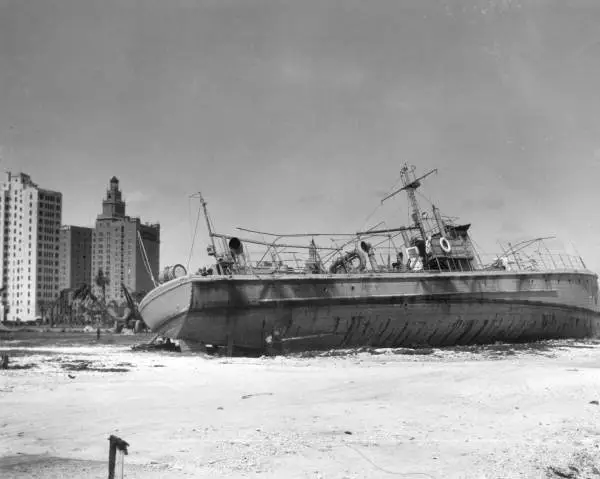
The storm shredded homes and buildings around the city and lifted large ships out of the Port of Miami, said Jim Lushine, a former weather service meteorologist.
“A lot of ships got washed up right on Biscayne Boulevard downtown,” he said.
Molleda said that more than 9,000 homes from Miami to Fort Lauderdale were damaged.
In addition to the death and destruction, the storm put an abrupt halt to the region’s building and population boom.
“It just put Miami into the Depression before the rest of the country,” said Alvin Samet, 82, of Coral Gables, who was a radar and public affairs worker with the Miami NWS for 42 years.
How Broward and Palm Beach newspapers reported the storm
A look back at local newspapers of the day is haunting.
On Sunday, Sept. 19, 1926, The Palm Beach Post reported that winds reached 80 mph at Lake Worth, and the area “suffered an enormous total in human injuries and property damage.”
“By dawn gales were sweeping the entire coast at a rate of about 100 miles. Mountainous billows crashed over the beach and swept in gusts across the ocean boulevard … Huge uprooted trees, fallen timber, coconuts and fruits, flying tiles and broken plate glass covered the landscape …” the paper reported.
The storm pushed a 75-foot yacht against a sea wall in the El Cid area of West Palm Beach, demolishing it, and four dredges sank in canals.
Palm Beach residents had no idea that the storm had been worse in Miami until an Associated Press reporter, R.R. Mitchell, walked and hitchhiked his way approximately 60 miles to spread the news on Sunday morning.
The Fort Lauderdale News (precursor to the South Florida Sun Sentinel) reported on Monday, Sept. 20, that, “The bodies of 15 dead from the hurricane of Saturday morning had been recovered by the relief workers in Fort Lauderdale.”
Disease prevention became a concern.
“The overflowed septic tanks and the impossibility of proper disposal of refuse made the danger of infection great, as it was scarcely possible to walk along the streets without getting into the contaminated water.”
Palm Beach County sent medical supplies to Fort Lauderdale by train, as well as 15 nurses, who reported for duty at Edwards Hospital.
The Fort Lauderdale paper reported that boats were piled in a “jumbled heap” at the Andrews Avenue Bridge, where the Riverwalk now traverses, and another boat was stranded on Andrews Avenue itself, 150 feet from the river.
The storm crashed two barges and a houseboat on the front yard of an apartment complex in downtown Fort Lauderdale, and one of the steel barges demolished two Fords, the paper reported.
“At the junction of the North and South forks of the New River near the residence of Mayor Tidball backed up waters caused a union of these two branches, making the stream spread out over more than a mile. The water was said to be salty in territory and causing much damage to residents.” In other words, storm surge had traveled up the river.
Read more UCF football players get a behind-the-scenes look at EA Sports
When canals swelled and retreated, they left dozens of boats stranded asunder in various neighborhoods.
Dania was “laid flat,” said the paper. “The number of injured in Hollywood was roughly estimated at 1,500 and all the hospitals and hotels filled with refugees …”
“Mountainous waves” swept over Las Olas beach and a beachfront tennis court was buried under several feet of sand.
Florida Gov. John Martin declared Broward to be in a “worse plight” than Miami and Dade County.
The paper reported 34 dead in Hollywood. Later counts would reveal 45 deaths in Broward, according to the American Meteorological Society, and at least 90 near Lake Okeechobee as the lake overtopped levees, drowning local residents.
The tragedy at Lake Okeechobee was a prelude to a larger catastrophe two years later, when the caused the lake to burst through levees at the south end, killing more than 2,000 people, an incident that was vividly recounted in Zora Neale Hurston’s 1937 novel, “Their Eyes Were Watching God.”
A first-hand account from Hollywood
Flamingo Gardens’ founders Floyd L. and Jane Wray weathered the storm in Hollywood with friend D.L. Gregory, who wrote an eyewitness account of the disaster.
As with many hurricanes, the storm itself was harrowing, but the aftermath was arduous and disturbing. The Wrays’ house withstood the storm better than most in their neighborhood, and it ended up being a gathering spot after the storm passed.
Gregory wrote:
“They were bringing in the wounded by the car full. Some people had been blown away from their families, and I never want to see anything like it again, legs broken, one man with a broken back, faces and arms torn, and the people so afraid it was awful. … Outside you had to pick your way around in the water, for the streets were covered with wires, boards, roofs and everything you could think of. We housed thirty the first night, six in a bed and the rest on the floor, and glad to get the floor where it was dry.”
Gregory was able to collect anecdotes about fatalities and rescues. One woman went onto a houseboat to help with childbirth, and brought her 9-year-old son with her:
“The night of the storm the baby was born, and died from exposure also in the midst of the storm. The mother died. There was a man on the boat about seventy, and the boat broke away from its holding, and they drifted. These people drifted all day Saturday, and all night people tried to swim to them, but it was impossible, and all of the other boats were either sunk or up on dry land having been thrown there by the high water and the wind. When these people were finally rescued, they were sure in awful shape.
In another instance, the storm destroyed a house with a family inside.
A falling beam knocked the father unconscious, and the mother and child were able to scramble on top of a barn door and pull the father up with them.
“As the water came up so high, they could not stand up, and they floated tied to this door. The man died about an hour after they got on the door, and they were not found for over twenty-four hours after this. The woman was sure brave, for they found them floating out into the Everglades (Sunday afternoon)… It was found that she was badly injured, but she has never uttered one complaint.”
Of the recovery, which lasted for weeks, Gregory wrote:
“Rich and poor alike had to be clothed. I loaned and borrowed until I had to stop or go like Eve myself. Food was furnished by requisition for almost two weeks, also coal, oil, and stoves and water. … There was no water for the bathrooms, and you can imagine how hard that was.”
How did the 1926 Hurricane grow so large?
Wide storms need time to grow, said Norcross.
“So hurricanes as they go over time, they go through cycles of strengthening and weakening. And every time they weaken, they get bigger and then they restrengthen and now you have a bigger strong hurricane … So long-track hurricanes quite often are large.”
The 1926 storm likely formed off Cape Verde and had thousands of miles to grow and cycle as it traveled west. Apparently it had a pristine path — no Saharan dust to dry it out, no significant wind shear and enough high pressure over the North Atlantic (known as the Bermuda High or Azores High) to steer the storm west to Florida.
Though small storms like Andrew can spin up faster with rapid intensification, large storms create more storm surge.
“I use the example in your bathtub,” said Norcross. “If you sweep the bathtub with your hand, you move a certain amount of water. If you sweep it with your arm, you move a lot more water, and that’s exactly what happens when you have a bigger radius of winds pushing at the coast as opposed to just a small radius.”
As a result, “the 1926 hurricane put water over all of Miami Beach and put huge ships into downtown Miami and flooded downtown Fort Lauderdale and pushed water up the river.”
Norcross said that a big sweep of wind like that would make Hollywood very vulnerable to storm surge.
“The area over there by the lakes is very low. So, the water comes up essentially to the railroad tracks in Hollywood,” he said.
If the 1926 storm happened today
In 1926, the storm affected 125,000 people in South Florida. The region now has 6 million residents. There are much stronger building codes, but also many more hard paved surfaces that don’t absorb water.
An in 2008 estimates that if the Great Miami Hurricane of 1926 were to strike the same location today, it would be the costliest hurricane in U.S. history.
Sea levels have risen about 10 inches in the last century. It’s unclear what that means for storm surge, other than there’s more water to push around.
“It’s hard to quantify that,” said Molleda of the NWS. “But I think we can assume that there would be a little bit, at least a little bit more flooding, maybe a little more inland extent, higher tide values, higher storm surge.”
The matrix of canals that flow through South Florida — and the spillways that control them — are on the verge of not functioning due to sea-level rise, according to the South Florida Water Management District, which operates them.
There’s a $1.8 billion plan to beef them up in the next 12 years. Meanwhile, the atmosphere will continue to spin up hurricanes.
“1926 was a hurricane very different than hurricanes anybody around today has experienced, including people that went through Hurricane Andrew,” said Norcross. “In my mind, there are huge lessons in that storm for all of South Florida, including Broward and Palm Beach County.”
Bill Kearney covers the environment, the outdoors and tropical weather. He can be reached at [email protected]. Follow him on Instagram @billkearney or on X @billkearney6.
Read more Carnival upgrades RelaxAway, Half Moon Cay in Bahamas for guests seeking pristine beaches