
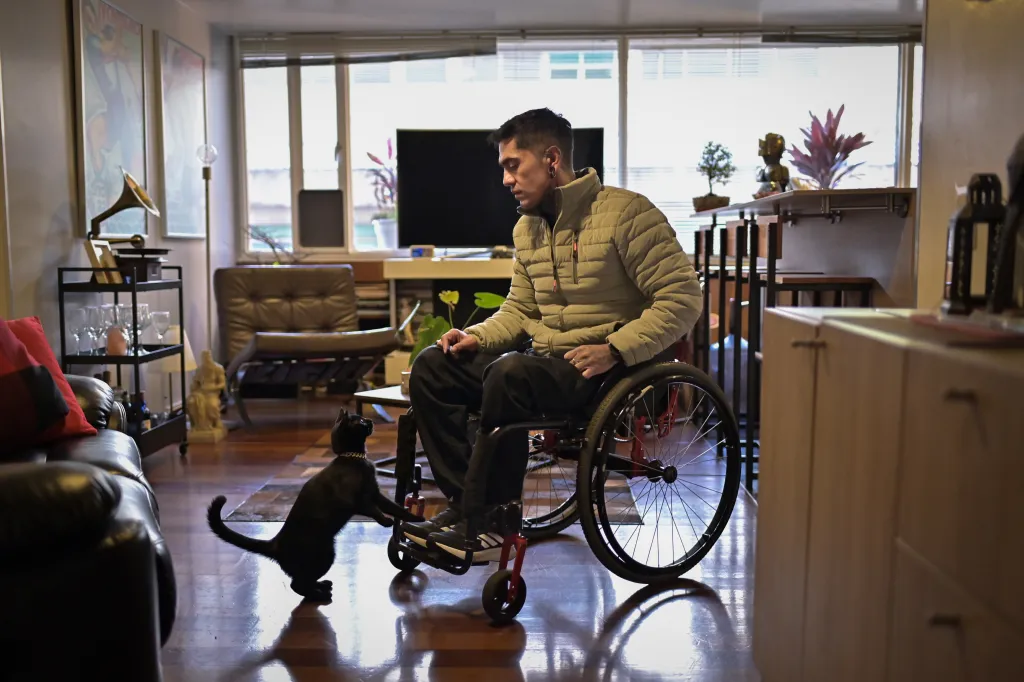
Juan José Cufiño Rodriguez was at Pulse celebrating one of his last nights in the United States. He’d been traveling around the country for three months, with his final weeks in Florida, and was slated to return soon to his home in Colombia. At the nightclub, he danced with friends and a new boyfriend, Jean Carlos Nieves Rodriguez.
Read more Asking Eric: Our car died, our neighbor helped, and now he won’t talk to us
Then gunshots rang out in the nearly pitch black nightclub, he said, the only flashes of light coming from the shooter’s gun every time he fired. One bullet hit Cufiño Rodriguez’s hand. Another his knee. Another his leg. The last strike to the former physical education teacher changed his life forever, hitting in the middle of his spine.
He spent about 100 days at Orlando Regional Medical Center, the longest hospitalization of any of the injured Pulse survivors. He was in a medically induced coma for months, he said, and woke to a difficult new life. He learned that Nieves Rodriguez perished in the massacre.
“I’ve tried to erase all those memories,” Cufiño Rodriguez said in Spanish during an interview from his home in Bogota. “But it’s complicated because I can’t forget everything. Every time I look down, I’m in a wheelchair, and it’s unyielding.”
Ten years after the shooting, Cufiño Rodriguez, 40, is still dealing with the injuries. He takes medication for the chronic pain, but its side effects are difficult to manage.
“I feel like I’m groggy all the time on this medication,” Cufiño Rodriguez said. “It’s a very ugly feeling.”
He works as a cashier at a restaurant in Bogota. But he doesn’t earn enough to have continuous physical therapy, so he saves for months to pay for the intermittent treatment that he hopes one day will allow him to walk again.
“Life continues,” Cufiño Rodriguez said. “Just because I’m in a wheelchair does not mean that my bills will stop coming, so you just have to continue.”
Read more Miss Manners: They didn’t comment on my body, and I’m offended
Managing in a wheelchair is exponentially harder in Bogota than the U.S. he said, as the city is not made with people with disabilities in mind. He barely leaves his apartment, and when he does he spends most of his time trying to find ramps to get in and out of places or bathrooms big enough to fit his wheelchair.
His parents and 19-year-old son live nearby but he doesn’t rely on them for much help, he said, though they were by his side when he recovered in Orlando.
“I don’t want to be a burden on them,” Cufiño Rodriguez said.
One day he hopes to go back to the U.S. to establish a life in a country that is more accessible.
But visiting Pulse memorials will not be on his to-do list, as he tries to shield himself from any news related to the nightclub.
Still, he did learn the city of Orlando had demolished the shuttered building in March. It was the only option, he said.
“I’m happy they tore it down,” Cufiño Rodriguez said. “What could you have done with a building where there was such a terrible massacre?”
Read more Orlando Kidz Zone celebrates 20 years of community impact