
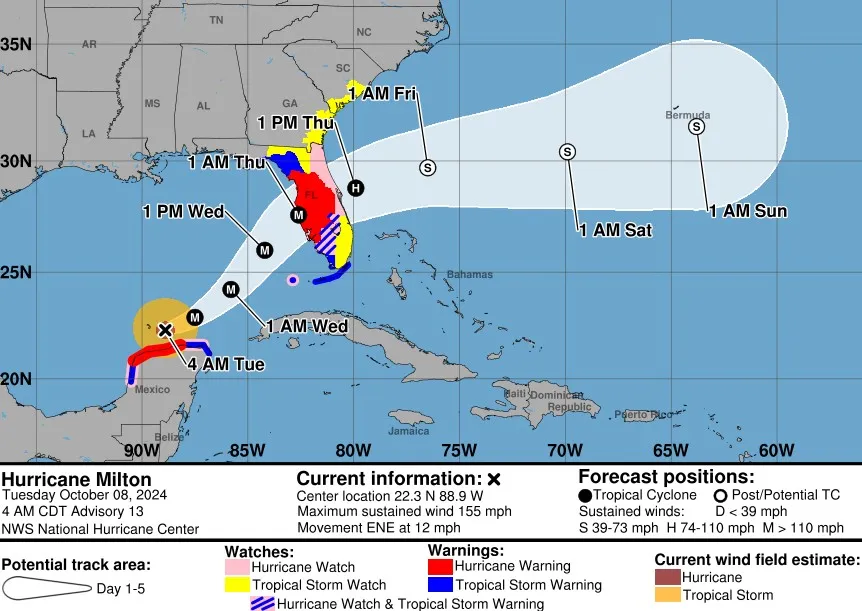
Michael Brennan, director of the National Hurricane Center, revealed the center’s new cone of uncertainty this week at the Governor’s Hurricane Conference in West Palm Beach, as well as an experimental cone that will be more definitive about storm tracks.
Read more Jane Healy, winner of Orlando Sentinel’s first Pulitzer Prize, dies at 77
The cone for the 2026 hurricane season will feature several new graphics elements, including colors that show inland impacts, such as inland tropical storm and hurricane wind watches.
For example, a map that once had red for hurricane-force winds on the coast will now show red as far inland as the NHC thinks hurricane winds will penetrate.
Brennan showed a slide of the new graphics for October 2024’s Hurricane Milton, which made landfall at Siesta Key on Florida’s west coast.
“Almost the entire Florida peninsula is under some type of tropical storm or hurricane watch or warning,” said Brennan. “It’s a great reminder of that inland wind risk that exists, especially in powerful hurricanes making landfall.”
The watches and warnings extended far outside the width of the cone.
The NHC will also change the color of declining systems that have no chance of developing into a tropical system from yellow to gray.
There also will be a new experimental cone this year that will be a tad wider and “easier to talk about,” said Brennan.
Read more Orlando Sentinel 150: Friday Flashback to fishing on Lake Apopka
Normally, the width of the cone means there’s a 67% chance of the center of a storm tracking within it, meaning there was still a 33% chance the storm would track outside the cone.
The experimental look will have a slightly wider cone and the storm will have a 90% chance of tracking within it. “The center of the storm is likely to stay inside of the cone nine times out of 10,” said Brennan. “The cones are visually similar in size, but there would now be less chance of the storm center moving outside the cone.”
How should the public think about being in the cone or out of the cone? “It really doesn’t matter,” said Brennan. “It’s all about, are you under some kind of watch or warning? Have your local officials asked you to evacuate or otherwise prepare?
“That’s what you really have to focus on because again, the cone is only showing you something about the track of the center. As we’ve seen in storms like Colleen and Milton, huge storms have impacts hundreds of miles away from the center.”
Despite making landfall on Florida’s west coast, Hurricane Milton in 2024 caused dozens of tornadoes to ravage the state’s east coast, 100 miles away.
Read more Asking Eric: I am stunned that my son’s family didn’t even open my gift
The start of hurricane season is approaching. It begins June 1 and ends Nov. 30.