
Want to visit places where American Patriots helped win the Revolutionary War?
In Florida, there aren’t any.
During the 1770s, most people in the areas that now comprise Florida backed the British.
Read more Federal agents at scene of ICE shooting in Houston didn’t have body cameras, DHS says
But as our nation celebrates its 250th birthday, you can see a few Revolutionary War sites in the Sunshine State, among them the stone fort that worried George Washington. And the creek where British loyalists pushed back Georgia Patriots and the site where English forces ultimately lost Florida to Spain.
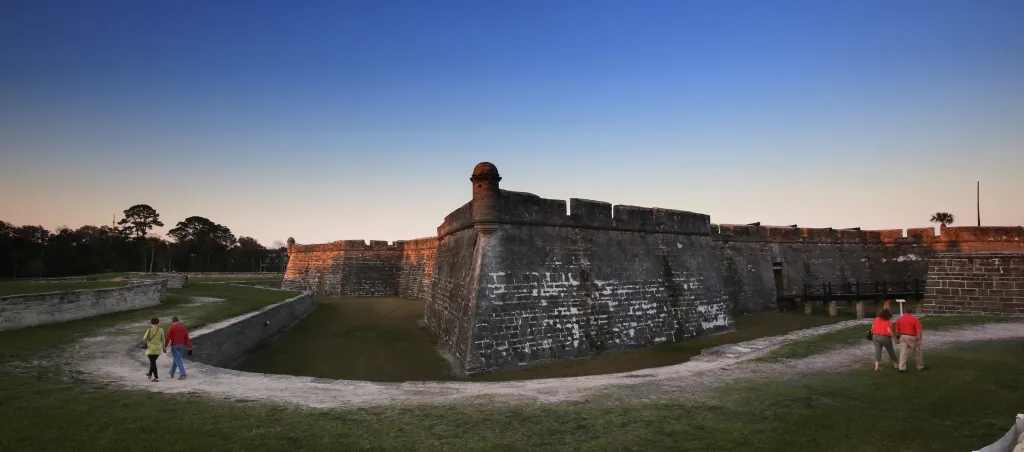
Castillo de San Marcos National Monument, St. Augustine
The oldest masonry fort in the continental United States sits not far from the Atlantic Ocean. Spanish forces completed the coquina stone fortress in 1695 on the site of an earlier wooden fortification. In 1763, when the Treaty of Paris gave Florida to Britain, St. Augustine became the capital of East Florida — a haven for British loyalists from other colonies.
The British renamed the fortress St. Mark. During the Revolutionary War, General Washington worried that British troops were stockpiling weapons and ammunition in the fort and preparing to attack northern colonies. British troops kept patriot prisoners in the fort.
A National Park Service monument, the fortress is open daily from 9 a.m. to 5 p.m. Visitors can walk along the diamond-shaped bastions, see the moat and view artifacts spanning more than four centuries. Admission is $15 for adults — but free July 3-5.
Governor’s House Cultural Center & Museum, St. Augustine
This 1598 building overlooks the downtown plaza and served as headquarters for Spanish and British leaders.
When news about the Declaration of Independence reached St. Augustine in August 1776, a mob spilled into the streets, burning effigies of John Hancock and Sam Adams.
Read more In Orlando, a quartet of music series to hit the right note
The University of Florida now owns the historic landmark, which is open to the public for free from 10 a.m. until 5 p.m. daily. To celebrate the nation’s 250th birthday, a new exhibit in the house traces East Florida’s role in the Revolutionary War.
Thomas Creek Battlefield, Jacksonville
On May 17, 1777, a group of British soldiers, loyalist militia and Native Americans ambushed Georgia Patriots near the mouth of Thomas Creek, near what is now the Jacksonville airport. They took more than 30 prisoners in what became the Revolutionary War’s southernmost battle and forced the Patriots to retreat.
Visitors to the Thomas Creek Preserve can hike the trails around the ambush site and learn more from interpretative signs. They also can picnic, fish and launch boats.
Fort George, Pensacola
Named for King George III, the fortress was built by the British in 1778 to protect West Florida from Spain. It was the biggest of three forts on Gage Hill and surrounded by a dry moat. On May 8, 1781, Spanish forces stormed the fort during the Siege of Pensacola and renamed it Fort San Miguel. It was a turning point in the American Revolution because the British were forced to divert attention away from battles in the northern colonies.
But Spanish troops never occupied the fort, and over the years, it deteriorated. For the U.S. bicentennial, archaeologists explored the fort and found a powder magazine and rooms that could have been latrines. Sections of the structure have been reconstructed, and visitors can take self-guided tours daily, any time, for free.
©2026 Tampa Bay Times. Visit tampabay.com. Distributed by Tribune Content Agency, LLC.
Read more Man charged with killing National Guard member is hospitalized after refusing food, prosecutors say