
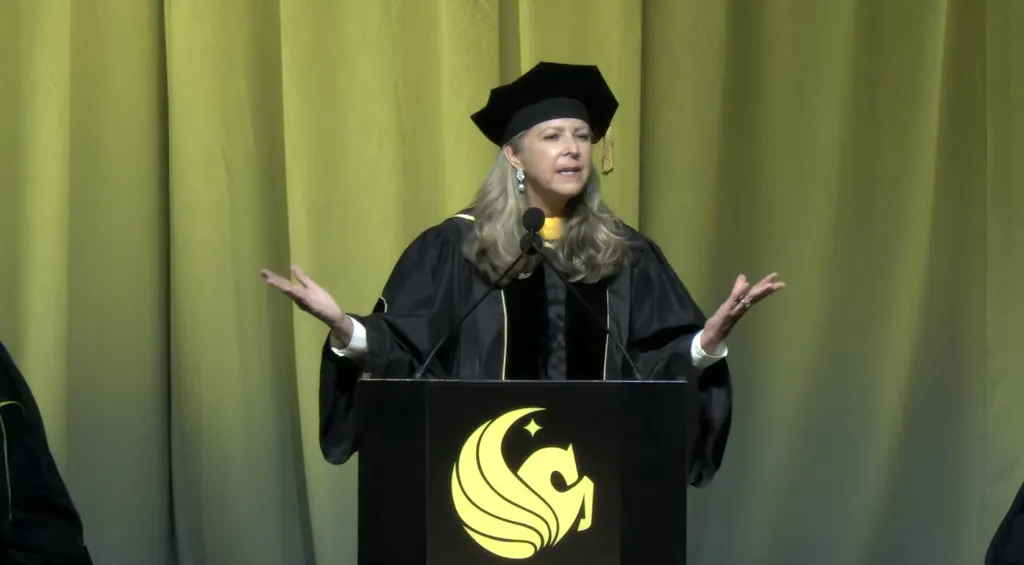
The atmosphere at the University of Central Florida’s recent commencement was charged, but not entirely with the celebratory spirit one might expect. As the speaker touched upon the inevitable rise of Artificial Intelligence, a wave of boos rippled through the graduating class. It was a visceral reaction to a topic that has become the “boogeyman” of the 21st century. While the speaker’s comments might have been perceived as tone-deaf to a group of students entering an uncertain job market, the reaction itself reveals a deeper, more complex tension between our fear of the future and our current dependencies.
Read more Orlando Fringe Festival reviews: Tea, wars, escaping and measuring up
To be clear, there is a valid reason for skepticism. We are witnessing a surge in corporate greed where AI is often treated as a “new God,” a silver bullet for cost-cutting. Many large corporations are aggressively seeking ways to replace human expertise with algorithms to save a dollar, a trend that is both short-sighted and detrimental to the social fabric. Investing in human talent should always be the priority. However, to focus solely on this negative ignores the transformative benefits AI has already delivered. It has created equitable opportunities for startups to compete with established industry leaders and has driven significant advancements in healthcare, logistics, and numerous other sectors that were once considered unattainable.
The irony of the commencement booing, however, lies in the common hypocrisy found within the student body. It is easy to boo AI on a stage when you are wearing a cap and gown, but it is much harder to reconcile that sentiment with the reality of the last four years. Many of those same students likely used AI to complete homework in minutes, write full essays in one-shot, or even navigate exams. There is a disconnect between hating the technology when it threatens our future and loving it when it simplifies our present.
This hypocrisy stems from a shift in how academia is perceived. As one of my students candidly admitted, “You are standing between me and my job. I need that piece of paper you provide, and I’m going to use every trick I can to get it, whether that’s using AI for assignments or outright cheating.” This “credentialist” mindset is dangerous. It reduces education to a transaction where the goal is a diploma rather than the mastery of skills.
As someone who has transitioned from industry to academia, I can tell you a hard truth: they don’t care about your piece of paper. In the professional world, the focus shifts entirely to results. Can you get the job done? Can you do it well? They don’t care if you use AI to assist you; in fact, if it makes you more efficient, they encourage it. But there is a significant catch.
If you spent your academic career using AI to “check the boxes” without adding any personal input, critical thinking, or unique perspective, you have effectively trained yourself to be redundant. If an AI did your homework, wrote your reports, and solved your problems without your intervention, then a manager has to ask: why do I need you? Why wouldn’t I just use the AI directly and save the salary?
Read more Letters: Trump doesn’t care | Leaders focused on wrong things | Political rebellion
This is where the distinction between using AI as a “slave” versus a “partner” becomes critical. We teach critical thinking and novelty because those are the human elements that AI cannot yet replicate. AI should be your brainstorming partner, an accelerator for your ideas, and a tool to amplify your creativity. It is not a replacement for the “you” in the equation.
The reality we must face is that AI is here to stay. To believe that we will suddenly stop using these advancements is a fool’s dream. The path forward is not through booing or resistance, but through adaptation. The curve of progress is steep, and many are already ahead of it. They are learning how to prompt, how to audit AI outputs, and how to integrate these tools into their workflows to produce superior results.
The greatest threat to your future job is not Artificial Intelligence itself. It is the person who knows how to use AI better than you do. Don’t boo the future, adapt to it. The “piece of paper” might get you through the door, but your ability to evolve alongside technology is what will keep you in the room.
JJ Jasser is a lecturer in computer science and director of the data analytics program at Rollins College.
Read more Commentary: Families deserve school choice. Reject union lawsuit | Jeb Bush