
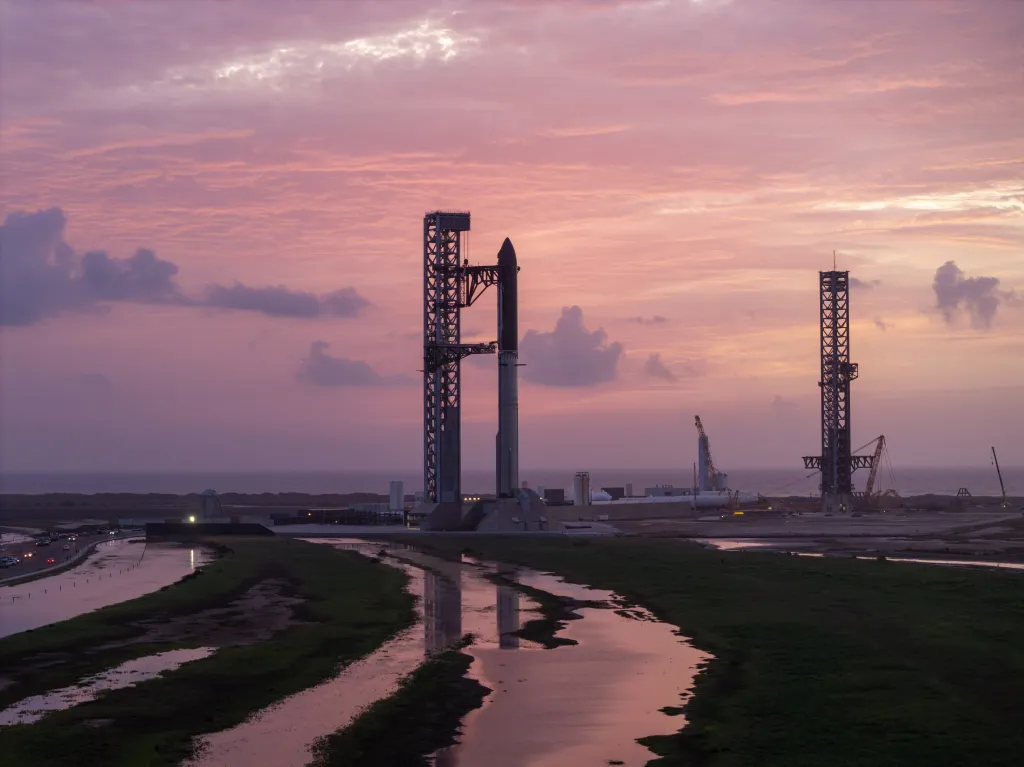
SpaceX is set for the 13th suborbital test flight of its Starship and Super Heavy rocket from Texas on Thursday as it drives toward its goal of beginning operational missions from Florida.
Read more Apopka commissioners can’t agree on tax rate as statewide tax vote looms
The massive rocket looks to launch during a 90-minute window that opens at 6:45 p.m. from the company’s Starbase site on the southeast Texas coast.
The flight plan looks to send the Starship upper stage more than halfway around the world to land with a controlled splashdown in the Indian Ocean off the coast of western Australia while the Super Heavy booster will try for a controlled landing in the Gulf shortly after liftoff and separation.
Watch Starship’s thirteenth flight test https://t.co/wYoNPiNMz8
— SpaceX (@SpaceX) July 16, 2026
The launch comes about two months since the 12th test flight that was the first time Elon Musk’s company flew Version 3 of the rocket. That mission suffered an uncontrolled landing of its booster in the Gulf that ultimately led to the rocket’s grounding by the Federal Aviation Administration.
The required mishap investigation that was led by SpaceX was accepted by the FAA, which announced Monday Starship was clear to fly again.
“There have been several modifications to hardware and software to address issues seen on the previous flight,” SpaceX stated on a mission update on its website.
Stacking Starship for Flight 13 pic.twitter.com/L4XN6gqgRt
— SpaceX (@SpaceX) July 16, 2026
The company said that on the 12th flight after the booster separation, the engine setup and flip maneuver caused it to be off by about 90 degrees, which led to its failure and ultimate crash into the Gulf. Five of its 33 Raptor engines had issues as they tried to relight and that caused a planned “boostback burn” to end early.
“The startup sequence has been modified to be more robust to timing variability and more reliably flip in the desired direction, which is done to increase overall performance,” SpaceX stated. “The Super Heavy on this upcoming flight has hardware modifications to improve re-light reliability along with updates to engine alarms and aborts to match the conditions seen in the multi-engine flight environment.”
While the booster failed to make a controlled return on Flight 12, the upper stage achieved its goals of getting to the landing site in the Indian Ocean, although minus one of the three Raptor vacuum engines, which was lost about 40 seconds after stage separation.
“The vehicle was able to demonstrate its engine out capability and reach its planned suborbital trajectory,” SpaceX stated. “Several hardware and operational modifications have been made to address the interconnected causes with additional reliability improvements planned in upcoming versions of the Raptor engine.”
Something new on this mission will be the deployment of real Starlink satellites during flight. Previous Starship test flights have tried out simulators deployed during the suborbital missions.
These large V3 satellites, which are too big for launches on SpaceX’s current Falcon 9 rockets, will have a test run during which they will attempt to extend their solar array and antennas, and connect to the existing Starlink satellite constellation using high-capacity lasers.
The Starlink satellites’ lives will be short-lived, though, as they follow the Starship upper stage after deployment for an eventual reentry into the Earth’s atmosphere to crash down over the Indian Ocean about 20 minutes after their deployment.
Six of the 20 satellites also have cameras on board to scan Starship’s heat shield, which continues to be modified for the rocket’s ultimate operational configuration.
Read more Winter Garden removes park sign banning guns after Uthmeier threatens city
Those flights are slated to take place in Florida where SpaceX continues to build out three Starship launch towers.
The first is at Kennedy Space Center’s Launch Complex 39-A while two more are in the works at Cape Canaveral Space Force Station’s Space Launch Complex 37.
The Space Force in late 2025 indicated it was prepared to support the first Starship launch on the Space Coast by mid 2026 while SpaceX has stated it would still try to launch before the end of the year.
SpaceX also is nearing completion of its Gigabay manufacturing site at KSC where it will build out future Starship upper stages and Super Heavy boosters, part of a $1.8 billion investment in Space Coast operations.
The first flights from KSC, though, will feature rockets shipped over from Texas until Florida’s Gigabay is up and running.
SpaceX ultimately is aiming for as many as 120 flights a year from across the three launch pads in Florida, a number that has raised criticism for its impact on commercial airspace. Also of concern has been its sonic boom potential during both booster landings and upper stage Starship return-to-launch-site flights that would bring it across Central Florida similar to how the space shuttle used to land back at KSC.
The rocket is the most powerful to ever launch to space with nearly 17 million pounds of thrust at liftoff, nearly doubling the power of NASA’s Space Launch System rocket.
Starship’s first test flight came in April 2023 and progress seemed to be on a good trajectory with the company managing to capture its first Super Heavy booster back at the launch tower using its swiveling “chopsticks” arms on its fifth-ever launch in October 2024.
Flights in early 2025, though, ended in a series of failures including two in which the Starship upper stage disintegrated in a fiery cascade of debris across the skies visible from Florida and the Caribbean.
It ended 2025, though, with two successful test flights using Version 2 of Starship followed by more than a seven-month lull before the first launch of Version 3 in May of this year.
NASA is eagerly awaiting operational Starship flights as a version of the rocket is tasked to become a moon lander as part of the Artemis program.
The Artemis III mission planned for mid 2027 is seeking to test out a crewed Orion spacecraft’s ability to dock with a pathfinder version of Starship as well as Blue Origin’s Blue Moon MK2 lander.
Blue Origin, though, has to get its Canaveral launch site rebuilt after a New Glenn rocket exploded on the pad during a test hot fire earlier this year.
Read more Close encounters: Kangaroos, wallabies meet the people of Animal Kingdom