
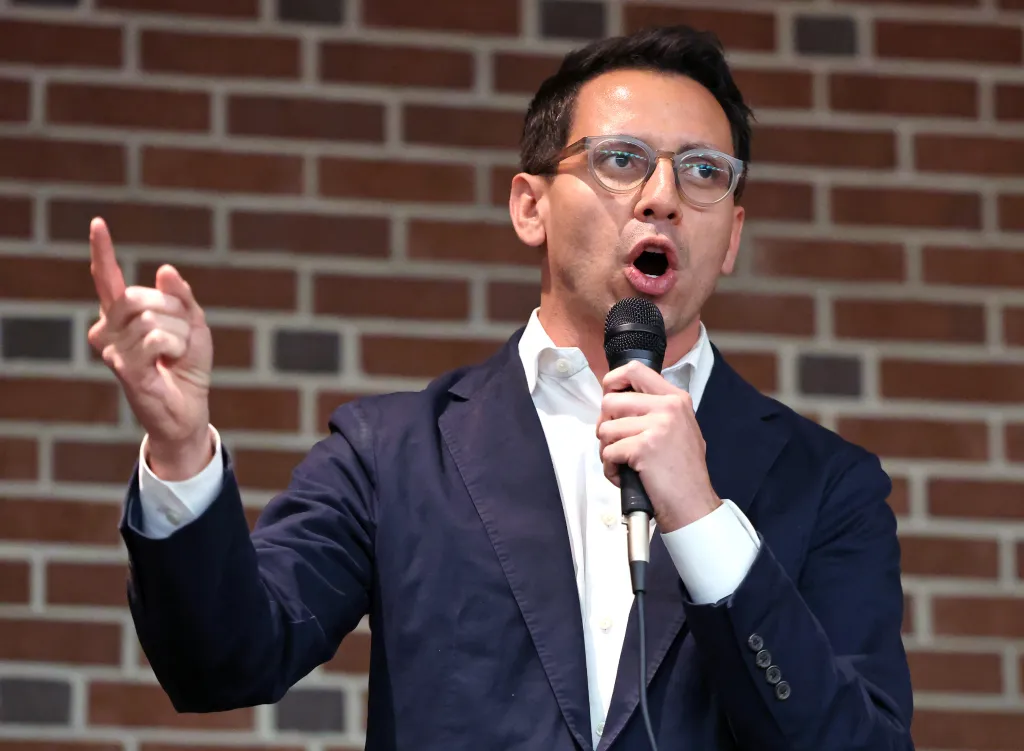
TALLAHASSEE — Fighting a lawsuit challenging his qualifications to be on the August primary ballot, GOP gubernatorial contender James Fishback admitted in court Tuesday that he voted in the 2020 presidential election in Washington D.C. and had a homestead exemption on a condominium he owns there.
Read more Man stabs Orlando Uber driver in disagreement over directions, police say
But he insisted he was never a resident of the nation’s capital.
The admissions were a stunning reversal from his comments to the Orlando Sentinel in April when he denied he ever registered to vote in D.C, even suggesting that voter records from that city showing he did must have been for a different James T. Fishback, his father, whose name is Jay T. Fishback, or possibly a forgery.
Now, Fishback is fighting a lawsuit filed in June by Lt. Gov. Jay Collins, who is also running for the GOP nomination for Florida governor, that argues he fails to meet the state’s residency requirement because he lived and voted in D.C.
Gubernatorial candidates in Florida must be residents and registered voters of the state for the preceding seven years. The records the Sentinel obtained in the spring suggest Fishback has resided here for no more than the last four.
Collins did not appear in Leon County Circuit Court on Tuesday, though Fishback did.
In early 2020, Fishback said he was back from an overseas trip, visiting his parents in D.C. when the COVID-19 pandemic was announced along with travel restrictions, lockdowns and mask mandates. He could not get back to Florida in time to vote.
So he went to a voting place in D.C., he testified, showed a precinct worker his Florida driver’s license and asked if he could vote in the national election. She handed him a tablet with a form to sign, and let him vote, he said.
“I voted for Trump in 2020,” Fishback said.
“I didn’t think I was registering,” he told a reporter after the hearing. “I just said, ‘Hey, I want to cast a national ballot’.”
During an all-day hearing, Collins’ lawyers presented public records and expert testimony showing that Fishback listed D.C. as his residence on three years of income tax returns for 2019, 2020 and 2021, registered to vote in D.C. in 2020, and signed a mortgage for a DC condominium apartment in 2021 and got a tax exemption for it. All of that makes him ineligible for the Aug. 18 ballot, they said.
“I think we made our case,” said Nicholas J. Boerke, one of Collins’ lawyers.
But Fishback said the same, after he and his attorney detailed his long ties to the state where he grew up and now lives.
“There is no question in my mind we won this case,” Fishback told a group of reporters after the hearing was adjourned.
A judge is expected to issue a ruling Monday.
Collins’ lawsuit was filed months after several published reports, including the Sentinel’s, raised doubts about Fishback’s residency.
Fishback, the provocative candidate with a penchant for slinging racial and anti-Semitic slurs that appeals to certain Gen Z crowds, trails Collins, who is running second behind Congressman Byron Donalds of Naples in recent polls.
The Sentinel reported in April it had uncovered records showing Fishback registered to vote in D.C. and voted in the 2020 election there, the only year he did not vote in Florida. Records obtained by the Sentinel also showed he bought a condominium in D.C., had a homestead exemption for it and that he claimed D.C. on his income tax returns for three years starting in 2019.
Responding to the Sentinel’s April reporting, Fishback said those records were incorrect and denied ever voting in the city.
But Tuesday, he admitted both that he voted and made mistakes on his mortgage application and said he would accept the consequences.
“I hadn’t seen any of these documents until they filed this case on June 28,” Fishback said. “So any prior conversation we had I was working under the memory for six years ago.”
Former state Rep. Anthony Sabatini, Fishback’s attorney, presented testimony from Fishback and others about his ties to Florida, how he took care of his ailing grandmother, and about the years he spent establishing and building up a nonprofit debating club exclusively in Florida.
Sabatini, who was rebuked by a federal appeals court July 10 for filing a brief with AI-generated hallucinated case law citations, said the court should consider all that evidence “not a single act.”
But Boerke, arguing Collins’ case, said a person’s intent doesn’t establish residency.
“A person can say after the fact what their intent was,” he said, “but it’s the documents — voting records, mortgage documents, homestead exemptions, all that contemporaneous evidence.”
Fishback also admitted in court that he signed mortgage documents inaccurately stating he intended to make the D.C. condo his primary residence.
“I incorrectly signed those seven years ago,” he said, adding he would accept the consequences. “You’ve got to tell the truth whatever the verdict is going to be from Judge Frank.”
Boerke said he was “a little surprised” by that admission of fraud but said Fishback might have calculated that it would be a better outcome for him if he admitted what he’d been denying to the media leading up to trial.
“When he saw all this evidence he finally realized he had to tell the truth,” Boerke said.