
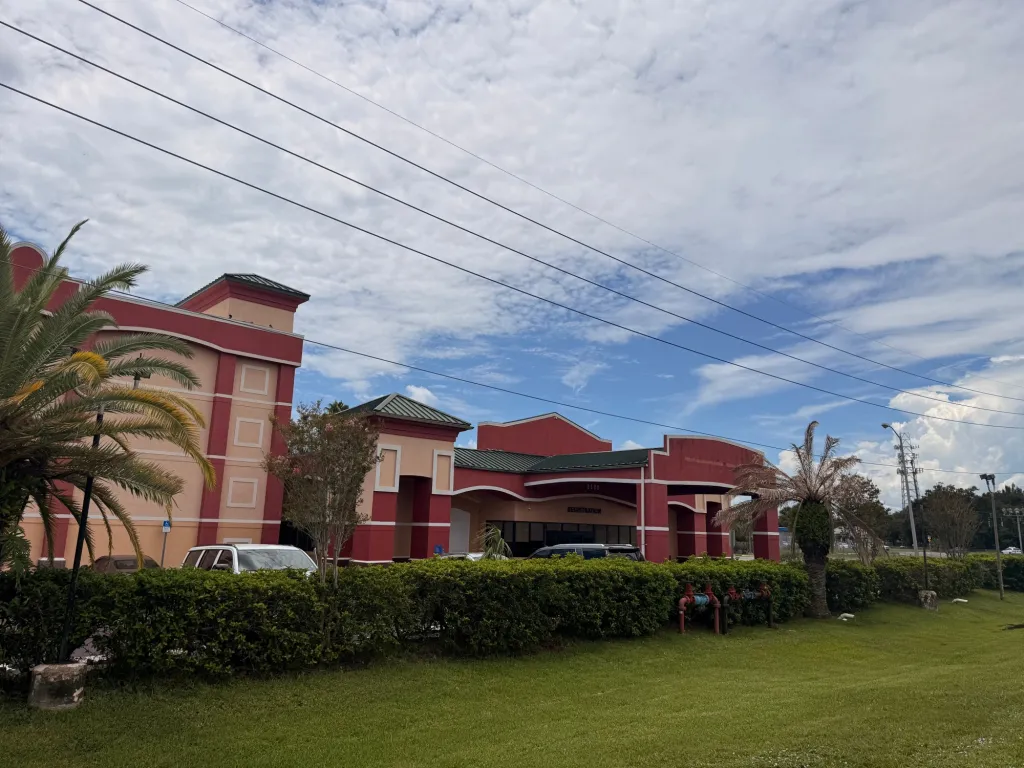
Orange County Commissioners voted to spend $13 million for a recently renovated hotel next door to the jail, with indications it could become their latest effort to find more housing for the homeless.
Read more ABC fights back against FCC regulators in dispute over ‘The View’ and equal time rules
Without publicly acknowledging its intentions, the county last month agreed to a contract to acquire the 3.82-acre hospitality parcel, located at 2500 33rd St., in a direct sale transaction, according to a report in GrowthSpotter. The property currently operates as the Baymont by Wyndham Orlando North Millenia.
Orange County Mayor Jerry Demings told an Orlando Sentinel reporter Tuesday the 200-room hotel could be repurposed into transitional housing for the homeless.
“People transitioning from homelessness to self-sufficiency, they need a place to stay sometimes,” he said.
Demings said it’s also possible the building could be used for offices.
Like municipalities across Florida, Orange County has struggled to find more shelter for its homeless population under pressure from a 2024 state law barring cities and counties from allowing camping in public places.
The hotel was formerly Developer Inn. Built in 1973, two years after Walt Disney World opened, it was originally a flagship Days Inn, intended to catch the sudden influx of budget-conscious driving tourists.
The transaction was executed on June 3 between the county and the holding entities, American Management & Consulting Co. LLC, which held the title to the land, and Developer Inn Downtown Orlando LLC, which owned recent structural improvements.
The property had been previously listed on the commercial market by Sarhan Hotel Group with an asking price of $11.9 million, but that the brokerage team was not a party to the final county contract. William Betancourt, a senior associate with Sarhan Hotel Group, did not respond to emailed questions.
That makes the final purchase price $1.1 million higher than the property’s public commercial listing asking price.
Orange County Commissioners approved the expenditure on June 4 with no discussion. The only background document was a Request for Funds by the Real Estate Management Division, with the budget allocation to come from the Community and Family Services Department.
The 97,794-square-foot, four-story property contains 200 rooms operating under the Baymont by Wyndham flag. Amenities include an outdoor swimming pool, a breakfast buffet and dining room, a business center, and a fitness center.
County administrative officials also declined requests for an interview; however, Senior Public Information Officer Ezzy Castro Nemzin confirmed the transaction in an email.
Read more Commentary: Hispanic community deserves access to lifesaving information
“This is a strategically advantageous purchase for Orange County due to its location and proximity to other County facilities and there are a couple of options at this point for the property,” Nemzin wrote.
The hotel sits adjacent to the Orange County Corrections Department campus and across from the county’s Public Works Division. If the county chooses to steer the asset toward a housing use, recent regional and national models provide a clear blueprint.
The property could be converted into an emergency shelter, a model that keeps unhoused residents off the street during the day by providing round-the-clock on-site services. Baltimore used this strategy in an $18.4 million acquisition of a downtown Holiday Inn Express and a neighboring Sleep Inn & Suites to create permanent, 24-hour shelter hubs three blocks from its high-volume central jail booking complex.
Orange County had planned to convert a work release facility in Orlando’s SoDo neighborhood into a 300-bed, low-barrier homeless shelter in 2024, but scuttled the plan due to fierce neighborhood opposition.
Similar hospitality assets are used nationally as pre-trial diversion centers to house non-violent individuals awaiting court dates, removing them from high-cost jail beds into structured behavioral monitoring programs. Harris County, Texas, pioneered this model with a centralized diversion facility that has minimized repeat local misdemeanor bookings.
Further, local governments frequently acquire hotels to establish integrated housing hubs, an adaptive reuse model deployed by the City of Kissimmee and Osceola County in 2023. The municipal partnership pooled $12 million to purchase a former Super 8 Motel on W. Vine Street, rebranding the 123-unit hospitality asset as the Haven on Vine. Utilizing federal American Rescue Plan funding, the site operates as a 24/7 care network that blends 40 emergency shelter and bridge housing rooms, 40 converted studio apartments for permanent affordable housing, and 40 adjacent two-bedroom apartments reserved for residents earning 80% or less of the area’s median income.
Before Orange County can pursue any of the potential reuse strategies for the Baymont by Wyndham Orlando North Millenia, the deal must be finalized. The purchase contract provides a 90-day due diligence window, giving county officials until early September to clear any hurdles before closing on the $13 million purchase.
Orlando Sentinel staff writer Stephen Hudak contributed to this report.
Have a tip about Central Florida development? Contact me at [email protected] or (407) 420-5246. Follow GrowthSpotter on Facebook and LinkedIn.
Read more Heat advisory for several Central Florida counties beginning at 11a