
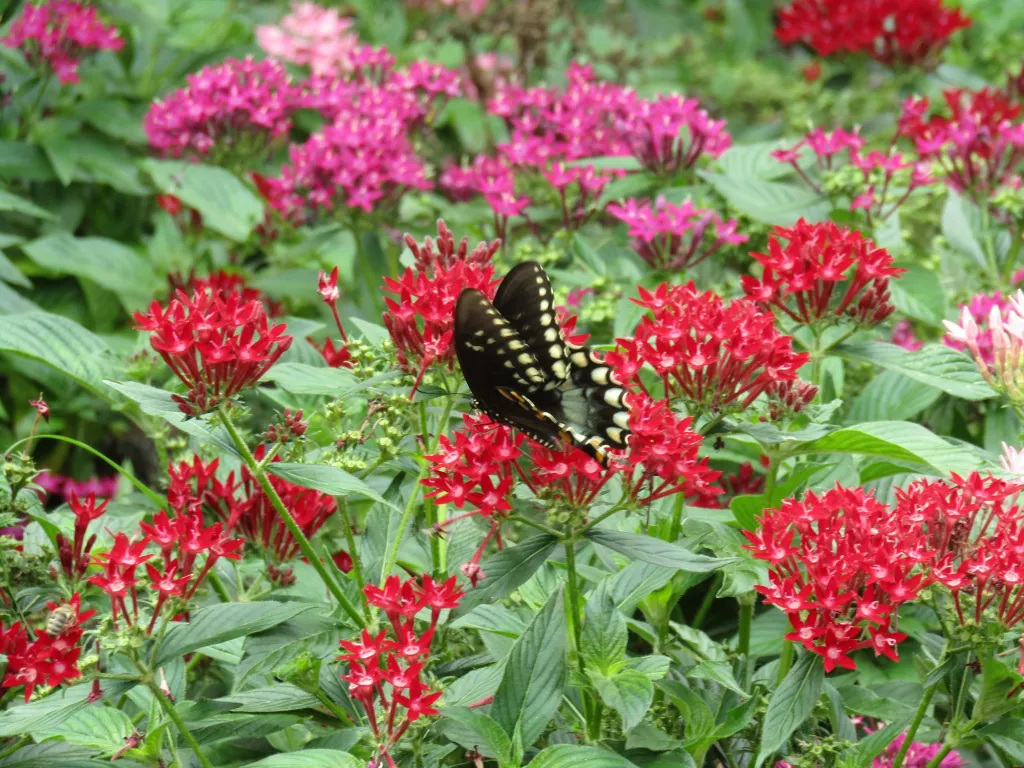
Q: A few butterflies are visiting our flowers. What can we plant to attract more?
Read more Today in History: July 11, train bombing in Mumbai kills more than 200
A: Usually colorful flowers can invite butterflies to visit. Of all of these, my favorite has to be the red pentas. Butterflies and hummingbirds love to visit the clusters of individual blossoms. But in your landscape also include bush daisy, coreopsis, firespike, gaillardia, lantana, marigolds, porterweed, salvia and zinnias. Locate these in sunny areas, either in containers or in ground beds. These should invite butterflies to visit summer through fall.
Plant Doctor: Celebrate America’s 250th with blooms in a patriotic container garden
Q: A small portion of our 15-year-old bottlebrush has some dead foliage. Is this a fungus and should it be pruned from the tree?
A: Most likely you’ve made a good diagnosis. As plants of all types age they become more susceptible to cracks in their bark that allow fungal organisms to enter and cause decline. An email photo showed the declining limbs in what appears to be shade from a nearby tree and the bottlebrush. These lower limbs would be most susceptible to decline and fungal activity. Now would be the time to trim the limbs with declining leaves back to healthy portions of limbs or trunks. You might also apply a copper fungicide, following label instructions, after pruning is completed.
Q: Last week our coontie was beautiful and now it appears to be on its last legs. The one next to it is beginning to have the same symptoms. Any thoughts?
A: Either moisture or insect problems are likely causing your coontie to decline. Your email picture only showed the tops of brown among green leaves. Part the leaves and look for insects down among the stems and near the ground. Scale insects and white mealybugs often feed in these plants. If present apply a horticultural oil spray to coat the insects. Also look for moisture extremes as the cause for decline. Dig down in the ground at the base of the plants. If dry you know the problem, and water to rewet the soil should help the plants recover. If for some reason the plants are staying too wet, the roots and lower stems may be rotting. Reduce irrigation to only once or twice a week to wet the soil to help control this problem.
Are you a Central Florida gardener? Here’s your to-do list for July
Q: My ponytail is a goner and is located in front of the house as the main attraction. I want to try something new, although cost is of primary consideration. Your suggestions would be of great value.
A: Remove the affected ponytail and search for a lower cost shrub or small tree. Some communities and counties offer a free plant or two to their residents. Call your local University of Florida Extension office to find out what is available in your area. My suggestions for low-cost replacements are crape myrtles, small-growing magnolias and treeform ligustrums or pineapple guavas. The smaller the plants the less cost. They all grow fairly rapidly.
Read more Commentary: The problem with building a bridge between church and state
Q: We have a number of tropical plants like dracaena, dieffenbachia and dwarf schefflera. Can I make cuttings at this time?
A: Summer is an excellent time to make cuttings that root quickly and begin new growth. The parent plants from which the cuttings were taken should rapidly heal wounds, and make lots of new grow to reform often more compact plants. Make tip cuttings 6 to 8 inches long and use a rooting powder dusted on the cut ends. Stick the cuttings so the ends are about 3 inches deep in containers of potting soil or coarse vermiculite. Keep moist in a shady location. Surround the containers of cuttings with clear plastic, which provides high humidity to prevent wilting and speed rooting. Most should root and be ready to continue growth in about eight to 12 weeks.
Q: We have noticed crape myrtles are full of blooms this year, whether or not they have been pruned. Could this have been the effect of the cold spell in February?
A: A period of very cold weather does appear to have been good for the crape myrtles. After all, the ones growing locally are not tropical plants but selections of a species found up the coast into Maryland and slightly north of there. It is reasonable to think the February cold helped mature the flower buds that have resulted in recent glorious displays. When given good care, crape myrtles are very attractive during the summer. But this year the shrub and tree forms, pruned and unpruned, are full of colorful clusters of blooms.
Q: Some of our shrubs are filling with vines that are hard to remove. How do I remove them from the plants without causing harm to the shrubs?
A: Weedy vines are the scourge of many shrub plantings, covering them with unwanted foliage that causes their decline. Regretfully there is no easy control. The sooner you deal with the vines the better to prevent them from expanding and filling the planting.
One not so easy, but effective control, is to dig or pull the vines out by the roots. Some break off and restart again from the in-ground portion, making this a continual job. A more effective, but time consuming control, is to cut the vine off at the ground line and wait for new growth. When new shoots are noted, treat them with a brush killer found at local garden centers. Follow the label carefully so not to affect the desired shrubs. Some brush control products also have instructions for treating cut ends of vines to cause their decline.
Tom MacCubbin is an urban horticulturist emeritus with the University of Florida Cooperative Extension Service. Write him: Orlando Sentinel, P.O. Box 2833, Orlando, FL. 32802. Email: [email protected].
Read more Commentary: How technology helped deliver justice for Madeline Soto