
By JON GAMBRELL and WILL WEISSERT
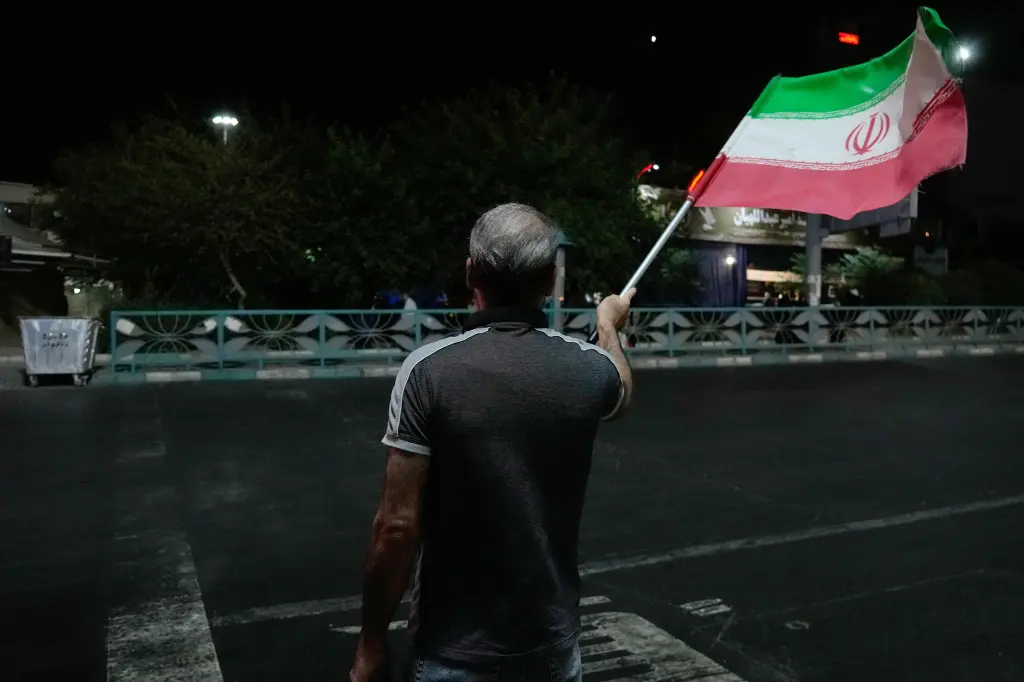
DUBAI, United Arab Emirates (AP) — The United States attacked Iran early Sunday over an Iranian strike on a container ship in the Strait of Hormuz that set it ablaze and left a crew member missing. Iran responded with attacks on countries including Bahrain, Kuwait, Qatar, Jordan and Oman — the nation on the other side of the strait that Tehran has pressed to join in managing traffic there.
Read more Iran reports new attacks on military targets on Qeshm island near the Strait of Hormuz
Later Sunday, Iran’s state-run IRNA news agency cited the governor of Qeshm island, located near the strait, as saying under a dozen projectiles had been fired at military targets there, with no casualties. There was no immediate U.S. military comment. The largest island in the Persian Gulf is home to about 150,000 people.
IRNA said explosions were also heard in the coastal city of Bandar Abbas and inland, in Hajiabad, a city to the north.
The exchanges came as Iran and the U.S. are nearly at the midway point of the 60-day period of their interim deal aimed at reaching a permanent end to the war.
The strait, a key route for the global supply of oil and natural gas and long considered an international waterway, has become the key sticking point in negotiations that seem in danger of collapse.
The United Nations secretary-general, António Guterres, was “deeply concerned by the serious escalation,” according to a statement.
Iran says the strait is closed and the US disagrees
The U.S. military’s Central Command said earlier Sunday that it hit some 140 targets, including missile and drone launch sites, ammunition dumps, communication equipment and other sites. It said the attacks, heavier than in recent days, would weaken Iran’s ability to threaten shipping.
“We bombed the hell out of them last night,” President Donald Trump told NBC’s “Meet the Press.”
Semiofficial Iranian news agencies reported that a navy officer was killed. Iran retaliated by attacking nations in the region hosting U.S. military forces, while insisting it alone must control the strait and potentially charge vessels for traveling through it.
“The era of one-sided deals is OVER,” Mohammad Bagher Qalibaf, the speaker of Iran’s parliament and a main negotiator, wrote. “We told you: keep your word or pay the price. Reality is knocking.”
The U.S. has launched three rounds of airstrikes targeting Iran in the last week over Iranian attacks on ships heading through the strait using a route off Oman, seeking to avoid the Islamic Republic’s territorial waters.
The U.S. military and Trump asserted that the strait remained open Sunday. Iran said it was closed until calm is restored, and Tehran would consider targeting “additional enemy bases in the region” if it faced more attacks.
The U.S. military said over 140 ships had transited the strait over the past week. A multinational body overseen by the U.S. Navy said traffic continued “at reduced levels” off both Oman and Iran. It said nearly 140 vessels transited daily before the war.
About a fifth of all traded oil and natural gas passed through the strait before the war began. Iran’s grip on it led to a global energy crisis, though oil prices have sharply dropped since wartime highs of $120 a barrel.
Oman summons Iranian envoy to protest attack
Missile alerts sounded across several Gulf Arab countries.
Qatar’s military said it intercepted incoming Iranian fire, with explosions heard in the neighboring United Arab Emirates. Three people, including a child, were wounded as a result of shrapnel from the interception of Iranian attacks, Qatar’s Interior Ministry said, giving no further details on their condition.
Missile alerts sounded in Bahrain, an island kingdom in the Persian Gulf home to the U.S. Navy’s 5th Fleet.
Read more An IRA playbook to build wealth
Kuwait’s Defense Ministry said three “land border posts” in the north and an offshore drilling platform of the Kuwait Oil Company were damaged, with one platform worker wounded.
A day after Oman and Iran held talks on the strait, the Omani state news agency said drones struck sites in an area on the waterway.
Oman summoned the Iranian ambassador to protest the strikes, the first such move since the war began, calling Iran’s acts “irresponsible.”
Three Iranian missiles struck areas across Jordan, causing minor damage but no injuries, Jordan’s state news agency reported.
Sirens also sounded in the UAE, but the government said missiles did not cross into its territory.
Iranian strike on ship harms Indian crew
A Cyprus-flagged container ship was hit by Iran and suffered “significant engine room damage,” the U.S. Central Command said.
Oman’s maritime authority said it rescued 23 crew members but one was missing. India’s Ministry of External Affairs called him an Indian national and it was working with Oman to locate him.
The United Kingdom Maritime Trade Operations center, overseen by the British military, said the ship had been moving along Oman’s shoreline.
Iran’s paramilitary Revolutionary Guard said multiple vessels “disregarded our warnings” and ignored instructions to follow what it called an approved route. One “was struck by a warning shot and brought to a stop.”
Iranian state media later reported U.S. strikes across the country, including southern Iran in the province closest to the strait and military sites in a province near Tehran.
Attacks followed more diplomatic talks about the strait
The strait sits in Iran and Oman’s territorial waters. Oman on Saturday said it and Iran agreed to continue discussing the strait “at the technical and political levels.”
Trump suggested last week that the interim deal in the war was “over.” But mediators, including Pakistan, Qatar and Egypt, have continued efforts to reach an agreement. A regional official involved in mediation, speaking on condition of anonymity to discuss talks, said efforts to shore up the ceasefire continued Sunday. Pakistan said its foreign minister spoke by phone with Iran’s top diplomat and urged “de-escalation” on both sides.
Iran’s new supreme leader, unseen since the war began, on Saturday vowed in his first statement since the funeral of his father, Ayatollah Ali Khamenei, that Iranians would avenge his killing in the war’s opening strikes on Feb. 28.
Such revenge “is the will of our nation and must certainly be carried out,” Supreme Leader Ayatollah Mojtaba Khamenei said in a statement carried on state television.
___
Weissert reported from Washington. Associated Press writers Samy Magdy in Cairo; Melanie Lidman in Tel Aviv, Israel; Munir Ahmed in Islamabad and Meg Kinnard in Columbia, South Carolina, contributed to this report.
Read more These church members disagree on politics. Together they’re wiping out medical debt