
When Osceola County created the master plan for its East of Lake Toho mixed-use district 16 years ago, the county designated 275 acres for public school sites. But now, as the thousands of acres of ranch lands are being transformed into new subdivisions, the county and school district are facing a critical shortage of classroom space.
Read more Maxwell: Common sense finally prevailed on convention center, hotel taxes
The School District of Osceola County hasn’t secured a public school site in Bella Tara or Whaley Platt, two side-by-side master-planned communities on Kissimmee Park Road approved for over 4,500 homes. The district is in litigation with the developer of Bella Tara and could be headed toward a second lawsuit with Metro Development Group, the owner and developer of Whaley Platt, according to a report in GrowthSpotter.
The SDOC missed the chance to lock down 20 acres on Kissimmee Park Road in Bella Tara for a K-8 school in 2024 when the school board failed to execute the purchase agreement because of a price difference that equated to 1% of the total land cost. The developer, Centerline Capital, offered the school site for $12 million, but the SDOC’s appraisal came in at $11.7 million.
In February 2024, Centerline dropped its price to $11.85 million, which included a $2 million cash payment upfront, but Osceola’s School Board voted 2-2 to reject the deal. The cash payment was the sticking point for Board Members Julius Melendez and John Arguello. At the time, the school board had a vacancy, but by the time Gov. Ron DeSantis appointed a new member, the inspection period in the contract had expired. The newly-elected board approved the purchase in December 2024, but Centerline said the contract was no longer valid.
The developer sued the school district, arguing that it was no longer obligated to provide a school site, and won the case without ever going to trial. On March 26, Circuit Judge Christy Collins granted a motion for summary judgment, stating that the developer could satisfy its obligations to the district by paying school impact fees. In her order, Collins noted that the school board’s attorneys had warned the members that they would lose the school site if they didn’t approve the acquisition.
“The School Board members discussed alternative school sites and costs of busing students to existing schools,” she wrote. “The school board was aware of the ramifications of its failure to approve the purchase price.”
Her order also prohibited the school board from objecting to the issuance of building permits in Bella Tara.
The school district has appealed to the Sixth District Court of Appeals. But in the meantime, development is underway in Bella Tara and its first homebuilder, Toll Brothers, is already advertising new homes priced at $500,000 and up.
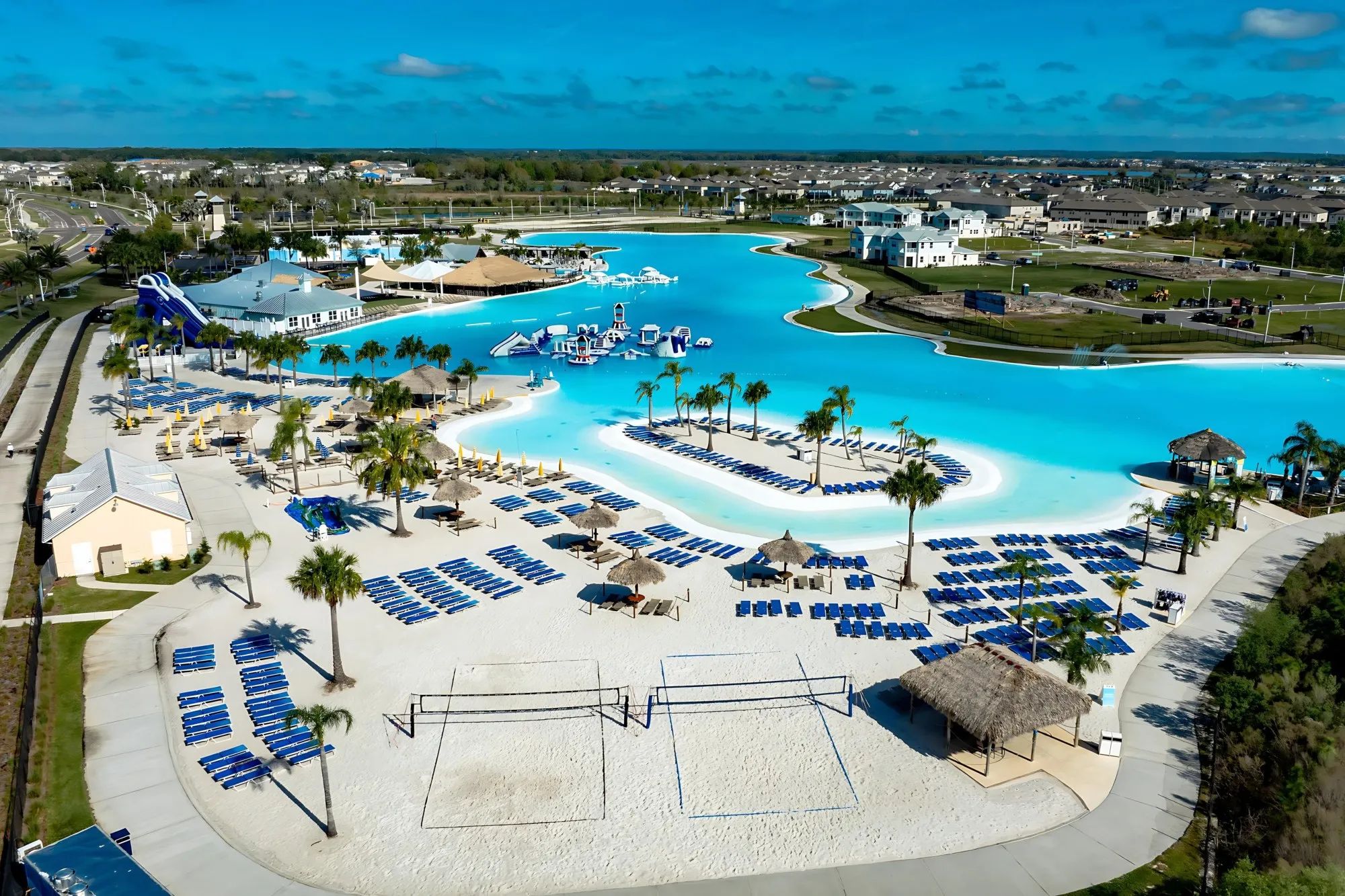
Fast-forward a few months, and the SDOC is facing a similarly vexing dilemma next door. Metro Development has filed construction plans for Phases 1 and 2 of Whaley Platt — now dubbed “Tranquility.” The much-anticipated community will be the first in the Orlando metro to feature a public-access Crystal Lagoon, the signature amenity that has made Metro one of the nation’s top developers.
The developer already had zoning and subdivision approvals with Osceola County when it sought annexation into the City of St. Cloud; those approvals included an 8-acre site for a K-8 charter school. The school district contends that during each step of the approval process with the county, it asked for an additional 20-acre site to build a district-operated public school, but the developer never set aside the land.
At some point, the school district’s request was changed from a condition of approval to an advisory note, which isn’t enforceable. School Board attorney Sarah Koren said that even though the district had approved the charter school, it never intended for that to be the only school in the community.
Until recently, only public school districts could use school impact fees to pay for new construction to increase capacity. Charter schools were built with private funding as a school choice option. But the Florida Legislature has reversed the policy, so charter schools can be built with impact fees and qualify for mitigation purposes. The Whaley Platt charter school would be the first in the region to be used for mitigation of new development.
“We are happy to have a charter school in that community. We are happy to approve a charter school on that 8-acre site,” Koren said. “However, we do not believe that charter school is sufficient for mitigation purposes, and the school district did not approve the charter school for mitigation purposes.”
They argue that if the charter school were to fail — and Osceola County does have a history of failed charter schools — the SDOC would be required to take over the school, and for them to do that the school must meet state standards for educational facilities.
Read more How UCF hopes to develop its quarterback of the future
On July 16, School Planning Director Rhonda Blake and several attorneys attended the St. Cloud City Council meeting to ask for a delay on the vote that would assign the city’s Mixed-Use land use and zoning for Whaley Platt. It was a Hail Mary attempt to force the developer back to the negotiating table, and to some degree, it worked.
The City Council agreed to postpone the votes until Aug. 6, giving the two sides three weeks to work out their differences. So far, the only solution that avoids a costly redesign of the project would be for Metro to sell the 20-acre community center site just north of the charter school to the district. But that would eliminate much-needed neighborhood retail and services and concentrate school-related traffic in a single area.
The other option would be for Metro and the charter school to use an “innovative alternative design” that can squeeze everything needed for a district-approved K-8 school onto the smaller site. That could require a multi-story building with a smaller footprint to accommodate the parking, recreational, and transportation uses.
Melissa Gross-Arnold, attorney for Metro, said the school district is misinterpreting the law. The statute requires charter schools to meet state standards, but it doesn’t require them to use the same amount of acreage as a district-operated school.
“And I want you all to know they want a public school in this community, and there’s one planned for this community,” she told council members. “Right now, it’s planned to be a charter school. That is a public school, and it doesn’t have to have 20 acres. It’s a more efficient use of land, some would say.”
Blake said the district already has schools or school sites in Kindred, Tohoqua, Crossprairie and Toho Trace. The last two school sites planned for the East of Lake Toho Mixed-Use District were supposed to be in Bella Tara and Whaley Platt, and if the district can’t purchase land in either community, those students will have to be bused to other schools.
“And that is something that’s going to be a burden to taxpayers. It’s going to be a burden to the community,” she said. “It’s going to be a burden to traffic. It’s going to be a burden to our students because, as you’re aware, there isn’t a lot of land around that area to just purchase 20 acres. So, we’re going to have to move these kids to another area to go to school, and that’s not what the goal is.”
On Aug. 6, the SDOC asked the St. Cloud council for another continuance, even though they had another meeting with the developer scheduled for Aug. 11. Mayor Chris Robertson was inclined to grant the request for another two weeks. “You know, I honestly believe the school district thought that the county and the developers were going to take their recommendations to heart and take care of the kids,” he said.
Robertson didn’t like the idea of parents in Tranquility not having a choice between sending their kids to a district school or a charter school, and pointed out that Osceola Schools, on the whole, outperform charter schools. “I’m not saying that this charter school is going to be detrimental to our schools. But if you’ve seen what happened with the gradings of our schools, the charter schools brought down our gradings,” he said. “We would have had A-rated schools in our entire district.… The Cs, the Ds, the Fs — they were the charter schools. They brought down our grade to a B.”
But after more than an hour of discussion, the council voted 3-2 to approve the land use and mixed-use zoning, allowing the development — with the charter school — to move ahead. Deputy Mayor Ken Gilbert and other council members said they resented being put in the middle of the dispute that could end up in another lawsuit.
“I’m going to tell you, if we push this and push it back, we do whatever we want, then we become a part of the litigation. I do not want the city to spend any money on this litigation,” he said.
Koren told GrowthSpotter the two sides had not resolved the matter prior to Tuesday’s meeting. “However, the district remains committed to engaging in good-faith discussions with the objective of securing an appropriate school site to mitigate capacity impacts associated with the development,” she continued. “The district’s intent is to provide students in the Whaley Platt development with the same high level of educational opportunities, support services, and resources afforded to all students throughout Osceola County.”
Have a tip about Central Florida development? Contact me at [email protected] or (407) 420-6261. Follow GrowthSpotter on Facebook and LinkedIn.
Read more Gators’ new center Harrison Moore, a former tight end, has ‘Jake Slaughter vibes’