
Floridians have reason to believe that ours is a government of, by and for the people — the people with the most money.
Read more Man charged with arranging fatal ambush of Microsoft manager faces murder trial in Florida
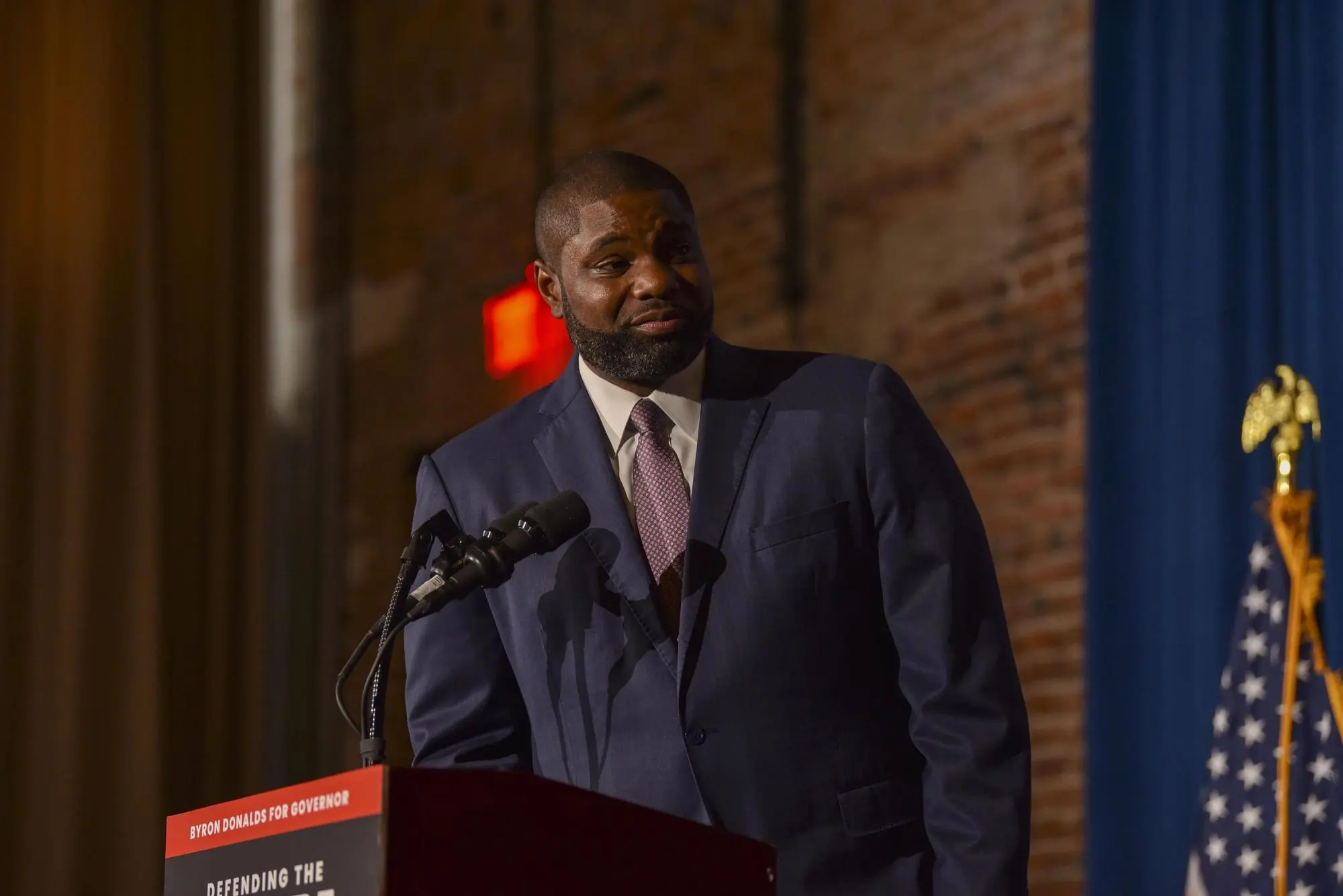
A political committee in California gave $1 million to Byron Donalds, a Republican candidate for governor.The gift, from an outfit called The People Versus the Powerful, was to Friends of Byron Donalds, a separate committee with no legal limits on what it can take or spend to elect him.
You would never know it from the name, but Donalds’ million-dollar benefactor is financed entirely by Airbnb, according to state records.
Investing in the status quo
What Airbnb surely has in mind is protecting the status quo in Florida, which bars cities and counties from regulating the short-term rentals that are a nuisance to many neighborhood associations and aggravate Florida’s housing shortage.
Gov. Ron DeSantis vetoed a hotly debated 2024 bill, opposed by many local officials, that they and the governor said would make the vacation rental pre-emption worse.
If Donalds is elected governor, how is your neighborhood association going to compete for attention with a million-dollar investment in him?
The truly powerful voices in Tallahassee are not the people, but the corporations that have millions of dollars to spend on politics and all sorts of motives to do it.
Friends in high places
Donalds is only one example, although he’s the leading one at this moment. Many other Florida politicians take advantage of the political committee loophole. So do special interests that curry their favor.
Hedge fund billionaire Ken Griffin, now living in Miami, gave $10 million to Friends of Byron Donalds. Jeff Yass and Richard Uihlein, two right-wing billionaires, gave him $7.5 million and $2 million, respectively. Donalds’ PAC got $2.5 million from Club for Growth Action Florida.
The Seminole Tribe, whose gambling interests depend on the state’s indulgence, invested $3 million in Donalds. There were $1 million contributions from Thomas Peterffy, a billionaire who’s close to President Trump, and casino mogul Steve Wynn. The private prison company GEO Group has given $1.5 million so far to Donalds. All are his “friends.”
Those were just the largest trophies in Donalds’ campaign cash, which has surpassed $93 million. NextEra Energy, parent of Florida Power & Light, was in for $1 million, Duke Energy for $500,000 and Tampa Electric for $275,000. Their profits depend on the utility regulators whom the governor appoints. So do their interest in what’s becoming Florida’s greatest controversy: data centers.
Read more Miss Manners: If I complain that my doctor is late, they try to make me look stupid
The Tampa Bay Times reports that the artificial intelligence industry has supplanted traditional influencers like Disney, Publix and Big Sugar in contributions, much of it to Donalds.
The Times cited more than $1.2 million from data centers to Donalds, including the folks behind a mega-complex theyr’e fighting to build in Palm Beach County. They’re in for $350,000. (The main campaign committee for Senate Republicans also received $100,000. from that group. Another backer of a Martin County data project chipped in $500,000.
Beholden to big money backers
The report said Donalds has hedged his support for data centers by introducing legislation to require them to source their water and electricity privately.
There’s only so much water in Florida, and all of it is regulated by the state.
Donalds’ official campaign account is a relatively miniscule $10.7 million, most of it in cash or services from the Republican Party.
One of the biggest frauds in Florida politics is the notion that the $3,000 donation limit to official campaigns means anything. Once upon a time, it did.
Florida is not unique.
The country has been on a figurative auction block since the Supreme Court first ruled in 1976 that mandatory spending limits were unconstitutional. While the court has not overturned laws limiting direct contributions to campaigns or prohibiting corporate gifts to them, it threw the doors wide open to so-called independent committees at the federal level. Florida politicians happily took advantage.
The late U.S. Supreme Court Justice Paul Stevens argued that it “is unwise to allow persons who are not qualified to vote — whether they be corporations or nonresident individuals — to have a potentially greater power to affect the outcome of elections than eligible voters have.”
Stevens proposed a simple amendment: “Neither the First Amendment nor any other provision of this Constitution shall be construed to prohibit the Congress or any state from imposing reasonable limits on the amount of money that candidates for public office, or their supporters, may spend in election campaigns.”
While Stevens’ warning goes unheeded, the 2026 election for governor could be the most expensive in state history.
The Orlando Sentinel Editorial Board includes Executive Editor Roger Simmons, Opinion Editor Krys Fluker and Viewpoints Editor Jay Reddick. The Sun Sentinel Editorial Board consists of Executive Editor Gretchen Day-Bryant, Editorial Page Editor Steve Bousquet, Deputy Editorial Page Editor Dan Sweeney and editorial writers Pat Beall and Martin Dyckman. Send letters to [email protected].
Read more ‘Don’t blame alligators’: Attacks spurred by risky behavior, drought, experts say