
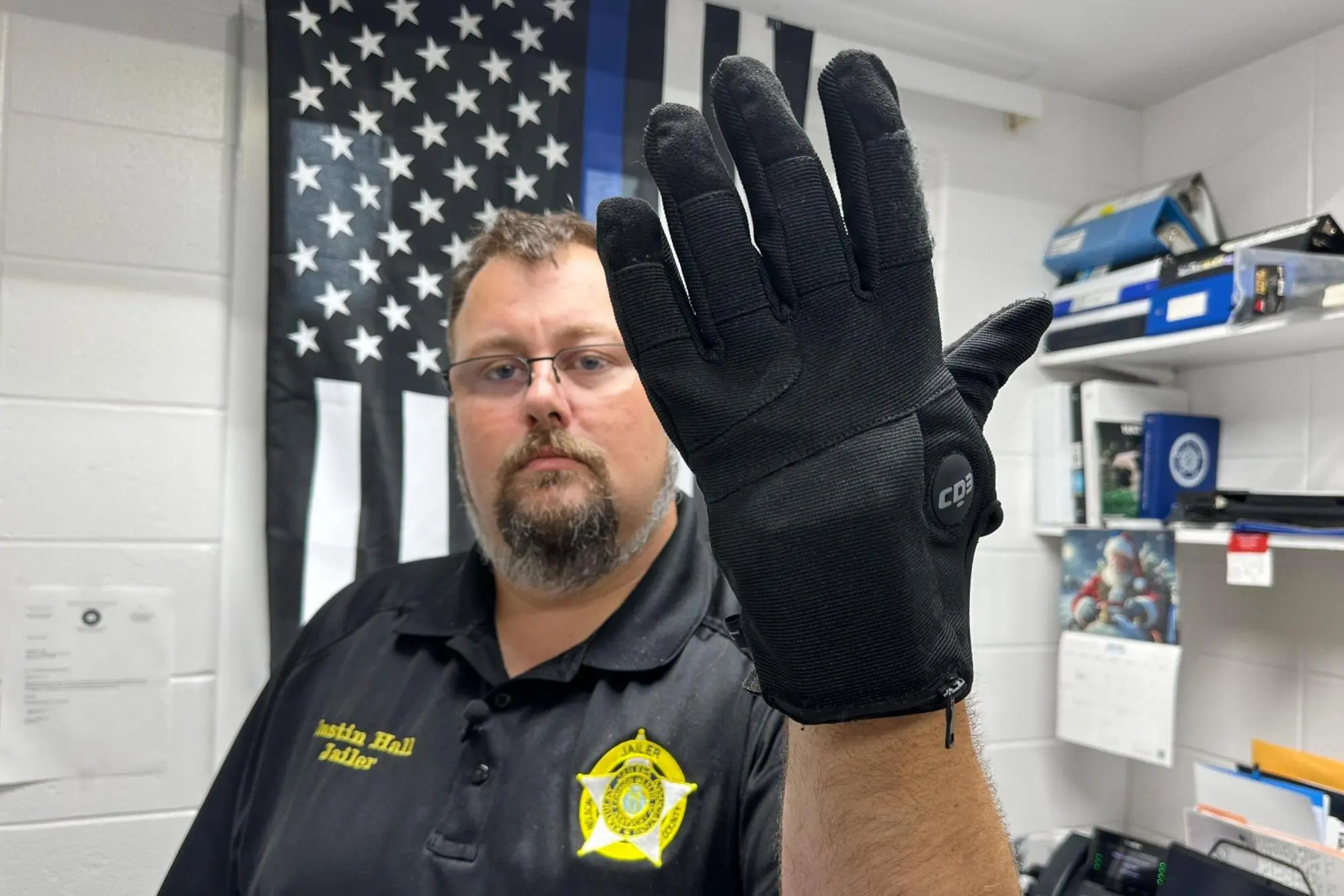
Picture this: an officer’s hand closes around your arm. It looks like an ordinary grip. Then, with the flick of a hidden switch, electricity tears through your body.
Read more Central Florida rain chances increase Sunday while heat index may pass 100
That is the pitch behind the “G.L.O.V.E.” — the Generated Low Output Voltage Emitter — a shock glove built by Compliant Technologies, a small company headquartered in Lexington, Kentucky, and led by CEO Jeff Niklaus, which markets it to police as an “invisible partner.”
According to a Department of Homeland Security notice, Immigration and Customs Enforcement wants to buy thousands of pairs, in a no-bid deal worth up to $20 million, with delivery expected by March. Neither DHS nor Niklaus will explain why.
We should ask why anyway, and we should ask loudly, because this purchase does not arrive in a vacuum. It arrives after a year in which ICE has made force, in the words of a sweeping ACLU investigation released last month, its “default tool.”
Reviewing more than 1,200 enforcement operations, ACLU researchers documented agents tackling, pinning and pushing people to the ground more than 400 times, deploying chemical irritants, rubber bullets and Tasers just as often, and using chokeholds and neck restraints that most American police departments banned years ago.
In one case, agents in Bowie, Maryland, smashed a father’s car window, dragged him out, and pinned him to the ground — while his 6-, 7-, and 8-year-old children watched from the back seat. His offense was showing up, as required, to an immigration check-in the day before.
So on whom, exactly, will ICE use this device designed to deliver pain invisibly? Not merely, it turns out, the “worst of the worst” the administration keeps invoking. As of late last year, nearly three-quarters of the more than 70,000 people held in ICE detention — itself a record — had no criminal conviction of any kind.
By ICE’s own count, only about 5% had been convicted of a violent crime. Arrests of immigrants with no record at all are up by roughly 2,450%. The people most likely to feel that “pain stimulus,” as the manufacturer calls it, are not hardened criminals. They are the father driving his kids to school, the worker on a job site, the asylum seeker who did exactly what the government told her to do.
Read more Asking Eric: Is it socially unacceptable to wear clothes with rips or scuffs?
And who is running this agency while it asks for new tools to inflict pain nobody can see? ICE has gone without a Senate-confirmed director since the Obama administration. It is currently led by an acting director, a former private-prison executive, while President Trump’s pick for the permanent job — a state trooper with no experience running a federal agency — awaits confirmation.
Oversight, in other words, is thin, even as the money pours in. ICE’s base budget for the coming year is about $11 billion, but reconciliation packages passed by Congress have handed the agency roughly $75 billion more to spend through 2029 — making it, alongside Customs and Border Protection, the best-funded law enforcement operation in the country, with more money at its disposal than the FBI, the DEA and the U.S. Marshals Service combined.
There is also a basic safety question nobody in this process seems to be answering: Electrical devices like this one carry real risk for anyone with a pacemaker or an implanted defibrillator, for whom an unexpected shock can trigger dangerous heart rhythm problems. ICE has no way of knowing, in the middle of a raid, who is carrying one of those devices — and by the manufacturer’s own design, the shock is meant to be delivered before anyone has a chance to say so.
History has taught us, at great cost, what it looks like when a state empowers agents to inflict harm on ordinary people quietly, with no one watching and no one accountable. We don’t have to reach for the most extreme comparisons to recognize the warning signs already in front of us — a growing paramilitary force, expanding budgets, waning oversight, and now a tool built specifically to hurt people without leaving a mark anyone can see.
The purchase isn’t final yet. Congress can still act. Call the Capitol Switchboard at (202) 224-3121 and tell your representatives to press DHS to drop the shock-glove deal, and to support the DHS Use of Force Oversight Act, which would require real limits on violent tactics, mandatory de-escalation training, and public reporting of every use-of-force incident.
Florida has one of the largest immigrant populations in the country. We will not have the luxury of watching this from a distance. The question isn’t whether we’ll be affected — it’s whether we’ll speak up before or after. No more silence. No more looking away.
Read more Editorial: Separating truth from fiction in property-tax amendment
Arlene Marcus is a resident of Fort Lauderdale.