
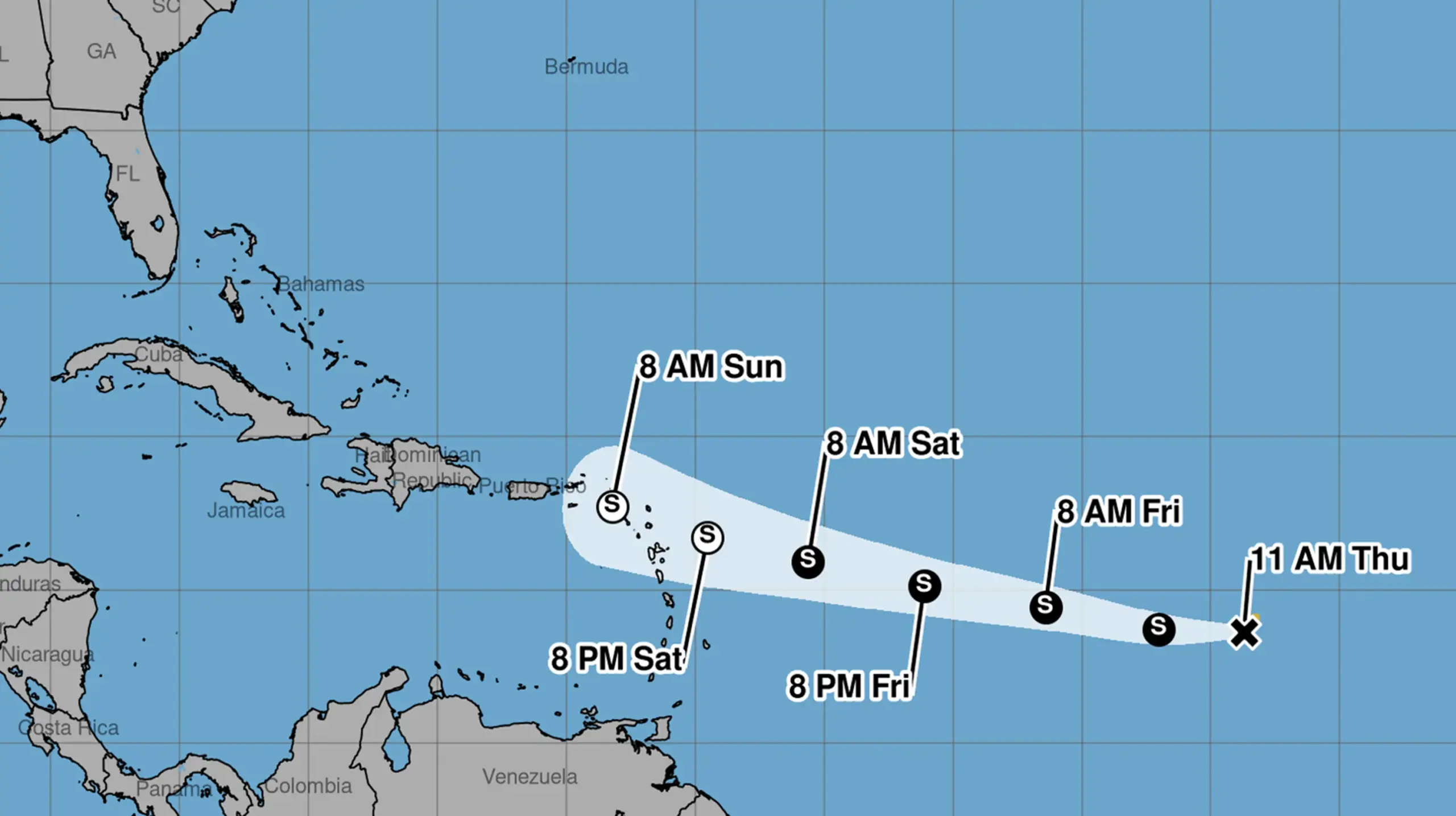
The National Hurricane Center on Thursday said Tropical Storm Dolly formed in the Atlantic after gaining more organization overnight.
Read more Ask a real estate pro: Under ‘as-is’ contract, is buyer responsible for water damage seller hid?
As of the NHC’s 11 a.m. advisory, the center of Dolly was located about 1,555 miles east of the Caribbean’s Leeward Islands moving west at 24 mph with maximum sustained winds of 40 mph.
Tropical-storm-force winds extend out 60 miles from its center.
“On the forecast track, this system should be nearing the Leeward Islands this weekend,” said NHC senior hurricane specialist Eric Blake. “Little change in strength is forecast during the next 48 hours, and Dolly is forecast to degenerate into a tropical wave before it reaches the Leeward Islands.”
Even if it does disintegrate, heavy rain from the system could begin lashing the Caribbean late Saturday into Sunday affecting the Leeward Islands, Virgin Islands and then Puerto Rico and Hispaniola from Sunday into Monday.
“This heavy rain may produce flash flooding, especially in areas of higher terrain,” Blake said.
The next advisory will be at 5 p.m.
Aug 27 8AM EDT: NHC is monitoring an area in the tropical Atlantic that has a high chance (90%) of development. If the current trends continue, advisories could be initiated on a short-lived tropical storm later today. For the latest information visit https://t.co/GrztW6mQJV pic.twitter.com/MBUxIR5bFM
Read more Tropical Storm Dolly likely to form today, hurricane center says
— National Hurricane Center (@NHC_Atlantic) August 27, 2026
Dolly becomes the fourth named storm of the 2026 Atlantic hurricane season after tropical storms Arthur, Bertha and Cristobal.
Hurricane season began June 1 and runs through Nov. 30, but the height of hurricane season runs from mid-August through mid-October.
The National Oceanic and Atmospheric Administration earlier this month updated its seasonal forecast and now expects between seven and 13 named storms this year. Of those, two to six would become hurricanes. It also predicted that there might not be any major hurricanes this year, or at most two.
Already, 2026 was forecast to have lower-than-average storm generation, and that has been reduced even further with the latest forecasts from the NOAA and other weather groups.
An average year would see 14 named storms and seven hurricanes, with three of those growing to Category 3 strength or higher.
Read more High rain chances with lightning storms expected in the afternoon