
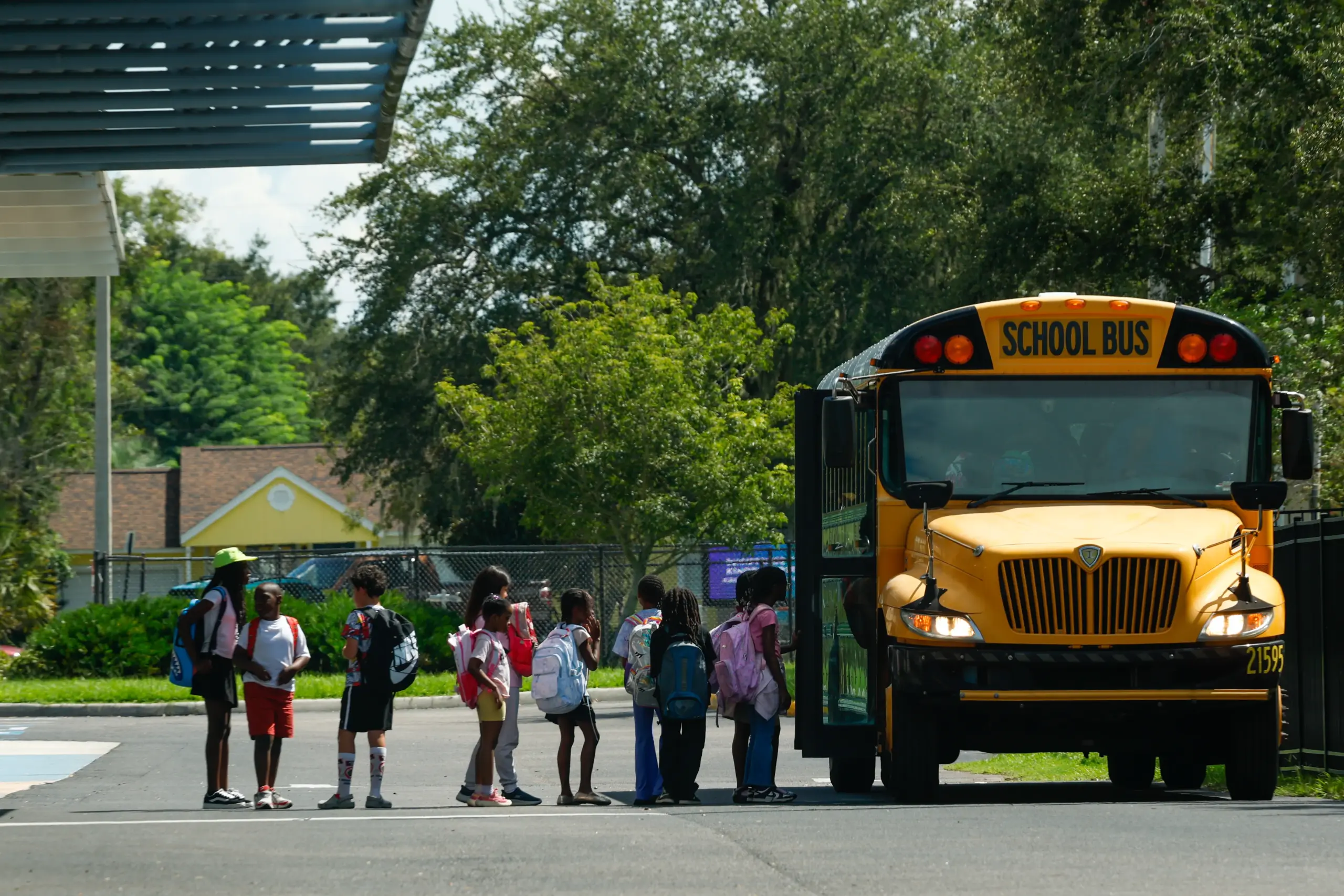
Nearly 40 public elementary schools in Orange County now enroll fewer students than needed to be financially stable, raising the specter of more school closings in a district that shuttered seven campuses in May.
Read more How Florida fights to hide insurers’ finances
Orange County Public Schools’ current enrollment is about 8,000 fewer students than it was in the spring, with empty seats in schools across the county, including in formerly crowded campuses.
For a school district that once added more students — and built more new schools — than any other in Florida, the change is stunning.
“You can tell when you pick them up. You barely see kids around here,” said Nathalie Peña, who sends her twin second graders to Lake Silver Elementary School in Orlando’s College Park neighborhood.
Lake Silver is the emptiest campus in the county this school year, enrolling about 347 students on a campus meant for more than 720, making it only 48% full.
A school needs to fill about 65% of its seats to generate enough per-student funding from the state to be self-supporting financially, district officials say. Schools with fewer students are a drain on district finances.
Forty five campuses are currently at or below that mark, including more than a third of OCPS’ 127 elementary schools, according to an Orlando Sentinel analysis of this month’s enrollment data.
The seven schools closed last school year were between 38% to 61% full, a range that 28 campuses fall into now. That includes 25 elementary schools and three middle schools. Fourteen other elementary schools, one high school, one middle school and one K-8 school were slightly fuller but under the 65% bar.
District leaders have said they do not plan to close any campuses this school year. But after that, with projections showing OCPS losing thousands more students over the next five years, closure discussions seem inevitable.
“We’re definitely gonna have to look at closing schools,” said Angie Gallo, an Orange County School Board member who will take over as the board’s chair later this fall.
OCPS blames its enrollment woes on four main culprits: Declining birth rates, a slow housing market, the national immigration crackdown and 2023 changes to Florida’s school voucher program, which made tuition help for private school or homeschooling services available to all students, regardless of family income.
Roughly 78% of the children born in Orange County five years ago have enrolled in kindergarten in district-run schools. That share used to be closer to 92%.
The combination of factors has meant a relatively sudden drop in enrollment for a district that even this summer opened new schools to reduce crowding on other campuses. And it has hit elementary schools the hardest, many in long-established neighborhoods from Azalea Park to Maitland, Pine Hills to Winter Garden.
Much of OCPS’ recent school construction has been in the fast-growing areas of Horizon West and Lake Nona. But even schools in those communities are now seeing their numbers fall.
In Horizon West, located in the southwest corner of the county, Bay Lake Elementary School opened about 10 years ago. It aimed to relieve crowding at Sunset Park Elementary School, which then had about 1,200 students.
Bay Lake filled quickly, opening with 800 students, slightly above its capacity. But today the school, nestled into a community of new single-family homes just a stone’s throw from Walt Disney World, has about 550 students — putting it just above the 65% mark. Sunset Park has dropped to about 650 students on a campus meant for 840.
About eight years ago, Jodi Jessop, a mother of three, helped start the Horizon West School Coalition, which urged local and state leaders to find ways to build new schools more quickly because so many were so crowded.
Until this year, her three children attended Horizon West public schools — but then her family became part of the declining enrollment trend. After deciding their district-run schools weren’t meeting their needs, Jessop transferred her younger two children to a private school in Ocoee, using vouchers to help pay tuition, and enrolled her oldest daughter in courses through Florida Virtual School, a statewide public online program.
“When you now have options you can now exercise that right and those options to find better, and that’s exactly what I did,” Jessop said.
She estimates that in her 65-home neighborhood plenty of other parents have made the same choice.
“I can probably count on maybe one and a half hands the kids that are still in public schools,” Jessop said.
Similarly, in the Lake Nona area south of downtown Orlando, once-rapid school growth has slowed.
Two years ago, OCPS opened its newest high school, Innovation High, in the Lake Nona area. That was to ease crowding at Lake Nona High, which by then had 4,500 students on a campus meant for 2,800, an enrollment overflow that required so many portable classrooms that the school dubbed the collection of temporary structures “the ranch.”
A new Lake Nona area middle school opened in 2024, too, followed by a new elementary school the next year and another in August.
Read more Editorial: Trust gap doomed crypto regulatory plan
But now, some of the community’s schools have lost students.
NorthLake Park Community School, for example, has about 551 students on an 840-student campus, so it’s about 65% full. In 2017, it had more than 900 kids.
The changes are even more stark in some of the county’s long-established communities.
MetroWest Elementary School is now one of the most under-enrolled in Orange, with roughly 400 students on a campus meant for 840.
The school in southwest Orlando sits in the large development off Kirkman Road that opened in the mid 1980s. A decade ago, it was one of the biggest elementary schools in the state with almost 1,600 students.
Twenty years ago, Camelot Elementary School in east Orange was so crowded that it needed 45 portable classrooms to accommodate more than 1,300 youngsters, structures that took over the basketball court and ran right up to the pitcher’s mound on the field behind the school.
Today, Camelot has 448 students on a campus meant for about 720 — only 62% full. The two schools OCPS built to provide relief to that packed campus, Castle Creek Elementary and Stone Lakes Elementary, are both below the 65% mark as well.
OCPS says there will be no additional campuses built for at least five years. It expects that less full schools in high growth areas will fill eventually but that is less likely in older, built-out neighborhoods where enrollment has plummeted.
Still, Gallo said OCPS did not overextend itself with a building program that added 71 new schools in the last twenty years. Instead, it made the best decisions it could given its rapid population boom.
In 2015, for example, more than 5,300 new students enrolled in OCPS, more than in any other Florida school district.
The Florida Legislature’s decision in 2023 to open up school vouchers, once reserved for low-income families or for those whose children had disabilities, to everyone was unexpected, Gallo said. And its impact was far reaching.
In Orange, about 34,000 students have received state-funded vouchers so far this school year, and the number could grow, according to Step Up for Students, the organization that administers most of the state scholarships.
“I don’t know that we could have predicted that, and we were growing at such a large rate that we had to keep up with that growth,” Gallo said.
Amanda Weber’s son Logan started third grade at a new OCPS school this year because her neighborhood campus, Bonneville Elementary School, was closed in May. In her view, the district “has gotten in way over their heads” with its new school construction boon.
And it blindsided families like hers when it announced the closure of some of its emptiest schools last year.
“Who’s to say this won’t happen again? Who’s to say I won’t be in this predicament again by the time he’s in fourth grade?” Weber said.
Nationally, birth rates peaked in 2007 and have declined since. But Orange, with its booming home sales and constant new construction, was buffered for years from shrinking student counts felt in other parts of the country.
That cushion has ended, said Scott Howat, a spokesman for OCPS.
Home sales here have slowed. Pre-pandemic, roughly 40 out of 1,000 Orange County homes changed hands each year. Now, that number is closer to 26. Older residents are staying in their homes years after their children graduate from high school or renting them to people without school-age children.
Residents who lived near Bonneville told district officials students at the University of Central Florida now rent many neighborhood homes.
Maggie Davis and Robert Borling, who live in College Park, got vouchers to homeschool their two daughters but found that difficult for their family. Nearby private schools proved too expensive, even using the state scholarship, which on average pays $8,000 to $10,000 per child. Lake Silver Elementary is close to their home, so they enrolled the girls there.
Kennedy, a second grader, and Vivian, a kindergartner, both love it, and Borling loves riding a bike with them as they scooter to campus every morning.
But the low enrollment worries him.
“There’s other kids in this neighborhood. I don’t think any of them go to public school,” he said.
The problem with under-enrolled schools isn’t that they have empty classrooms, said Marguerite Roza, a professor who studies education finance policy at Georgetown University. It is that districts must still pay for essential school-wide employees, like principals, physical education teachers and media specialists, and do it with smaller budgets.
So when enrollment drops, district leaders often find themselves forced to choose between two unpopular options: Closing campuses or cutting amenities like music classes or counseling services.
“It is possible to run a smaller school, but most parents expect them to look the same as a bigger school, and they’re not the same,” Roza said.
Read more Plant Doctor: Free and easy way to turn cuttings from your plumeria into new plants