
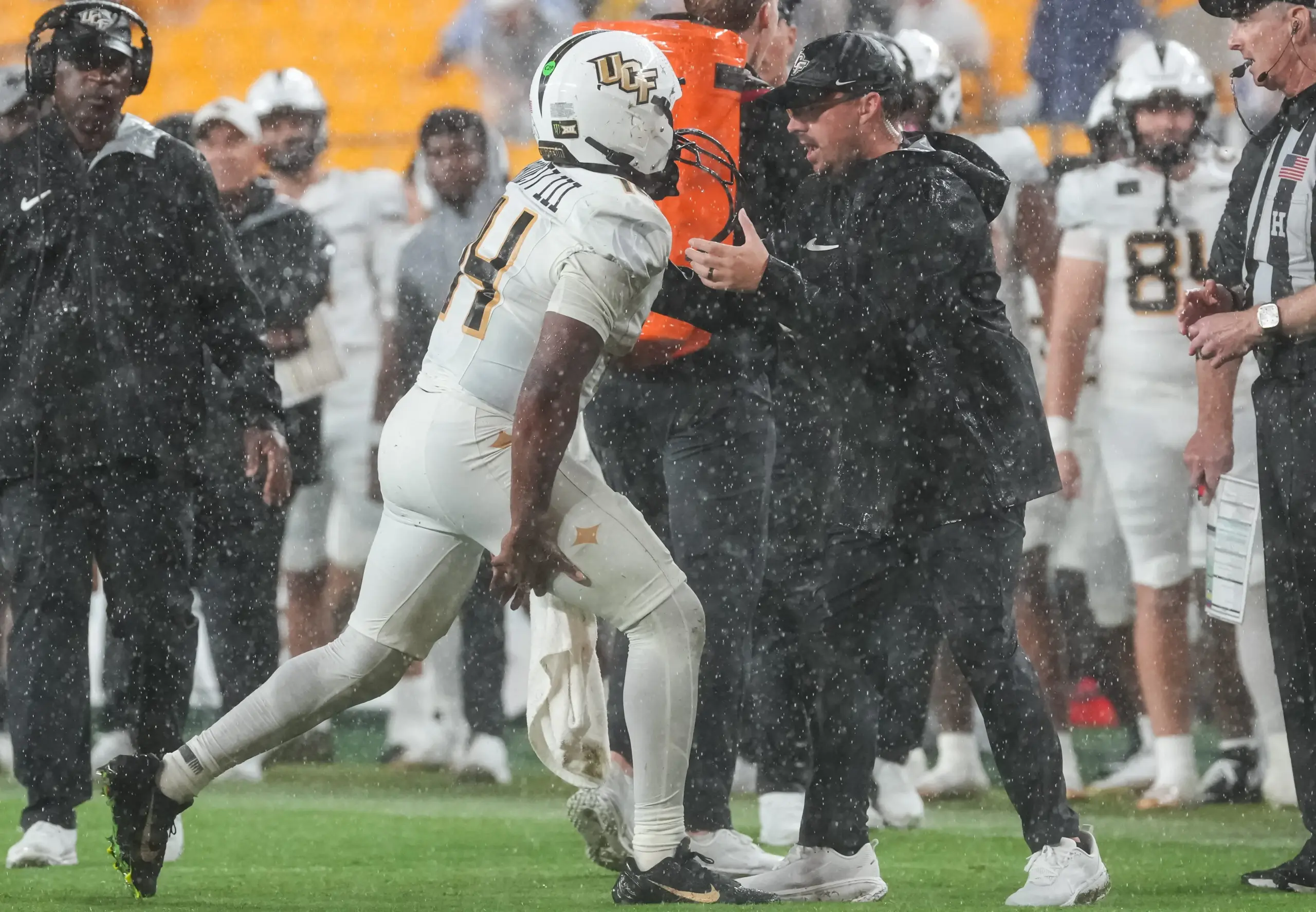
With UCF still dealing with the ramifications of Alonza Barnett III’s injury, the Knights are moving forward with Keyone Jenkins as their starting quarterback for the foreseeable future.
Read more Nearly 100 Orange teachers likely to lose jobs as enrollment falls
Barnett injured his hamstring late in the fourth quarter in the team’s 12-7 loss to Pittsburgh on Sept. 12.
Coach Scott Frost said he would be out for an undetermined amount of time.
“I don’t know how long Alonza will be out,” Frost said following the team’s 44-30 win over Georgia State on Saturday. “He had a fairly significant hamstring injury, so we’re going to do everything we can to get him back. But I don’t think that’s going to happen in the near future.”
Frost said that while it will be a week-to-week decision regarding the starting duties, he reiterated that the Knights’ plan is to stick with Jenkins. UCF is preparing to open Big 12 play at home this weekend.
“He earned the No. 2 spot for a reason. I don’t see any reason that’s going to change,” said Frost.
Barnett was on the field during the team’s warmups Saturday, but didn’t suit up or participate in any drills. He was wearing jogging pants and moving slowly.
Jenkins made his first start of the season, finishing 7 of 17 for 86 yards with a touchdown and an interception. He also rushed for 25 yards and two touchdowns in leading UCF (2-1) to the win over the Panthers.
The Miami native said he spoke with Barnett following his diagnosis. “When we got the report from the doctors, he called me,” Jenkins said.
Jenkins said Barnett told him, “‘I’m with you. I’m behind you.’ And I really appreciated that. I told him, ‘I love you,’ and all that. ‘I’m just filling the gap until you get back.’”
While Barnett remains one of the team captains, Frost wants him to focus on his recovery.
“He’s still around and involved, but I want him focused on trying to get healthy again,” said Frost. “That’s where his primary focus should be.”
Read more Sanford Police search for suspects in shooting that injured 8 people
Hamstring injuries are among the most common in sports, according to Dr. Lyle Cain, an orthopedic sports medicine surgeon at Andrew Sports Medicine & Orthopedic Center in Alabama.
“They’re probably the most common kind of non-contact injury we see in football overall, from a soft tissue standpoint and they’re really hard to treat once you get them, depending on your position,” Cain recently told the Sentinel. “We don’t have a great way right now to know how to prevent them.”
While Cain isn’t familiar with the details of Barnett’s injury, he has treated hamstring injuries throughout his career.
“They (hamstrings) handle a lot of the load when we run, in terms of slowing the leg down as you stride forward,” said Cain. “We see it in football specifically; the injuries are typically quick trigger type motions where somebody’s sprinting or making a quick move, and as they accelerate, they kind of stretch the hamstring in the back of the leg.”
Hamstring injuries are common in the NFL, Cain said, citing weekly injury reports.
“Basically, the severity determines a lot of the return-to-play timing and how disabled the player is,” he added.
Cain said initial treatment for a hamstring injury is pretty conservative, as doctors will work to reduce the swelling. The next step is to regain flexibility in the muscle, which can take time depending on the injury’s severity.
UCF hosts TCU on Saturday (3:30 p.m., FS1) in its conference opener before back-to-back Big 12 road games at Houston (Oct. 3) and Oklahoma State (Oct. 10). Following the game against OSU, the Knights have a bye week before hosting BYU on Oct. 24.
Please find me on X, Bluesky or Instagram at @osmattmurschel. Email: [email protected]. Sign up for the Sentinel’s Knights Weekly newsletter for a roundup of all our UCF coverage.
Read more Week 5 Super 16 Coaches Poll: DeLand, TFA, Jones, West Orange, Seminole still top 5