
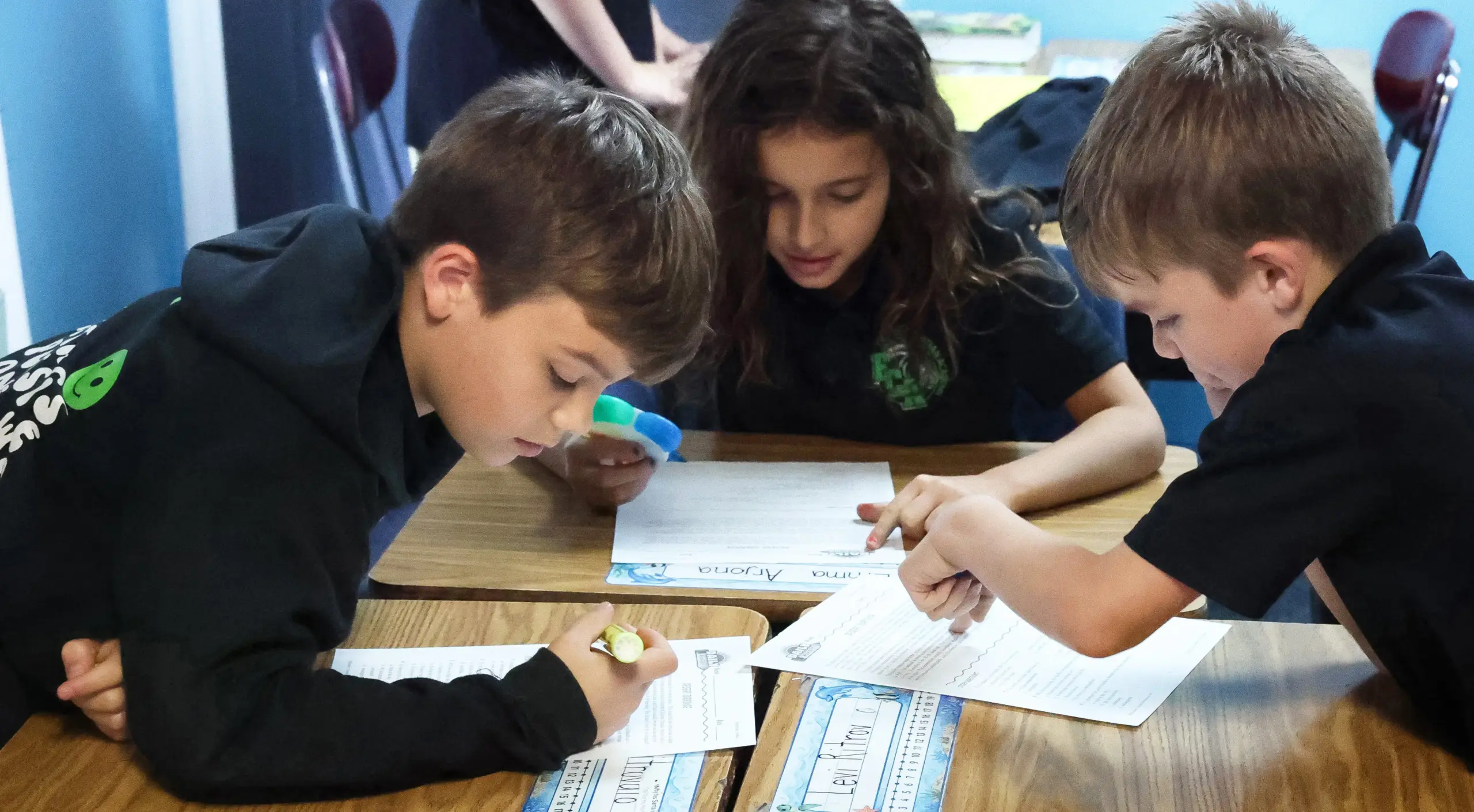
Enrollment in Orange County’s private schools has soared over the past four years, propelled by the growing popularity of Florida’s voucher program, with those campuses gaining almost as many students as their public counterparts have lost.
Read more Christa Pike’s lawyer says she has not regained consciousness since her failed Tennessee execution
An Orlando Sentinel analysis of enrollment data suggests that the voucher program — now providing scholarships to more than 30,000 county children — is driving stark change.
Orange’s district-run schools showed a decline of 8,500 students between the 2022-2023 school year and this past May, state data shows, prompting the closure of seven campuses. And district leaders say their schools are down another 8,000 students since the spring, forcing them to consider shuttering more campuses in the future.
Private schools in Orange, on the other hand, gained roughly 8,000 between 2022 and 2026, according to an analysis of data from the Florida Department of Education. Those campuses likely added even more students to their rolls this fall, though current enrollment figures are not available yet as the state does not collect that information as frequently as it does for public schools.
Families who recently opted to send their children to private schools say they were drawn to smaller campuses and the promise of fewer behavior issues, regular religious instruction and a reduced focus on standardized testing.
The state’s 2023 expansion of the voucher program — providing scholarships worth roughly $8,000 to $10,000 per child — made that choice more affordable and, for some families, doable for the first time.
State scholarships have been “a savior” for Ashli Hawthorne, allowing her to bypass her neighborhood public school to send her three children to a small Christian academy in east Orange.
“We would not be able to attend if we did not have the scholarship,” Hawthorne said.
OCPS leaders stress the two sets of enrollment numbers do not reflect a direct transfer of 8,000 students from public to private schools. The enrollment losses in Central Florida’s largest school district are due to several forces that have decreased the number of school-age children in the county, not just vouchers.
“We do not have 8,000 students that left us,” Superintendent Maria Vazquez said at an August school board meeting. “We have 8,000 fewer students than last year.”
But, she conceded, vouchers have had a “tremendous impact.”
In 2023, the state’s GOP-led state government passed a law expanding the program, once restricted to those from low-income families or with disabilities, to all students. Last year, more than 400,000 students statewide received state-backed scholarships to help pay for private school.
The expansion has transformed K-12 education in Florida. As an Orlando Sentinel analysis last year demonstrated, the scholarships now allow wealthy families to get state help for the private school education they were already paying for and families of more modest means to opt for private schools.
At the same time, the Orange County school district has seen a sharp drop in enrollment.
A recent analysis by the Sentinel found 45 Orange campuses are operating at less than 65% capacity and therefore not generating enough per-student funding from the state to be self-supporting. Schools with fewer students strain district finances, leaders say.
To compare the enrollment in public schools with their private counterparts, the Sentinel obtained data from the state education department for the past four years. The education department does not verify the accuracy of information for private campuses, which is self-reported by the schools.
But data from Step Up for Students, which administers most of the vouchers, also suggests a growing number of students are attending private campuses.
Across Central Florida, more than 60,000 students used state funding to attend private schools last year, according to the organization. In Orange County, more than 34,000 students received vouchers, an increase of more than 5,000 students over the past four years.
The data for the current school year is still preliminary and, therefore, not a good comparison to previous years, a Step Up spokesman said.
Enrollment also has declined in most other Central Florida school districts, but the private schools in those counties have not gained as many students as in Orange, suggesting other forces may be a bigger driver of the enrollment declines in those counties.
Seminole County Public Schools, for example, lost more than 4,500 students between the 2022-2023 and 2025-2026 academic years. But the private schools in that county gained less than 2,000 students during that period.
“We do not see a big movement of our students to private schools,” said Robin Dehlinger, a Seminole County School Board member and former county teacher and administrator.
Rather, she said, falling birth rates and an aging population likely are the main causes of Seminole’s enrollment losses. Longtime Seminole residents have tended to stay in place. And while Orange has for years seen a boom in new housing construction, Seminole has had far fewer projects underway, curtailing the number of new families with children moving in.
Vazquez said declining birth rates and a slow turnover of existing housing have also hurt her district’s enrollment. A national crackdown on immigration and the end of programs guaranteeing legal protections for people from specific countries, including Haiti, also have prompted some families to leave the area.
But in Orange, and across the state, the number of kindergartners using vouchers has grown sharply since the 2023 law change. Roughly 4,200 Orange kindergartners used vouchers during the 2025-2026 school year, up from 2,400 two years earlier.
Read more He’s blind, and he’s called Rays baseball on the radio for 3 decades
The district used to look at the number of babies born countywide to plan kindergarten enrollment five years later, expecting that about 1,200 of those children would not enroll, choosing private schools or homeschooling options. This year, the gap between the number of babies born five years earlier and the number of new kindergarten students grew to 4,400, said Thomas Moore, a demographer who works for the district.
Many of those kindergartners are starting in private schools. Family Christian Academy in east Orange, where Ashli Hawthorne sends her kids, exemplifies the type of private campus that many Florida families are choosing: It is small, religious and virtually all of the students use vouchers to pay tuition.
Nestled onto a church campus on a rural road, the school has just one or two classes per grade level that are split between the building that houses the sanctuary and a row of modular classrooms bordering the parking lot.
Joshua McConkey picked Family Christian for two of his four children, after becoming frustrated with the reliance on laptops in public schools and what he described as “negative influences.”
But his youngest son remains in a public middle school in east Orange and is likely to remain in OCPS schools through high school, he said. His oldest son is enrolled in a district-run program for young adults with disabilities.
“I think giving parents a choice is a really good thing,” McConkey said.
Janna Weisbrod found Family Christian after Googling “Christian school” a couple of years ago after deciding she did not want her younger daughter, then a fifth grader, to attend her local public middle school. She chose Family Christian because it was close to their home and also decided to enroll her older daughter, who was starting ninth grade, as well.
Weisbrod, who is now Family Christian’s admissions coordinator, said she and her daughters appreciate the small schools’ benefits. “All of their teachers know them, and they know all of the students. They really like the atmosphere.”
At Regency Christian Academy in south Orange, parents enroll their children because they want a safe environment and religious instruction during the school day, said Principal Victor Lopez, Jr. The school enrolls roughly 100 students and most use vouchers to pay the tuition of $8,750.
“We’re high on academics, but we have a Christian, Biblical worldview that we want to teach these kids about,” Lopez said.
Vazquez acknowledged during an August board meeting that the vouchers are enticing for some families.
“Certainly, there are some that are choosing other options, and I recognize and respect that,” she said. “I believe that we need to continue to listen to our families about why they’re leaving, what is it that we can do, to work together, to provide those supports.”
However, public schools can’t offer a faith-based education, and more than 80% of the students who receive vouchers attend religious schools. The majority are Christian, but a handful of Jewish and Islamic schools in Central Florida accept vouchers, as well.
Stephanie Vanos, a member of Orange County School Board, said she understands some parents want their children to receive religious instruction. And some private schools in the county are very good.
But she said the state’s program is siphoning money from public schools into private campuses that have few guardrails. Unlike public schools, Florida’s private schools that take vouchers do not need to employ teachers with bachelor’s degrees, disclose which curricula or books they use or publicly report student test scores and graduation rates.
“There’s no transparency and there’s really very limited accountability,” she said.
“We have to ask, when we’re using our tax dollars, are our students learning and are we using our public money wisely? And we can’t answer that question when this money is being diverted to private entities,” Vanos said.
A drop in enrollment also means a drop in state per-pupil funding, and OCPS, in addition to closing campuses, has had to cut its budget and is laying off about 100 teachers.
Step Up insists the voucher program is not to blame for the public school districts’ financial woes, noting that percentage wise the impact is small. Last year, new scholarship recipients who previously attended public schools were equivalent to just 1.2% of the enrollment in OCPS campuses, its data shows.
But that is still nearly 2,000 students, or as if two middle schools were suddenly emptied.
Many parents sending their children to private schools say their decision doesn’t necessarily reflect dissatisfaction with the public schools.
Hawthorne attended Seminole’s public schools as a child and said she had a “great experience” there. But when it came time to enroll her oldest child in kindergarten two years ago, she feared her neighborhood campus, the 500-student Deerwood Elementary School in the Rio Pinar neighborhood, would overwhelm her. So she started searching for a smaller, Christian school near her home and found Family Christian.
“As soon as I toured it, it just felt like the right choice,” she said.
Hawthorne said her daughter, now a second grader, feels safe on the 270-student campus, where she is treated “like family” and has “blossomed.” This year, Hawthorne’s twins started kindergarten there, a decision that made sense.
Read more Guest Commentary: Orange’s next mayor must lead region’s economic future
“I don’t regret choosing this over public school,” she said.