
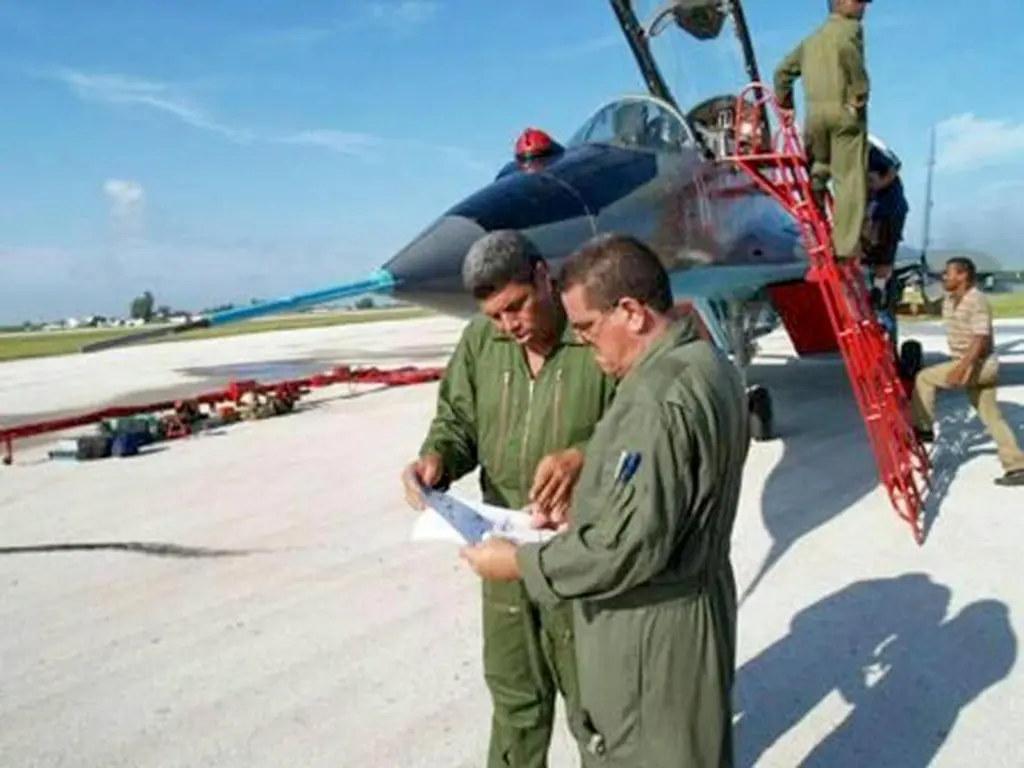
MIAMI — For almost 10 years, a retired Cuban air force pilot, Lt. Col Luis Raúl González-Pardo, traveled between Cuba and Florida, entering the United States without disclosing his military history and going unnoticed.
Read more Orlando Pride tries to break out of slump at second-place San Diego
That was until his arrest in November, when he was accused of failing to mention on U.S. immigration forms that he had been a member of the Cuban air force for nearly 30 years.
He pleaded guilty in January to immigration fraud charges and was scheduled to be sentenced on May 28 in federal court in Jacksonville.
González-Pardo, 65, who is jailed, could receive a maximum sentence of 10 years.
On Wednesday, González-Pardo faced even more serious charges when he was named as a defendant in a federal indictment against former Cuban President Raúl Castro and four other members of the Cuban air force.
All are charged with conspiracy to commit murder in a notorious case involving the killing of three Americans and a U.S. resident, all of Cuban descent, who were members of Brothers to the Rescue, a group of pilots that scoured the seas looking for rafters fleeing Cuba.
All four died in February 1996 when Cuban fighter jets shot down two civilian planes operated by the group over international airspace in the Straits of Florida. A third plane escaped and landed safely in Miami.
Cuba said the planes had repeatedly violated its airspace and had dropped antiregime leaflets over Havana.
González-Pardo’s inclusion in the indictment is potentially significant because he is the only defendant in the United States and could testify in a trial.
If found guilty in the new indictment, González-Pardo faces life in prison.
His lawyer, Miguel Rosada, declined to comment on any of the charges.
González-Pardo flew one of the MiG fighter jets involved in the shoot-down, but did not open fire, according to the indictment.
The charges brought a measure of satisfaction to one Cuban activist in South Florida, Luis Domínguez, who said he has spent years trying to identify all the Cuban pilots involved in an episode that has been an open wound in the Cuban exile community.
“He was in one of those MiGs that day,” said Domínguez, an investigator for the Foundation for Human Rights in Cuba, a group that describes itself as promoting democracy in the island nation. “And he’s the only one that’s here that we have access to that can tell you who participated.’’
For years, two MiGs had been identified as involved in the shoot-down. In 2003, a U.S. federal court indicted the two pilots and their commanding officer, but they lived in Cuba and were never tried.
But Domínguez said that in 2014 he learned of a report by a U.N. agency, the International Civil Aviation Organization, that detailed the involvement of two other MiGs in the chase for the third Cessna that returned to Florida. The Cessna was flown by José Basulto, the founder of Brothers to the Rescue.
The report, which is part of the U.N.’s public record, was commissioned in 1996 by the United Nations as part of its examination of the episode.
The report includes a transcript of radio communications between the MiG pilots and their base.
Read more UCF softball coach believes ‘best is yet to come’ for Knights
“That was like the Bible to me,” Domínguez said.
The transcript showed that the pilots spotted Basulto’s plane, a light-blue-and-white Cessna.
“OK, I have contact,” one of the pilots, identified as “22,” radioed to his base. But two minutes later, when asked to report, he stated that “we lost it. Did we pass it?”
Two minutes after that, the pilots were told to “suspend the mission.”
Cuban authorities later told the civil aviation agency that the mission was aborted because “the contact was then outside Cuban territorial airspace and withdrawing to the northeast.”
Domínguez said the transcripts provided clues about the other pilots in the episode.
The transcript showed that during the chase one of the pilots used his name, “Gual,’’ instead of his military call sign. One of the other pilots indicted on Wednesday is named José Fidel Gual Barzaga.
Armed with the tidbit about “Gual,’’ Domínguez said he started asking other former Cuban air force pilots who had defected.
He said he was eventually told that González-Pardo was aboard the second fighter jet that went after Basulto’s plane and that about a decade ago he had traveled to Florida to visit a sister living in Jacksonville.
“It was a process,’’ he said. “It took a lot of patience.’’
Domínguez said he obtained photos of González-Pardo visiting the Kennedy Space Center in Cape Canaveral.
Court records show González-Pardo first entered the United States in May 2017, when he also failed to disclose his military service in Cuba.
In 2024, González-Pardo entered the country again “after being granted humanitarian parole” under a Biden administration program for migrants, according to his plea agreement in the immigration fraud indictment.
Domínguez said he had reached out to federal authorities to share what he had learned about the Cuban pilots. An FBI spokesperson in Miami, James Marshall, said the agency would not comment on what he said was an ongoing investigation.
He also said he contacted members of Congress, including then-Sen. Marco Rubio, R-Fla., asking how González-Pardo had been allowed to enter the country given his military record.
In 2024, in a letter to Biden administration officials, four Florida Republican members of Congress, including Rubio, highlighted that González-Pardo was “notoriously linked” to the Brothers to the Rescue incident in 1996. The representatives also called for an investigation into González-Pardo’s entry into the United States.
“Former Cuban regime officials involved in the oppression of innocent Cuban citizens or the transnational persecution of Cuban-Americans” should not be allowed to remain in the United States, they wrote.
Read more SEC Spring Meetings center on CFP expansion, NIL uncertainty
This article originally appeared in The New York Times.