
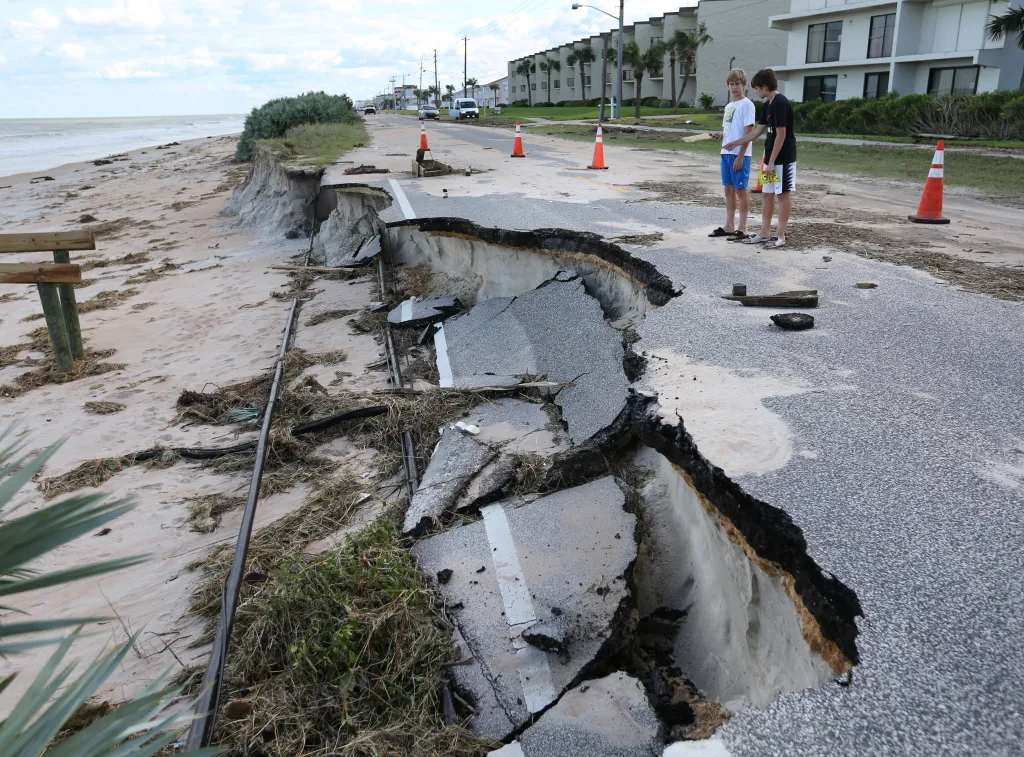
Although 2016’s Hurricane Matthew technically never made landfall in Florida, the center passed about 30 miles offshore, which was enough to carve a devastating path along our east coast. It was the first major hurricane to threaten Florida in 11 years.
Read more What’s in a name? Hurricane season starts Sunday and here are the storm names for 2026
During Matthew, all of Florida’s east coast was under a Storm Surge Warning, an experimental product at the time. This product was issued to alert the public of what has long been considered the most deadly hazard within tropical systems, the abnormal rise of water being pushed onto typically dry land.
Spectrum News spoke to Cody Fritz of the National Hurricane Center about the evolution of these alerts.
“We wanted to separate storm surge, the hazard, from the wind hazard,” he said. “So when you think about category of a hurricane — 1, 2, 3, 4 or 5 — that really just talks about the wind. It doesn’t really communicate what the storm surge impact is.”
Storm surge watches and warnings then became operational in 2017, and the increased communication has had drastic public benefit.
“Since the inception of the new storm surge products, we’ve seen a decline in overall deaths related to storm surge directly,” Fritz said.
And while warning and communication continue to improve, some innovators are focused on reducing storm surge effects before water ever reaches the shore.
Read more Ranking the rotisserie: Which store-bought chicken rules the roost?
Nick Bourdon is the cofounder of Reed Arches, a coastal protection system designed to weaken wave energy through engineered offshore reef structures. Their concept was recently recognized at a national convention of the Associated General Contractors of America.
“We really wanted to focus on how we protect our state from hurricane damage,” Bourdon said.
He explained Reef Arches to us as, “a half a ton structure, so 6 feet long, 4 feet wide. The way it works is you place this facing the waves, and it actually acts as a way to trip the wave. So it goes through the honeycomb structure, reducing the energy.”
Reef Arches have already been deployed in Palm Bay, Titusville and Cape Canaveral.
“It’s a good way to reduce wave energy, reduce that wave inflection on the seawalls,” Bourdon added.
Dune restoration projects have also been implemented along parts of the Central Florida coast, a natural buffer to help prevent water from reaching nearby roads and businesses in the event of storm surge events. Such mitigation initiatives are helping Central Florida communities be more resilient as we face another upcoming hurricane season.