
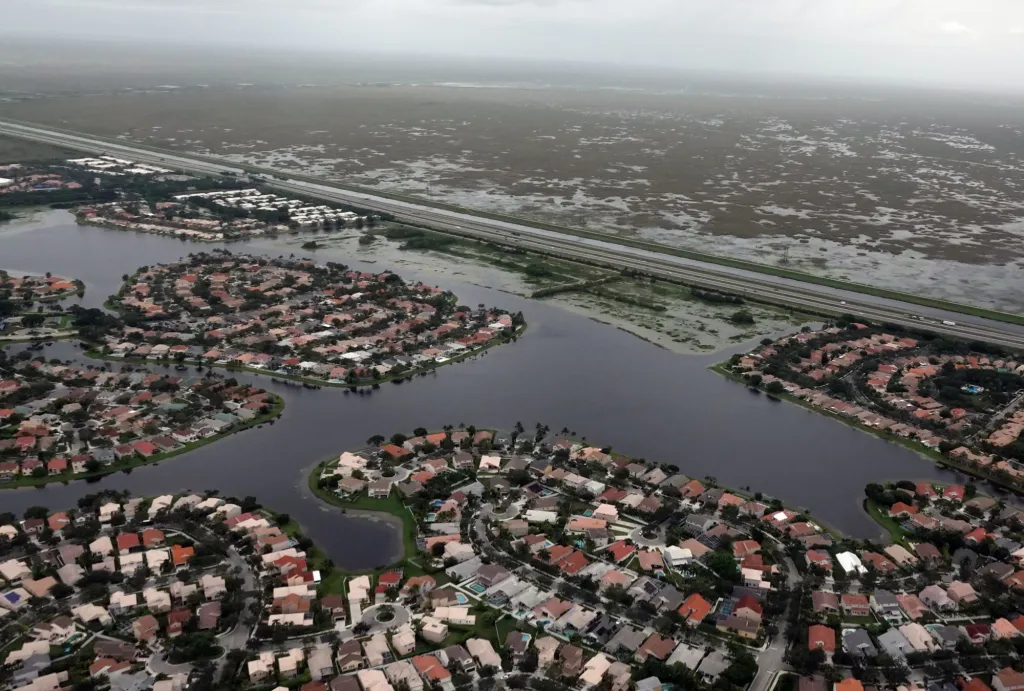
A Fort Lauderdale federal judge has stayed a lawsuit brought by a Buddhist group which alleges that a component of the Everglades restoration project operated by the U.S. Army Corps of Engineers poses a threat to the environment near the group’s expansive retreat in Weston.
Read more Gatorland opens Guzzlin’ Gator, adds Crooked Can beer collaboration
U.S. District Judge William P. Dimitrouleas ordered the suit set aside after declining a government request to dismiss the case outright. Although he was told by the Army Corps that the project in Western Broward County had been defunded and canceled, evidence arose that the project might be revived in a different form.
In late 2024, faced with the prospect of years of noise, air pollution, and, possibly, water intrusion, Soka Gakkai International and its affiliated Florida Nature & Culture Center sued the Corps, alleging it failed to conduct an environmental assessment of the project’s impact on the property, which contains a religious retreat and conference center that has operated since the 1990s.
Besides asking the court to delay the start of construction until the Corps produced an environmental impact statement, the religious group’s suit also asked the court to declare that the agency violated the National Environmental Policy Act, the Administrative Procedures Act and the Religious Freedom Act.
The retreat is not far from 1,830 acres of swamp designated for the C-11 Impoundment Project, which is part of the sweeping Comprehensive Everglades Restoration Plan. The C-11 project, one of 68 in the state, involves the construction of a massive above-ground reservoir, seepage canal, underground barrier wall, a barrier trench, and a pump station, according to court filings. It is intended to capture and treat water, thus reducing the flow of nutrients into the Everglades and preventing flooding in Weston.
Postponed, not canceled
After nearly two years in court, the government told the judge the project had been canceled, making the case moot and ripe for dismissal.
Lawyers from the law firm of Greenberg Traurig said the evidence showed otherwise.
They pointed to an affidavit filed by a Corps official that indicated it plans to seek additional funding from Congress for a contract that was canceled for a portion of the project.
“Until additional funding is available, the Corps cannot proceed with this work,” according to the affidavit filed by Eva B. Velez, a Jacksonville-based Corps official who oversees the South Florida Ecosystem Restoration program, including the Broward County Water Preserve Areas (BCWPA) Project. The C-11 Impoundment is a component of the overarching BCWPA project.
Read more Orlando Pride hosts Bay FC with a chance to go into break on a winning streak
“The Corps has identified a statutory maximum cost limit issue for the overall BCWPA Project, of which C-11 is one component.” she wrote. “In order to complete the overall BCWPA Project, the Corps will need to prepare a report to Congress seeking an increase in the authorized total project cost. The Corps could re-solicit bids for the C-11 embankment construction if additional funding becomes available. However, no such funding has been made available to date.”
The Buddhist group argued that if the judge concluded that the project has been postponed, the court should stay the case rather than dismiss it. After conducting a hearing last Friday, the judge agreed the case should be “administratively closed,” not dismissed.
“While the Court does not find dismissal of this case to be appropriate based upon the defunding of the Project and its consequent postponement to an unknown timeframe, administrative closure is,” the judge wrote. “It makes no sense for the parties … to litigate a challenge to a project that may or may not go forward, or that may go forward in a form that differs from that assumed by the litigation.”
“Administratively closing the case and staying further litigation until the project is refunded is the most prudent solution, based upon principles of judicial economy and efficiency,” the judge added. “The Court may reactivate the case either of its own accord or at the request of the parties if and when the relevant circumstances change.”
Judge calls for status reports
In an interview Wednesday, attorney Paul Seby, who represents the Buddhist group and the retreat, said his clients are pleased with the outcome. He noted the government initially sought to dismiss the case on the grounds that it was filed too late. Now, he said, the government says there is nothing to argue because the project is off the board.
“The federal government is just flopping around and the judge wasn’t going to let them off the hook,” Seby said. “The Buddhist organization is very pleased that the Corps is either going to be reasonable and go back to the drawing board, or they’ll have to face trial in federal court.”
A media representative for the Army Corps district office in Jacksonville could not be immediately reached for comment. Previously, the office has declined to discuss the litigation.
Whatever transpires, the judge wrote in his order that he wants the parties to file status reports on the project before or on Sept. 1, “and every ninety (90) days thereafter.”