
Another big rocket is set to take shape in Florida with the announcement Relativity Space will expand production facilities in the state, bringing with it thousands of high-paying jobs in the next decade.
Read more Florida officials rescue nearly 100 cats, dogs hoarded by postal worker
Gov. Ron DeSantis announced the move while attending the Farnborough International Air Show in England, as well as detailing an expanded agreement between Florida and the U.K. Space Agency for international space collaboration.
For Relativity Space, which has been pushing to launch its new Terran R rocket from Cape Canaveral Space Force Station’s Launch Complex 16, the agreement with the state means a commitment to expand Space Coast operations with “substantial capital investments” that would create “thousands of high-skill, high-wage jobs for Floridians” by 2034, according to a press release from the governor’s office.
“Expanding our capacity in Florida enables our ability to scale the Terran R program to support commercial, scientific and national security missions,” said Eric Schmidt, Executive Chairman & CEO for Relativity Space in the release.
That includes the construction of “an additional Terran R production facility to complement its existing facilities” as well as an expansion of its test and launch support infrastructure across Kennedy Space Center and Cape Canaveral Space Force Station.
Details on the production facilities were not revealed, but it could mean manufacturing of the rocket in Brevard County, the latest rocket production site on the Space Coast following Blue Origin’s existing New Glenn facilities in Merritt Island and SpaceX’s forthcoming Starship and Super Heavy manufacturing site located within Kennedy Space Center.
The number of jobs or their average salaries were also not announced.
Space Florida, the state’s aerospace finance and development authority, had been working on the agreement with the Long Beach, California-based company, under the secretive name “Project Forge.”
“Relativity is exactly the partner that helps advance our mission to solidify Florida as the world’s hub for aerospace commerce,” said Space Florida President and CEO Rob Long. “This project is a win for Florida’s commercial space economy and is the direct result of how our infrastructure, strategy, and talent ecosystem makes Florida the inevitable choice. We look forward to actively helping them grow in our state.”
At its June 2 board of directors meeting, Space Florida approved moving forward with the agreement, meaning Relativity Space is eligible for up to $134 million from the Florida Department of Transportation’s Spaceport Improvement Program.
That’s a dedicated fund for space transportation infrastructure that has been tapped for $531 million in state investment fund since it started in 2012 and is in line in fiscal 2027 to increase by another $87 million, according to Space Florida estimates.
Read more 2-term incumbent Bankson faces Republican primary challenge from Longwood dentist in HD36
The move follows major infrastructure projects announced since last year for both SpaceX and Blue Origin. The construction of SpaceX’s Gigabay manufacturing site at KSC revealed in March 2025 is part of a $1.8 billion investment Space Florida had been calling “Project Hinton” to support Starship and Super Heavy launches at both KSC and Cape Canaveral. Space Florida stated that investment was forecast to bring 600 jobs with average wages of $93,000 a year to the region by 2030.
In May this year, Space Florida revealed “Project Horizon” to be an expansion at Blue Origin’s rocket park that would bring 500 jobs at an average salary of $98,000 a year. Already the site employs about 4,000 people, with another 1,500 jobs expected as it ramps up production of both its New Glenn rocket and the Blue Moon MK1 and MK2 lunar landers on the Space Coast.
“Relativity expanding to Florida strengthens our aerospace network and deepens the supply chain, our workforce, and infrastructure,” said Space Florida Chair Jeanette Nuñez. “Florida’s aerospace strength exists because we created a strong and resilient ecosystem where companies can easily expand. The compounding effect of what we have built is what secures our leadership for the long term.”
Relativity is playing catchup to SpaceX and Blue Origin, though. Last year, company co-founder Tim Ellis stepped down as CEO to make way for former Google CEO Schmidt, who brought financial backing to stabilize the company founded in 2015.
Relativity had its one and only rocket launch in 2023 when it managed to fly its smaller Terran 1 rocket from LC 16 on a mission called “Good Luck, Have Fun.” While liftoff was successful, the upper stage did not make it to orbit. The company, however, decided it was good enough as a proof of concept and shut down Terran 1 production in favor of the larger Terran R.
It will have a payload capacity of more than 50,000 pounds to low-Earth orbit powered by 13 of the 3D-printed Aeon R engines running on the liquid oxygen-methane mix that burns blue on launch. They combine to provide more than 2.4 million pounds of thrust on liftoff. Similar to SpaceX’s Falcon 9, the Terran R is designed for reusability, with the first stage aiming to land on an offshore barge that would sail out of Port Canaveral. The company aims to fly them up to 20 missions with refurbishment of boosters done on the Space Coast between launches.
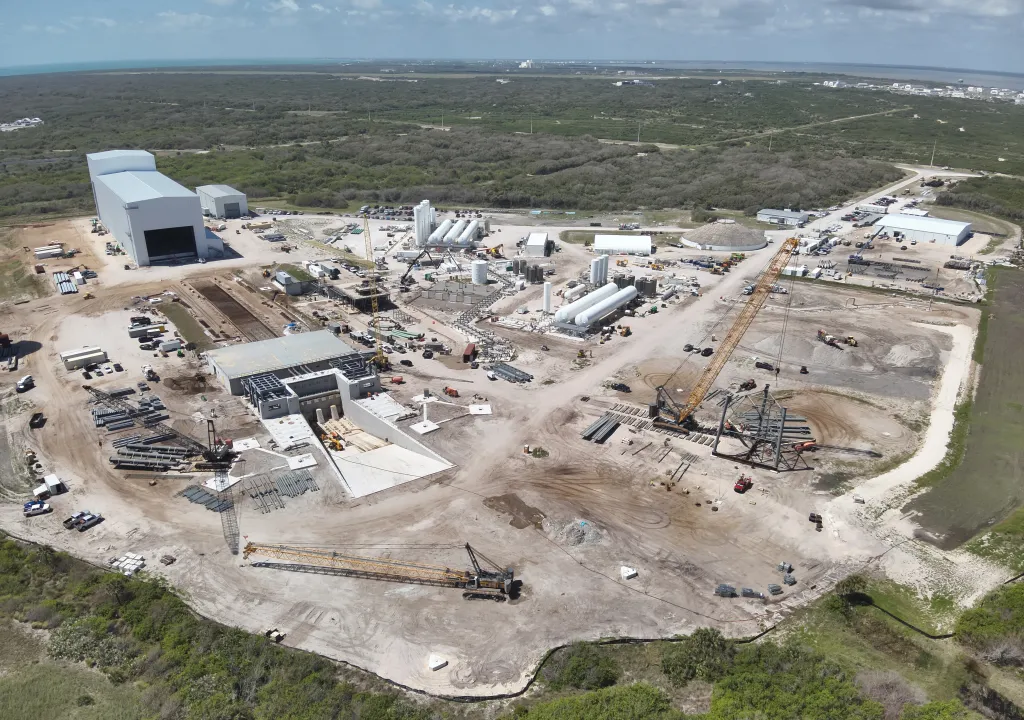
The company continues to build out a new launch pad at LC-16 for the larger Terran R rocket, and had been targeting launch by the end of 2026, but will now more likely fly in 2027.
In its latest update, the company said 60,000 gallon tanks had been installed at the water farm on site while tanks for liquid oxygen were activated. The horizontal integration facility adjacent the launch pad is getting a crane installed while the lower portions of two lightning protection towers are complete and concrete work progresses for the launch table on the new pad for Terran R.
The first rocket remains a work in progress with testing complete on all the first stage engines for the first flight, and acceptance testing for the upper stage engines underway at NASA’s Stennis Space Center in Mississippi. Testing also continues on the first and second stages of the rocket fuselage, with a testing campaign for the upper stage coming up at Stennis while a first stage remains in California.
Read more Best saucier