
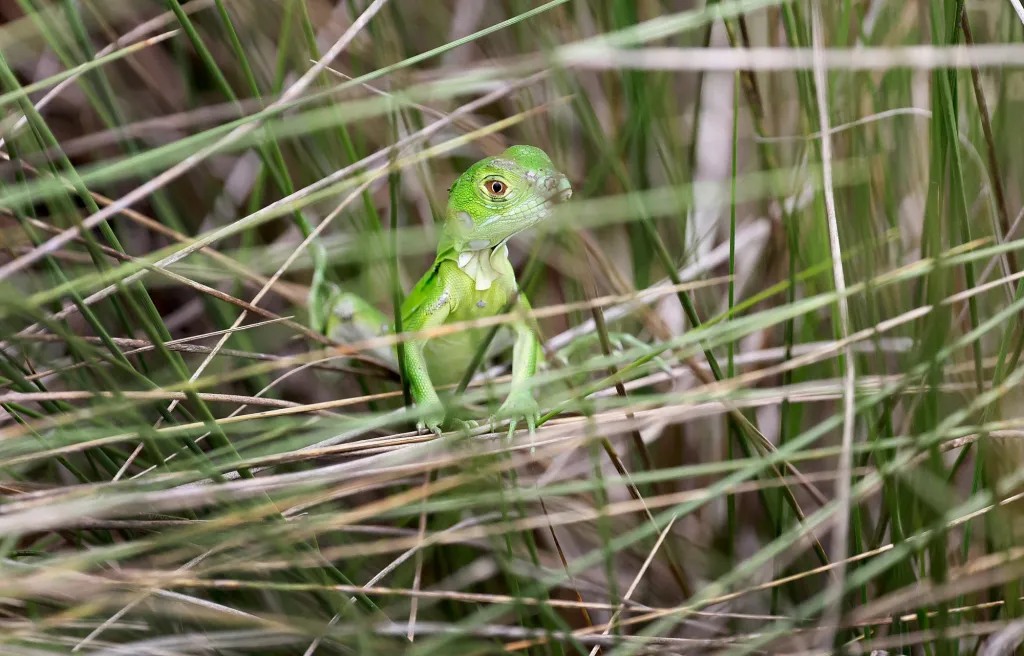
Michele Holtfreter planted fresh pentas in her yard this spring — only to find an iguana was tearing into her blossoms.
Read more Trump issues pardon to former Republican congressman convicted of insider trading
“After they started flowering, there was a big green iguana hanging around my palm tree,” recalled Holtfreter, of Deerfield Beach. “Next thing I know, the tops of the pentas are being chewed off.”
It was too late for her to intervene. The purselanes she planted in the backyard faced the same fate.
Iguanas have been making a comeback in South Florida — in residents’ backyards, near sidewalks and along canal banks — months after many of them were wiped out in a freeze. Thousands of the lizards were captured during a cold snap in February, leading to weeks of fewer sightings.
But iguana-removal companies say they’ve been receiving more calls in recent weeks about the invasive lizards. They expect the upcoming hatching season to reverse any downturn and help the lizard species keep thriving.
“It felt like the iguanas took a 30-day sabbatical” earlier this year before they bounced back, said Pierce Kennamer, president of IggyTrap, an iguana-removal company.
For Jessica Kilgore, owner of Iguana Solutions, the impact from the freeze was more drawn out. Kilgore is usually so inundated with calls in March that she starts a waiting list for customers. This year, she “got very few calls until about two to three weeks ago,” when requests started picking back up.
Steve Kavarshansky, owner of Iguana Busters, also noticed there were fewer iguanas earlier this year. He said his company similarly saw fewer calls after the freeze.
Kilgore says that the freeze roundup likely “put a decent dent into the population,” though there is no complete count of the actual number of iguanas captured.
In February, the Florida Fish and Wildlife Conservation Commission announced 5,195 dead or frozen iguanas were turned in at drop-off sites. At the time, at least 8,000 iguanas overall were collected by the commission and private operators.
But any estimate of their numbers “is likely to be incorrect,” said Frank Mazzotti, a professor of wildlife ecology at the University of Florida. He added that “there’s been no systematic monitoring of iguanas post-freeze.”
The short-term impact of the freeze is also difficult to calculate, Mazzotti said, because “there is no way to estimate the population size” of all green iguanas in South Florida.
“We do not have a current population estimate of wild green iguanas in Florida,” the wildlife commission wrote in an email to the South Florida Sun Sentinel. They added that they were not aware of any accurate data detailing the impact of the cold snap in February.
With hatching season on the horizon, trappers expect the apparent decline in iguanas to be reversed.
Read more Female Navy officers say they fear a career cap after Hegseth cuts women from promotions list
The reptile’s primary hatching season starts in June and peaks in July, according to two of the trappers. On average, female iguanas lay between 14 and 71 eggs per season, meaning a normal hatching season would compensate for the decline.
“Whatever reduction that occurs is only gonna be temporary,” Mazzotti said. “It’s not likely that any long-term effect occurred in terms of reducing the population.”
Tom Portuallo, founder and owner of Iguana Control, anticipates regrowth as well.
Like the other trappers, his business saw a lull after the freeze. Though his company usually sees 30% annual revenue growth, this year they have seen only 15% to 17%, indicating a “severe reduction” in the population this February.
Though the freeze “may have slowed the trajectory slightly,” Portuallo said, the population will probably return to last year’s size by the end of hatching season.
In Kavarshansky’s assessment, the population has already rebounded “stronger than ever,” with his business only seeing a slight downturn when compared to last May.
An increase in sightings and upturn in business in the last few weeks also may have more to do with warming weather than a shift in population size.
“In the warmer months, you’re gonna see heightened iguana activity,” Kennamer said. “The iguanas are cold-blooded, so that the hotter it is, the more active they are. They eat more when it’s hot. Their metabolism runs higher.”
He added that iguanas also are attracted to the “bright beautiful flowers” that residents plant in the spring.
The iguanas generate debate in the community, partly over whether they should be allowed to roam free, or if they should be humanely killed.
Dirk Gilbert, a Pompano resident who grew up in South Florida, favors leaving the reptiles alone, opposing efforts to kill them. He says that, eventually, “nature takes care of the invasive species” without human intervention.
Given the species’ growth rate, Portuallo said iguanas will remain a fixture in the region.
Read more Warm and dry weather conditions on tap for Central Florida this weekend
“This is just ongoing,” Portuallo said.