
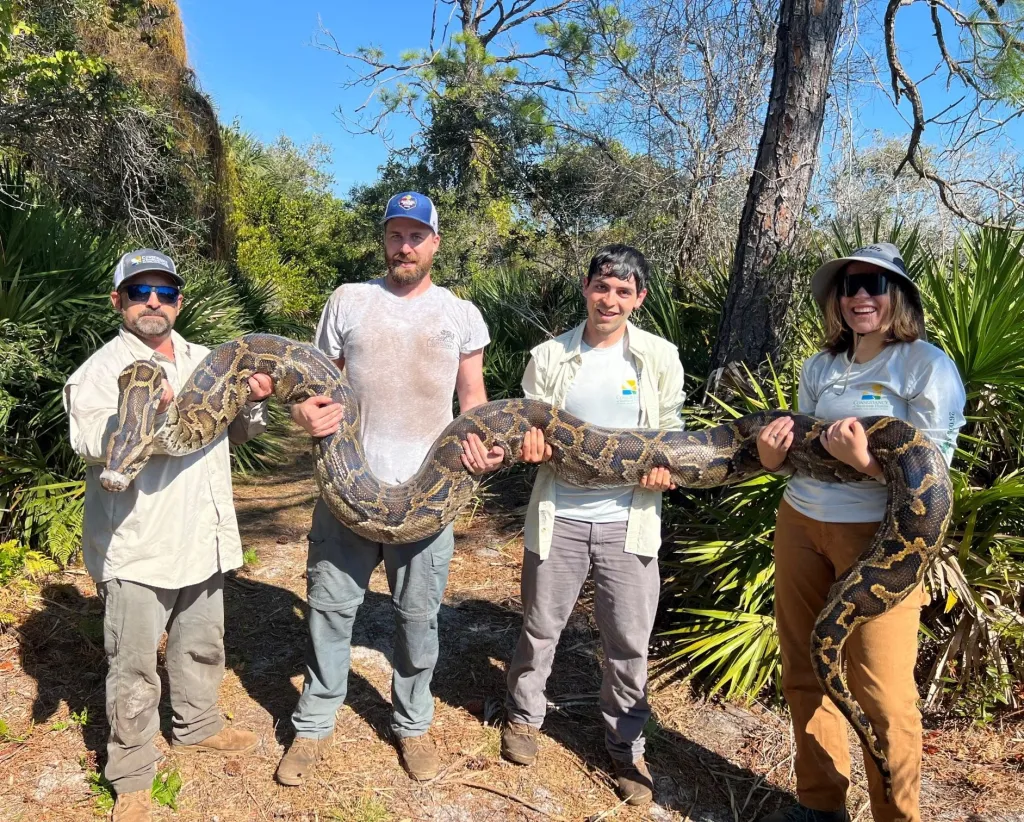
Biologists at the Conservancy of Southwest Florida removed 8,080 pounds of invasive Burmese pythons from the outskirts of Naples in just six months.
Read more Time is running out to win HGTV Smart Home giveaway in Orlando
The haul — 177 snakes in total — beats their previous record of 6,500 pounds last year. The average weight for female snakes this year was 95 pounds, and the biggest snake was 17 feet long and 153 pounds.
Python hunting is often done by simply looking for the snakes along rural roads. But the secret to the Conservancy’s capture success is sex drive.
The pythons were captured during the breeding season, which runs from November through April. During those months, large females release pheromones into the breeze, which attract males from miles away.
Conservancy biologists track 40 male snakes with VHF radio implants. The males — all living in a 200-square-mile area of farms and wilderness outside Naples — seek mates and lead the biologists to large, fertile females holding up to 100 egg follicles.
These are the most important snakes to remove from the ecosystem, both because they have so many offspring and because they eat large amounts of prey, including white-tailed deer.
Females necropsied this season carried an average of 70 eggs each, for a total of approximately 3,500 to 4,000 developing eggs removed from the ecosystem this year alone.
Lead biologist Ian Bartoszek said that though bushwhacking into the wilderness to find snakes can be arduous work, they lighten the mood by keeping statistics on which male finds the most females each year.
“This year’s Most Valuable Python was ‘Midas’ (named for his gold flanks),” said Bartoszek. “He found three females and four males. Honorable mention for his breakout rookie season goes to ‘Snaquan Barkley.’ He found us two females close into town, in a new area.”
Bartoszek said one of Snaquan Barkley’s females was 16 feet long and 150 pounds. “She alone was probably responsible for decades of snakes showing up in that sector.”
The biology team’s biggest one-day haul was 462 pounds of snakes, consisting of two large females and eight males — oftentimes several males will gather around one female in a breeding ball.
Read more Florida immigration arrests have quietly surged, with state and local agencies at the forefront
Cute names and impressive numbers aside, the snakes did not choose to be here, and the python invasion has decimated ecosystems in South Florida.
In areas of Everglades National Park, where the snakes started showing up in the 1980s, sightings of mammals such as marsh rabbits, raccoons, opossums, bobcats and deer have plummeted by 80% to 99%, depending on species.
“One thing that has stood out across all seasons is the number of white-tailed deer remains we find in adult female pythons,” said Bartoszek.
Bartoszek and his team, including biologist Ian Easterling, who conducts many of the necropsies, often find deer hooves and bobcat claws in the digestive tracts of the larger snakes.
“They seem to target this high-calorie diet to put on mass for the high-energy requirement of making eggs,” said Bartoszek. “Each necropsy is only a snapshot in time for the potential of observing the last meal of the python, and we have found about 25% of female pythons over 70 pounds have the remains of deer inside their digestive tract. That is concerning, especially for the recovery of the endangered Florida panther.”
The impressive snakes were brought from Asia to Florida via the exotic pet trade from the 1970s through 2010, when it became illegal to buy Burmese pythons as pets in Florida. There were also breeding facilities in the state. Once the snakes escaped captivity or were released, they thrived.
Though snakes are challenged by cold weather, neither cold snaps nor millions of dollars in removal efforts have stopped their population explosion and range expansion. They are currently established from the Everglades north to the northern end of Lake Okeechobee, as well as areas in the Fort Myers suburbs.
The Conservancy’s python capture program has been running since 2013, resulting in the removal of 1,750 pythons weighing more than 53,000 pounds, and that’s just from a 200-square-mile area.
The snakes’ established range is about 16,000 square miles.
Bill Kearney covers the environment, the outdoors and tropical weather. He can be reached at [email protected]. Follow him on Instagram @billkearney or on X @billkearney6.
Read more Asking Eric: Should I leave my son a letter, or just let him find out he’s disinherited?