
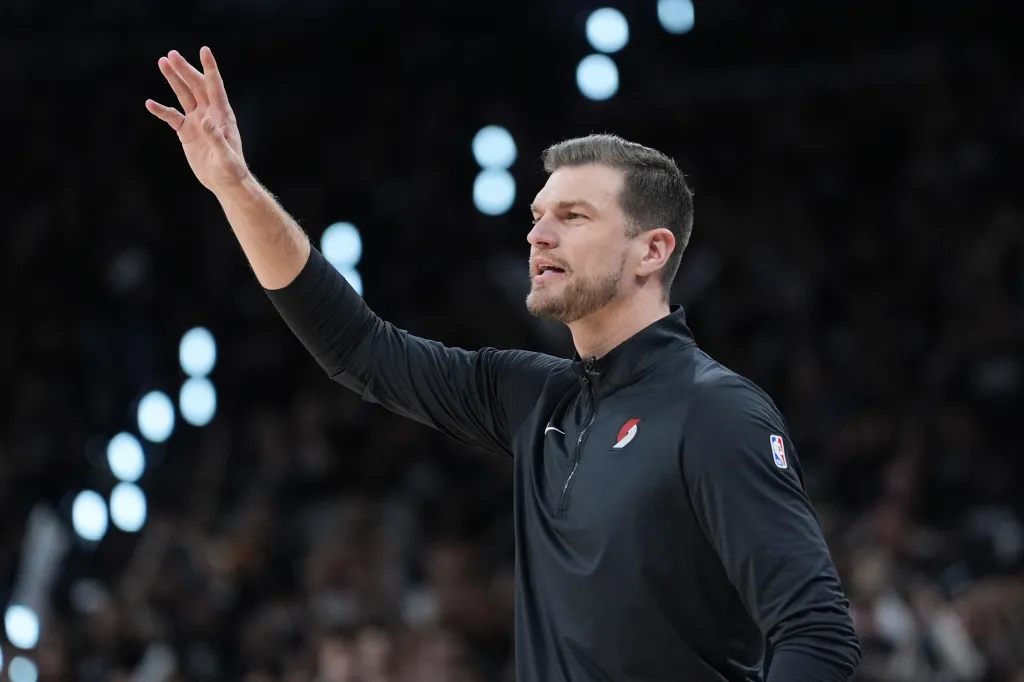
Change is nothing new for Tiago Splitter.
That was an important factor when the Chicago Bulls decided to hire the former Portland Trail Blazers interim coach to helm the franchise’s next era. After taking over a team in tumult last fall, Splitter spent this past NBA season proving he wouldn’t flounder in uncharted waters.
Read more History center screens documentary about Central Florida segregation
For the Bulls, dependability is a necessity for a transitional period that will be defined by change. They have a new top executive. After next week’s NBA draft, they could have a new star. And that means their new coach can’t be daunted by the turmoil of a rebuild.
After an in-person interview with Splitter last week, the Bulls are finalizing a deal to bring him to Chicago for his first full-time head coaching position, a source confirmed to the Tribune on Monday. ESPN first reported the news.
Splitter made an impression on the Bulls front office with his ability and eagerness to develop young talent. But the ultimate takeaway from the hiring process was simple: This is a coach who knows how to stay steady under pressure.
A Brazilian big man who won an NBA title with Gregg Popovich and the San Antonio Spurs in 2014, Splitter is a rising star among the league’s coaching ranks. At 41, he was the youngest of the four finalists — including Wes Unseld Jr., Micah Nori and Ryan Schmidt — the Bulls considered for the position.
Splitter also had the shortest — and most intriguing — coaching resume of the candidates.
After retiring as a player in 2017, Splitter almost immediately transitioned into a scouting position with the Brooklyn Nets. He was promoted to player development coach before earning his first assistant coaching position with the Houston Rockets in 2023. He briefly went to Europe to coach Paris Basketball to the 2025 French Cup title before returning to the NBA for an assistant coaching job with the Trail Blazers.
In Portland, Splitter’s career took an unexpected turn. Barely four months after he was hired, the FBI arrested Blazers coach Chauncey Billups following an investigation into a wide-ranging gambling case. Billups’ sudden removal threw the organization into chaos. Splitter was promoted to interim coach to guide the Blazers through the storm.
Despite the tumultuous nature of his entrance into the role, he made a strong impression by lifting a young and somewhat underdeveloped Blazers team to the playoffs through the play-in tournament. Deni Avdija earned his first All-Star nod, and the Blazers won 42 games to finish seventh in the Western Conference.
The team’s hurdles stretched far beyond the coaching turnover. Avdija couldn’t maintain his All-Star-caliber production after the trade deadline because of a lingering back injury. Scoot Henderson and Jrue Holiday missed significant stretches due to injuries. Still, the young core grew in a season practically designed to derail its progress.
Read more B-52 bomber crashes after takeoff at US military base in Southern California
“He’s done phenomenal,” Avdija said of Splitter during the first-round series, which the Blazers lost in five games to the eventual West champion Spurs. “He’s getting the best out of everybody. He’s believing in each single one of his players. We love playing for him. He’s a winner. He’s a competitor. He knows how it is to win a championship. And you can see that he’s passionate and he’s got all the tools to be a great coach.”
After that type of debut performance, most teams would have been scrambling to lock down an interim coach as a long-term solution. But per a source, the Blazers were either unwilling or unable under new owner Tom Dundon to make a competitive offer to retain Splitter, and the Bulls were able to poach him as a result.
Now Splitter will look to make his mark with only seven years of coaching experience under his belt. His hiring reflects the willingness of new executive vice president of basketball operations Bryson Graham to push for new ideas and put his trust in young talent at the start of a lengthy rebuilding process for the Bulls.
Splitter has spent only two ears — one in Paris, one in Portland — as a head coach. Most of that time was spent learning on the fly. Still, he already has begun to build the foundation of his coaching identity on several key principles.
He prefers a high-speed, simplified system. He believes in molding a system around the players, not the reverse. He leans on a technique of giving players “a menu” of plays and options in any given scenario, a tactic that streamlines decision-making for young players.
“Usually, the good things are simple,” Splitter said in an interview on the “Slappin’ Glass” podcast earlier this year. “When you rehearse one situation over and over and over again, guys just get used to playing and they play better and they read the situations better. I believe that a team doesn’t need many sets to play well.”
That outlook complements Graham’s perspective on how the Bulls should approach the rebuild. In his first two media appearances as their new top executive, Graham repeatedly emphasized the importance of investing in young talent and refusing to skip steps despite an eagerness to return to competitiveness as quickly as possible.
Splitter replaces Billy Donovan, who stepped down April 21 after six seasons as Bulls coach. Donovan’s departure followed the April 6 firings of executive vice president of basketball operations Artūras Karnišovas and general manager Marc Eversley with four games left in the season. The Bulls finished 31-51, missing the playoffs for a fourth straight year and eighth time in nine seasons.
After a wave of deadline trades, however, the Bulls are poised for a transformative offseason following the installation of Graham and Splitter. They have the Nos. 4 and 15 picks in next week’s draft, a potential foundation for their next era — and the basis of the team’s new identity and vision under Splitter.
Read more Florida economists project cities and counties to lose $12 billion under property tax plan