
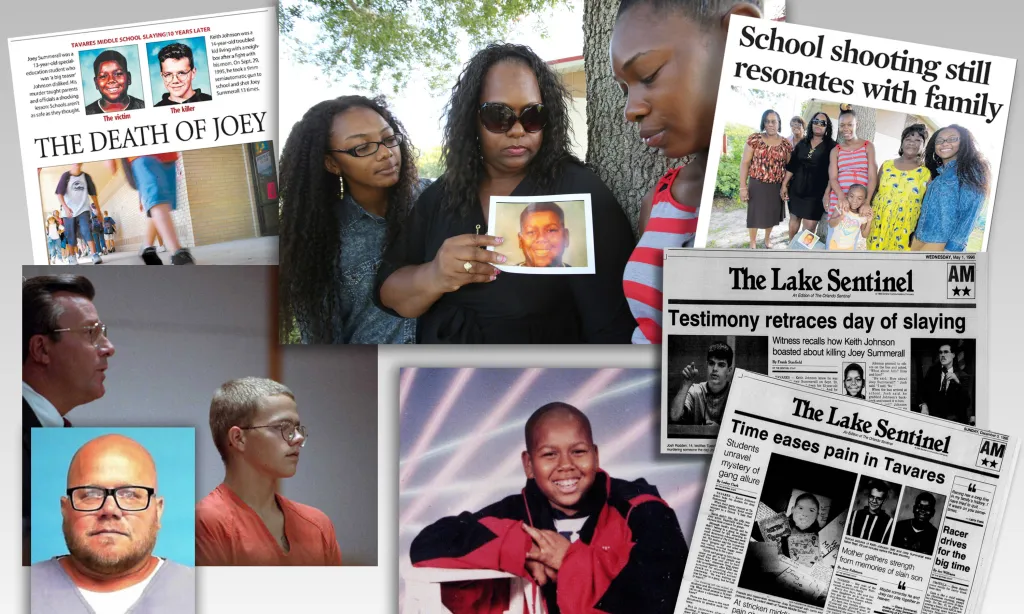
A Lake County man convicted of murdering his classmate at Tavares Middle School 30 years ago has been released from prison and is now in a halfway house, ending a decades-long legal battle triggered by a U.S. Supreme Court ruling.
Read more Smoke + Fire for Juneteenth; Sip + Savor at The Lucky Goat
Keith Johnson, 45, was convicted and sentenced to life in prison in 1996 for the murder of 13-year old Joey Summerall at Tavares Middle School. Johnson, who was 15, shot Joey 13 times with a 9mm pistol in the hallway of the Lake County school, a case that sent shockwaves through that community.
The judge who presided over the case said Johnson could have also been convicted of robbery because he “robbed this community of its innocence.”
Prosecutors at the time said there was “no chance” Johnson would ever get parole, but a 2012 Supreme Court ruling gave him a path out of prison. He was released in April and is now living in a halfway house in Gainesville.
Elaine Summerall Howard, Joey’s aunt, said in an interview Friday that while she’s come to forgive Johnson, he “should not have been released, if Joey can’t be released from death.”
“He still has a life, and Joey doesn’t,” she said, adding that she believes Joey, who was Black, would still be behind bars had he killed Johnson, who is white.
Howard, who was a Tavares police officer at the time, was the first officer to arrive on the school on the day of Joey’s killing. She didn’t initially know Joey was the victim, she told reporters then, so she secured the crime scene but broke down in tears when she learned the dead student was her nephew.
In 2012, the U.S. Supreme Court ruled that sentencing a minor to life in prison violated the Constitution’s protections against cruel and unusual punishment. Because of the ruling, Johnson’s lawyers in 2016 asked a judge to overturn his 1996 sentence and re-sentence him taking into consideration Johnson’s youth and troubled home life that included alcoholism and emotional abuse.
For the next ten years, Johnson’s lawyers and the state’s attorneys went through a legal back-and-forth, taking new depositions and engaging in plea negotiations.
In April, a Lake County judge tossed out Johnson’s life sentence, crediting him for the 30 years served, granting him parole and releasing him from prison. As part of his parole, Johnson is participating in a reentry program at the House of Hope halfway house facility in Gainesville.
On the day of the murder, Johnson pulled his pistol on Joey in a crowded school hallway, causing other students to scatter into nearby classrooms.
In a video-taped confession, shown to jurors at Johnson’s trial, the teenager described what he said led to the killing. Joey had called him a “white cracker” and said, “Come over here and you’re dead.”
“I said, ‘I don’t think so.’ I pulled the gun and I shot him,” Johnson said in the taped confession.
After the shooting, he ran to a nearby orange grove still holding the gun. Officers found and arrested him there.
Read more Despite tourism dip, World Ballet Competition cheers move to Steinmetz Hall
Friends and relatives of Joey described him as a polite, happy-go-lucky kid who would strike up a conversation with anyone. A special education student, he could be a “tease,” his mother said at the time, but he wasn’t a bully.
Joey was on a Tavares Youth Football team and the day of this death was to be the first game he played. He died wearing his football jersey, which a teacher who rushed to help him realized was marked with bullet holes.
The killing prompted the Lake school district to hire police officers and buy hand-held metal detectors for its middle and high school campuses. For days afterward, parent volunteers patrolled Tavares Middle hallways, their sense of safety shattered.
Joey’s mother, Diane Summerall, could not be reached for this story. But Summerall has spoken in the past of her devastating loss, how she moved away from Central Florida but returned about 20 years after her son’s death. In a 2015 interview, she spoke about her fears for her grandchildren, who were then in elementary school.
“I know schools are safer than they were when Joey was killed, but it’s something always on my mind,” she said. “All I can do is pray and know Joey is watching over us.”
Johnson declined an interview, with the executive director of House of Hope writing in a statement that he wanted to focus on “settling into this new chapter of life and the opportunities ahead of him.”
In his order to overturn Johnson’s 1996 sentencing, Judge Lawrence Semento said Johnson’s reasoning “was limited by the immaturity of his brain, which, like juveniles his age, was not fully developed and lacked fully formulated decision-making capability.”
The judge also said Johnson lacked appropriate adult supervision and counseling because of poor family conditions, including emotional abuse, divorce and alcoholism. Court documents noted that Johnson previously had stolen his mother’s car twice, though she declined to press charges. At the time of the killing, he was living with a neighbor because of a fight with his mother.
“Most likely, childhood stress factors and experiences present in Mr. Johnson’s adolescent years had a negative effect on his brain development,” the judge wrote.
Semento also wrote that Johnson, while in prison, “established an exemplary disciplinary record” and had no record of violence. Johnson participated in self-improvement programs and vocational classes, he added.
“Overall, there is a very good likelihood that the Defendant can be rehabilitated,” Semento wrote.
Johnson’s murder of Joey was an early instance of gun violence in schools, a trend that has only increased in recent years. Court documents outline how Johnson had told several other students that he planned to shoot Joey that day and showed them his gun. But no students told anyone ahead of time.
Now, in the wake of the 2018 school shooting at Marjory Stoneman Douglas High School in Parkland, Florida schools have implemented anonymous alert systems and red-flag policies that help law enforcement prevent school shootings before they happen.
Read more USDA steps up screwworm monitoring as cases expand in Texas