
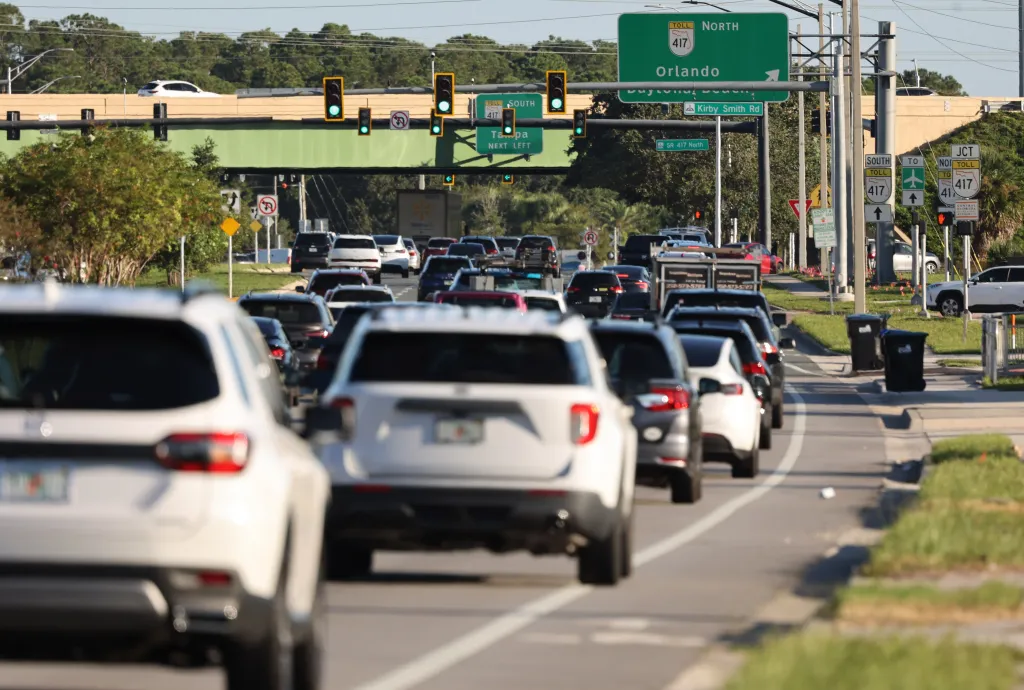
Orange County finds itself at a crossroads with its roads.
It needs many new lanes of highway to handle exploding growth but lacks the money to build them and has few ways to raise cash.
Read more Gators budget jumps $30.4 million as revenue sharing, football spending expand
County commissioners chose this week to put off a decision on one promising option to raise revenue for new roadway pavement — hiking transportation impact fees, a one-time capital charge assessed on most new development in unincorporated Orange County for road infrastructure.
Amid myriad legal and financial pressures, commissioners couldn’t manage a consensus on how to approach the fee hikes. The board almost certainly won’t revisit the issue until 2027 when it grows from six to eight members plus the mayor.
The deferral followed an hour-long analysis of options — and challenges, outlined by Jon Weiss, deputy county administrator.
Among the hurdles are some recently approved state legislation that “generally had the intent and purpose of putting greater legal scrutiny on our impact fee methodologies and really limiting and handcuffing local government’s ability to increase impact fees,” he said.
One of those measures is Senate Bill 180, a controversial hurricane recovery law that is being used around the state to block local land-use regulations viewed as “more restrictive or burdensome” for development of all types. Landowners and their attorneys are arguing that higher impact fees act to restrict new development.
The fees, an upfront cost for building a new house, apartment complex and other residential or commercial project like a restaurant, are meant to help handle the increased traffic that accompanies growth.
Orange County Mayor Jerry Demings favored a delay, saying the board needs a better understanding of other financial obstacles the county faces — which will greatly depend on the fate of a statewide property-tax initiative to increase homestead exemptions and lower tax revenues.
If approved by voters in November, higher exemptions could cost the county $165 million in the first year, and $275 million the next.
Florida economists project cities and counties to lose $12 billion under property tax plan
“I don’t agree yet that the property tax reduction that’s being proffered to our voters is going to pass,” said Demings, whose eight-year tenure as mayor ends November 17. “But we certainly need to understand the full breadth of what we’re going to be dealing with if it does pass.”
In his first term, Demings led an unsuccessful campaign to enact a penny-per-taxable-dollar sales-tax increase with the estimated $600 million in annual proceeds marked to add roads and lanes, expand SunRail and improve LYNX and pedestrian safety.
Nearly 60% of voters said no, leading to a desperate search for other funding options.
Read more ‘Elf’ actor Faizon Love arrested in Florida
“In our community, we cannot solve our housing problems without solving the transportation challenges,” Demings said during Tuesday’s discussion. “Until we have a multimodal system that can get people off the highways with a dedicated funding source, this board — and the future boards — are going to continue to have these same conversations.”
While some people advocate tapping the county’s tourist tax for transportation needs, state law does not permit it, he noted.
Weiss described transportation impact fees as a volatile alternative.
“Collections really ebb and flow based on the general economy and development activity so they’re not a terribly reliable source for transportation funding,” he said, noting the existing fees generated $55 million one recent year in Orange County but plummeted to about $10 million a few years later.
Impact fees, including those for schools, law enforcement, fire protection and parks, already add about $26,000 to the price of a new 2,000-square-foot, single-family home in unincorporated, suburban Orange County. The proposed fee for transportation would push the total over $30,000.
Inflation meanwhile has made road-building more expensive.
Building one lane of highway mile costs 50% more now than in 2020 — up to $6.8 million from $4.5 million, Weiss said.
The 149-page reviewed by commissioners, proposing a wide-ranging update of the transportation impact fee structure, is Orange County’s most comprehensive look at the issue in five years. It examined hundreds of categories of land uses, from pubs to pickleball clubs, and calculated traffic generated by each.
The fees are not intended to “dig ourselves out of a hole,” Weiss said.
They’re intended to ensure infrastructure can be provided to support new development.
The county spends more than $70 million a year on road expansion projects funded with non-impact fee revenues.
Orange County officials: Developers need to pay more for transportation
Commissioner Nicole Wilson, whose west Orange district includes Horizon West, where congested roads are a frequent complaint, was frustrated by the board’s inaction. She favored adopting an updated fee schedule right away to make sure development pays its way.
The delay benefits development interests, “not our residents struggling with the pressures of growth,” Wilson said.
“It’s so disappointing to have the research done…and then chose to do nothing with it,” she said.
Read more US Supreme Court to consider if Florida law on jury size is constitutional