
Editor’s note: Pennsylvania and New Jersey have played a key role in the nation’s 250-year history. While most are familiar with the events that happened in Philadelphia, our region also played a pivotal role in the development of the fledgling nation. In honor of the country’s 250th anniversary celebration, we will feature some of the places, people and events in the region that helped shape America’s history.
Read more Congress wonders as the Iran war draws to a close: Was it worth it?
While the First Battle of Trenton needed months of storylines and buildup, actual fighting lasted all of one hour as Gen. George Washington claimed a victory that turned the tide for the American Revolution.
Euphoria associated with the signing of the Declaration of Independence, a manifesto for separation from England and pursuits of life, liberty, and happiness, hot-blooded passions cultivated inside Independence Hall during the summer of 1776, had been reduced by chilling defeats.
Continental fighters lost at the Battle of Long Island, aka the Battle of Brooklyn, in August 1776, in the first showdown following ratification of the Declaration of Independence. The American side witnessed 300 killed, 650 wounded, and more than 1,000 captured or missing during the late summer encounter.
Revolutionary troops fell against the British in White Plains, N.Y., in October, a setback that preceded defeats in Fort Lee and Fort Washington (2,800 American troops lost) one month later. The losses put Washington and his soldiers on the run as he and troops high-tailed across the Delaware River into Pennsylvania. Historians theorize that if the British had followed Washington across the Delaware for one final fight, the revolution would have ended on those western shores.
Fort Lee had produced a low point as the Americans left behind most of their supplies, including 50 cannons, hundreds of tents, thousands of barrels of flour, and ammunition, Battlefields.org explains.
British Gen. William Howe ordered Lt. Gen. Charles Cornwallis to capture Fort Lee, removing the Continental Army’s defenses along the Lower Hudson River. On Nov. 20, 1776, Cornwallis’ force of 5,000 British and Hessian soldiers crossed the Hudson River and landed north of Fort Lee. Continental Maj. Gen. Nathaniel Greene learned of the approaching British Army. Knowing that defeat loomed, Greene ordered the abandonment of Fort Lee.
The retreat preceded a brutal march through New Jersey towns of Hackensack, Newark, New Brunswick and Princeton. Cold rain drenched the procession while low rations cultivated desertions, while enlistment contracts ended.
The American soldiers, 2,000 to 3,000 strong, arrived in Trenton on Dec. 2 with the Revolution on life support. Even Washington appeared close to ending the Continental Army fight, writing to his cousin in Virginia: “I think the game is pretty near up.”
They eventually crossed into eastern Pennsylvania, regrouped and set the stage for the aforementioned one-hour fight in Trenton.
A Washington Crossing Historic Park website offered this account:
On Christmas Day, continental troops marched from as far away as Newtown in the rain and cold to join soldiers already encamped near McConkey’s Ferry (Washington Crossing) on the Pennsylvania side of the Delaware River.
As darkness fell, the rain became driving snow, sleet and wind. Sailors from Massachusetts and the Pennsylvania Navy ferried the 2,400 troops across the icy river under Washington’s careful supervision. Durham boats, typically used to carry pig iron and other cargo, carried the soldiers across the fast-moving water. Artillery and frightened horses crossed the river on larger ferry boats.
Because the boats had to make several trips across the river, the army was not ready to march. The patriots pressed on, hoping that they could still surprise the British troops in their barracks in Trenton.
Gen. Ewing and Col. Cadwalader and their troops were to cross to the south, but icy conditions prevented the crossing. Washington and 2,400 fighters would fight alone. At 8 a.m., the American troops surprised and defeated the Hessians at Trenton, taking many prisoners.
According to Crossroads of America, “some 22 Hessian soldiers and officers were killed, including Colonel Johann Rall, their commander; 84 were wounded, and 886 were taken prisoner.” Only a few American soldiers were injured in the short fight that lasted slightly longer than one hour. Laden with captured supplies and prisoners, Washington’s troops recrossed the icy river.
On Jan. 2 and 3, the Americans again crossed the Delaware River and defeated the British in the Second Battle of Trenton and in the Battle of Princeton, driving the British so far back that the Continental Army went into winter quarters in New Jersey.
The victories not only boosted the morale of the army, but also inspired the patriots of the colonies. Many of the soldiers due to leave the army agreed to extend their service. New recruits joined the army. The daring attacks revitalized the American effort. Numerous publications identify 10 crucial days that reshaped a revolution.
Day 1: Dec. 25, 1776
A Continental Army force of 2,400 soldiers crossed the Delaware River at McConkey’s Ferry to New Jersey. They march 10 miles to Trenton in a blizzard to assault the 1,500 Hessian troops occupying the town.
Read more Armed man killed in deputy shooting at Sanford block party
Day 2: Dec. 26, 1776
First Battle of Trenton: The Continental Army defeats the Hessians at Trenton to win its first significant victory of the war, then returns to Pennsylvania with its prisoners and captured goods.
Day 3: Dec. 27, 1776
Washington and his generals recross the Delaware into New Jersey to discover the enemy has withdrawn from the Trenton area.
Day 4: Dec. 28, 1776
After convening a council of war, Washington and his generals plan a defense in Trenton from Cornwallis.
Day 5: Dec. 29, 1776
The Continental Army crosses the river at several ferry crossings and returns to Trenton.
Day 6: Dec. 30, 1776
Washington persuades a bare majority of his soldiers whose enlistments are to expire on Dec. 31 to remain with the army for another six weeks by promising to pay each of these soldiers $10 in hard coin. Washington’s force of 6,000 men prepares a defense on high ground south of Assunpink Creek in Trenton.
Day 7: Dec. 31, 1776
The Continental Army advances from Trenton toward enemy occupied Princeton.
Day 8: Jan. 1, 1777
British and Hessian forces gathered strength in Princeton. The Continental Army skirmishes with British and Hessian troops on New Year’s Day.
Day 9: Jan. 2, 1777
Second Battle of Trenton: The Continental Army fights against 8,000 British and Hessian troops under Cornwallis. The Continentals repelled Cornwallis’ attacks along Assunpink Creek until dusk. Cornwallis planned to “bag the fox in the morning.”
Day 10: Jan. 3, 1777
Battle of Princeton: Overnight, Washington and his troops withdraw from Trenton and begin to march to Princeton where they defeat the British and the Hessians. This results in the third and final victory for the Continental Army, thereby ending the military campaign associated with the “Ten Crucial Days.”
Postscript: Jan. 3-6, 1777
The Continental Army makes its way from Princeton to Morristown, N.J., where it establishes its winter quarters.
Crossroads of the American Revolution recommends visits to these historical sites in Trenton:
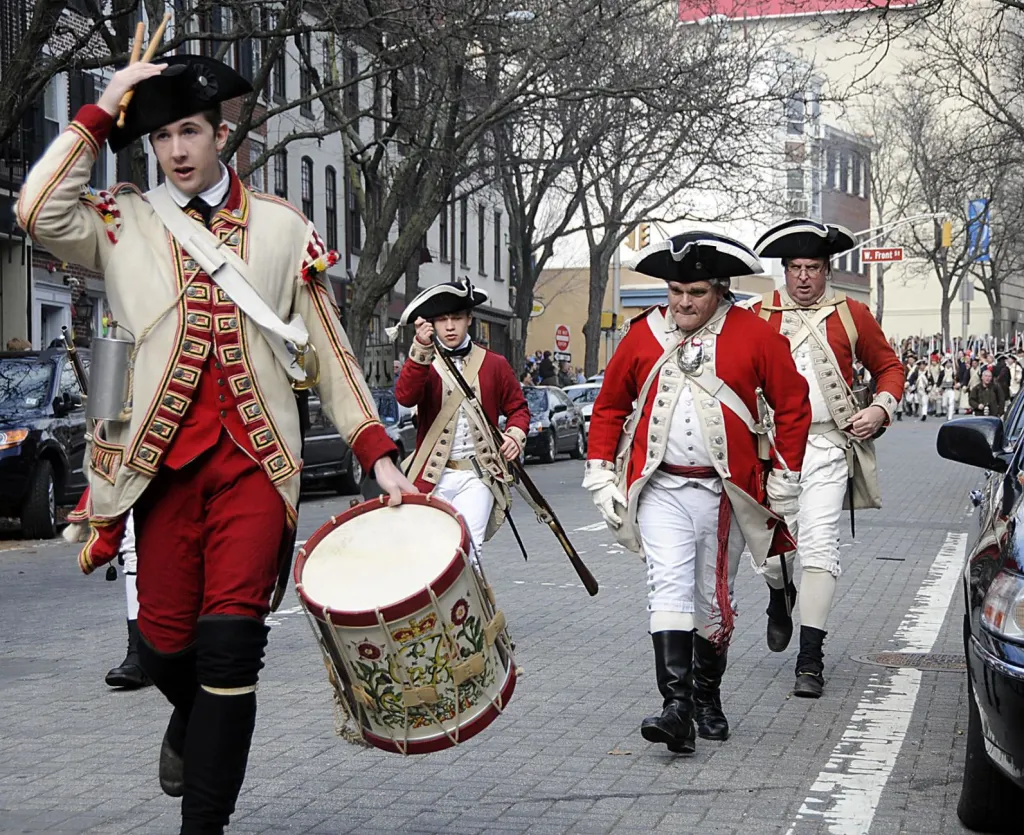
The Old Barracks Museum is a prime spot to begin your Ten Crucial Days tour in Trenton. In December 1776, the Barracks were occupied by British and Hessian troops. After the Battles of Trenton and Princeton, the Barracks were then occupied by the revolutionaries and used as a hospital. Every winter, the Old Barracks is central to Patriots Week celebrations and the Battles of Trenton reenactments.
The 1739 Friends Meeting House (Hanover and Montgomery Streets) was occupied by British Dragoons in December 1776. George Clymer, a Pennsylvania signer of the Declaration of Independence, is interred in the burial ground.
Saint Michael’s Church (North Warren Street at Perry): The congregation of this 1747 “English Church” was split between Loyalists and Patriots, causing the suspension of religious services during the war. David Brearly, a New Jersey signer of the Constitution, who later became the state’s first federal judge, is buried in the churchyard.
Buried on the west side of the First Presbyterian Church (120 E. State St.) in unmarked graves are Hessians who died in the First Battle of Trenton, including Colonel Johann Rall. The Rev. John Rosbrugh, a casualty of the Second Battle of Trenton, and the first American clergyman to die in battle is buried on the east side.
On Jan. 2, 1777, the small frame 1766 Alexander Douglass House (oft-moved, now at Front and Montgomery Streets) sheltered the Continental Army council of war where the decision was made to make an overnight march to Princeton to attack the British garrison.
Plus, the Battle Monument serves as a sight line to downtown Trenton where American soldiers held high ground against Hessian mercenaries. National Parks on both sides of the Delaware River offer interesting visits.
Read more Asking Eric: I took a DNA test to debunk my sister’s gossip. It turns out she was right.