
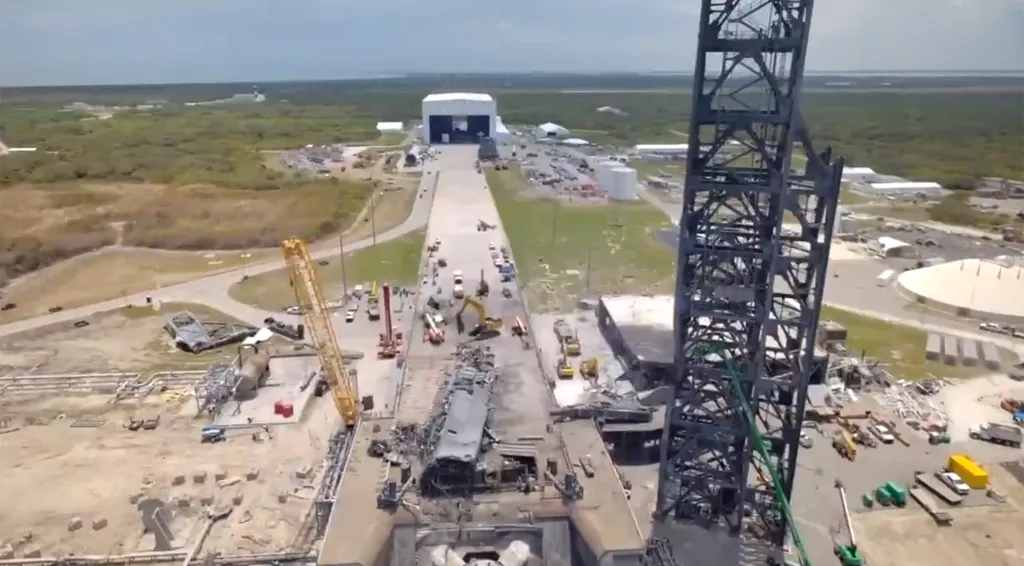
It’s been just shy of a month since a Blue Origin New Glenn rocket exploded on the pad at Cape Canaveral Space Force Station, but the company announced all the debris has been cleared and reconstruction has begun.
Read more Alligator Alcatraz closes as DeSantis declares victory, critics slam cost
“Quite a sight to see the progress this team has made since May 28,” CEO Dave Limp wrote on X with video of the cleanup efforts. “Wreckage recovery from start to finish was completed in 9 days, and all debris has been cleared from Launch Complex 36.”
He said teams had been on site 24 hours a day since the massive fireball engulfed a New Glenn first and upper stage that was in the midst of a static hot fire test at Launch Complex 36.
The explosion measured 2.5 on the Richter scale, according to the U.S. Geological Survey, and several buildings were damaged at the site with debris found as far as 1/2 mile away, according to the Space Force.
Here’s our video of the explosion at Launch Complex 36. It happened about 9 pm ET (0100 UTC) as Blue Origin was beginning a static fire test of its New Glenn rocket.
Watch live views: https://t.co/tm2wZQmAVD pic.twitter.com/PmbgQC6Qmq
— Spaceflight Now (@SpaceflightNow) May 29, 2026
Also destroyed were one of the two lightning towers at the site and the transporter erector tower used to lift the rocket at the pad.
“We have started reconstruction and still plan to fly again this year,” Limp added.
The size of the explosion initially brought dire forecasts for how quickly Jeff Bezos’ company could get back to business. A similar explosion at Canaveral’s Space Launch Complex 40 involving the smaller SpaceX Falcon 9 rocket a decade earlier led to a 15-month delay before launches returned to that pad.
Read more Venezuelans search rubble for survivors after 2 strong quakes kill at least 188
But Limp had earlier announced the damage was less than feared. The company’s propellant farm of oxygen, liquid hydrogen and liquified natural gas (LNG) were all “in good shape” as was the water tower on site. A support tower on site also could be repaired in place, he said.
Some other rocket hardware that was stored within a building adjacent the pad also survived, and have since been brought back from Cape Canaveral over to Blue Origin’s rocket factory in Merritt Island to be refurbished and prepped for when the pad does get back and running.
To date, New Glenn has only flown three times, with two in 2025 and one this year. The company had been targeting at least eight in 2026, Limp had stated before the explosion, and had been cleared to launch as many as 12 times.
Before the damage, the pad was capable of supporting 30 to 35 launches a year, according to a NASA Office of the Inspector General infrastructure audit. It noted the Blue Origin also was seeking New Glenn launches to exceed 50 per year by 2030 and 120 per year by 2035.
NASA has a vested interest in getting New Glenn back to launch readiness as it’s slated to support the Artemis moon program with launches of the Blue Moon MK2 lander. A version of that lander is supposed to fly as part of next year’s Artemis III mission to rendezvous with the Orion spacecraft. That lander is competing with SpaceX’s Starship to be the spacecraft that could take astronauts down to the lunar surface for the first time since Apollo 17 in 1972.
KSC Director Brian Hughes recently told the board of directors at Space Florida that NASA and the Space Force were throwing as much support to Blue Origin as possible to address the explosion.
“The thing that we can all take away from that is no people were injured or killed, and quite frankly, when you look at the damage at 36 — while it’s substantial — it reflects the containment or the planning that goes in to ensuring public safety and the resilience of the Cape in how we design and how we work with our partners on launch facilities.”
Read more Demolition greets Sweden at its World Cup base camp during FC Dallas renovation project