
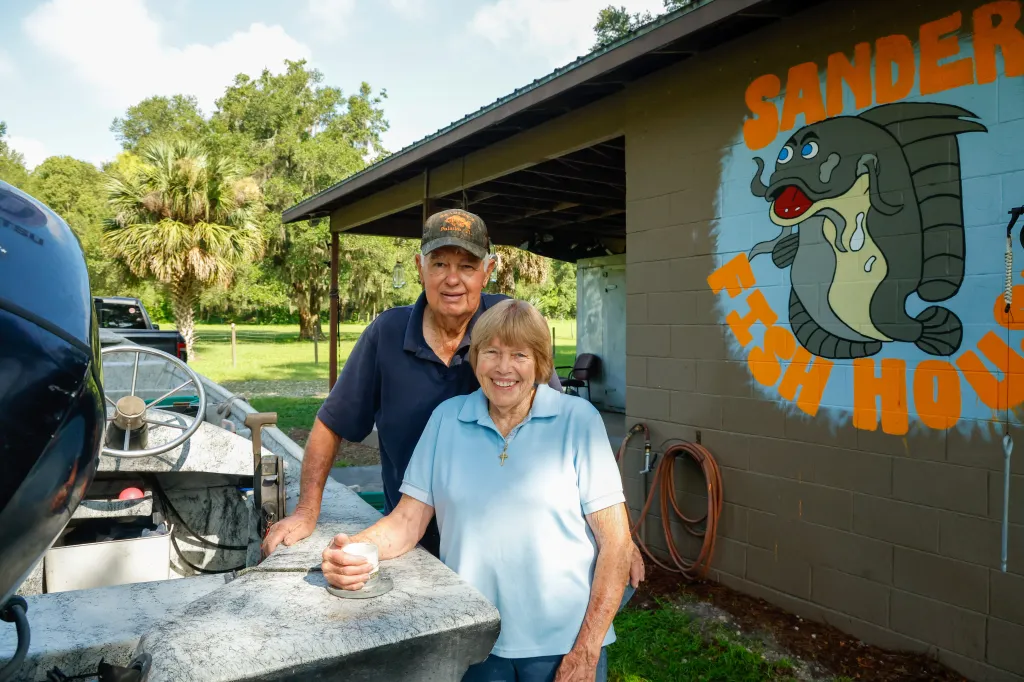
Right now, there’s a current in the St. John’s River, Richard Sanders tells me. It makes for good fishing.
Read more Supreme Court ruling blocks thousands of lawsuits against maker of Roundup weedkiller
“[If] you get an east-northeast wind and the river flows backward, you don’t catch nothing. But as long as it flows north like it’s supposed to, you do pretty good.”
Sanders, 82, and his wife, Betty, 81, have been doing pretty good for more than 63 years on their little stretch of Florida’s longest river, one that — as Sanders noted — flows uniquely north. Its headwaters are in Indian River County, its mouth in the Atlantic near Jacksonville, which is the furthest place Sanders Fish House delivers its wild catch.
They sell straight to restaurants, mostly — places like Shady Oak, Porkie’s BBQ and the DeLand Fish House closest to home, Drifters Riverfront Bar & Grill in Astor, even Bradley’s and Corky Bell’s up in Palatka. There are local folks in the know, however, who come to stock their own freezers, as well.
In 2026, farmed catfish are America’s largest aquaculture industry according to the American Farm Bureau, though Asian competition is fierce. On the St. John’s, however, the Sanders have outlasted virtually everyone.
In the ’60s, when they first set up shop, there were millions of figurative hooks in the water. These days, it’s quiet when they pull up the morning’s catch. Dead fish get tossed to the gators who’ve come to know there’s a free meal coming. Sometimes, they even lie on the nets, waiting — a display of reptilian patience.
The Sanders’ catch is as fresh as it gets.
Sanders, along with two of his daughters, skins the fish straightaway.
“I don’t ice the fish,” he says. “If you ice them first, then skin them, they don’t look good. They look raggedy. When you do ’em fresh, they look much better.”
The haul gets a short bath before it is dispatched.
“I put them in a tub of water, chill ’em down to where they’re not jumping all over the table.”
Fans of wild-caught catfish — bullheads, reds, yellows and channel cats mostly — say it’s the only way to eat this white, flaky delight, and I’m inclined to agree. Farmed fish can taste muddy, due in part to s.
A buttermilk soak is often used to remove that “farm-raised” flavor, but when it’s there, it’s there, turning fine fillets into something that tastes more like fish food than fish.
“They taste like what they eat,” Gerri Sanders Roos agrees. “And better when they’re able to eat their natural diet.”
Circulating river water means there’s nowhere for algae compounds to build up. Constant swimming means less fat and firmer muscles. And the catfish’s naturally diverse good eating — mollusks, small fish, juvenile crabs, insects, as well as decaying plant and animal matter — makes them good eating for us.
Grass shrimp and crawfish, also part of its natural diet, are among what the Sanders’ use for bait, setting out 3,000 hooks — two sets of 1,500 when they use lines.
The nets, for the most part, stay out consistently, says Roos, though they are checked regularly, every few days, which prevents not only the algae problem that plagues farmed fish, but also fishermen, as well.
“We’ll swap them out where the algae doesn’t grow on them, so the fish will go into them easier,” she explains. “They can catch the scent of something down there and won’t go into a dirty net, plus dirty nets are harder and heavier to pull up.”
No matter the method — nets or trout lining — they’re hauling up boatloads most mornings, then bringing them to their current space to process. It’s a small cinderblock house with a colorful mural. A cardboard sign, inked in black marker, tells folks who drive up the dirt road to “blow your horn for fish.”
There are large freezers outside, and a processing room-slash-office within. They bought the property and built the place, about two miles from their home, in 1998.
Read more How lifelong learning helps older adults stay sharp and connected
“Before that, I was skinning fish in my garage outside,” he says.
The couple met in Kissimmee and married shortly after high school. Betty’s family, commercial fishermen, plied their trade on Lake Kissimmee, where her brothers taught Sanders to fish, but soon after, they came to DeLand, where many of Betty’s family were originally from.
“He took to fishing like a duck to water,” she says of her husband.
Fishing methods back then were often … creative.
“Even the nets I use now were illegal back then,” he tells me. The trout lining was all you could do when folks were watching, though many fishermen — there were a lot more here back then — did what was called monkey fishing.
“It was a long, long time ago,” he says, explaining the popular but prohibited process of electrofishing with an old-school, hand-cranked telephone. Current-stunned fish would float to the top, making them net-scoopable.
Sanders catches more than fish in his nets, of course. A colorful collection of lures and lines — including a weighty, three-hook gator snatch — sits above the desk in his office. It’s a temporary art installation; he purges it every six months. More will come.
“I caught a pistol out there once,” he tells me. “Picked it up with a grapple hook.”
Roos’ husband, a police officer, ran the numbers. The gun came up clean.
“I still got it,” he says. “It looked like it had just been thrown in there. It wasn’t rusted up or nothing.”
Roos and her sisters grew up in the business, making lines after school at the table, setting them out, then returning home for dinner and homework.
“We didn’t go anywhere Saturday mornings ’til the fish were done,” she says, noting that sibling squabbles were likely more interesting at their house than most.
“We had knives,” she jokes.
“But we made it through and were better for it.”
Betty’s retired now. She worked as a manager at Winn-Dixie for 20 years, but on this day, she’s out, riding her own mower alongside her husband’s. It’s a rare non-fishing day. They are tidying the property.
“He managed this business for years,” she says. “Now, I help with everything, but he draws the salary.”
“You’re good help,” he tells her. “The money all goes to one place.”
Betty chides her husband in the way couples married 63 years can. Tomorrow is their anniversary.
“One thing I’m sure he didn’t tell you is that we never bought anything we couldn’t pay for … We worked, we saved, and we bought what we needed, and it’s been a blessing to us.”
Sanders may not be the young dad Roos remembers, who could wrap heavy line around his hands and snap it, or hit the bottom out of a thick glass Coke bottle to her delight, then his grandchildren’s, “but I’m still going.
“I got a bad heart. One of these days I’ll walk out of here and probably fall over, and that’ll be that.”
But for the time being, he says, there are just as many fish as there have always been. Perhaps even more.
“Because now, I’m the only fisherman here.”
Find me on Facebook, TikTok, Twitter or Instagram @amydroo or on the OSFoodie Instagram account @orlando.foodie. Email: [email protected], For more foodie fun, join the Let’s Eat, Orlando Facebook group.
Read more 988’s LGBTQ+ hotline to relaunch this year. But the group that helped start it might be excluded
Our 2026 Foodie Award winners list revealed — see who won