
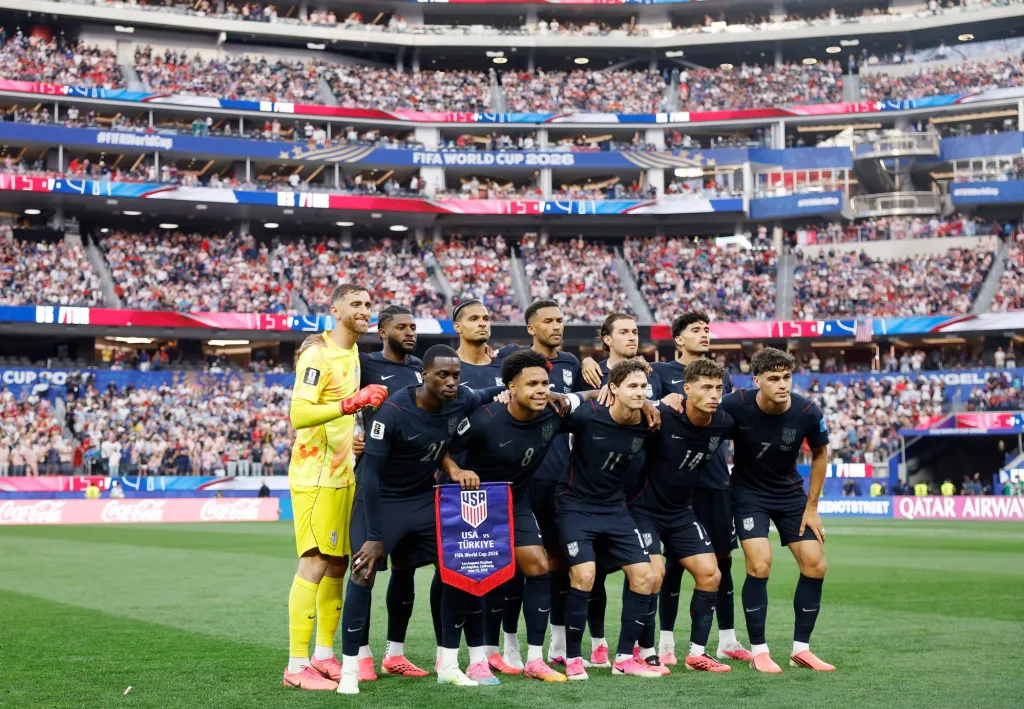
Midfielder Sebastian Berhalter was asked after last week’s 3-2 World Cup loss to Turkey why the U.S. men struggle so mightily against European opposition.
Read more World Cup: Pochettino has instilled belief within US team, and across the country
“Ummmm,” Berhalter said, pausing, “I’ll have to get back to you on that. I’m not sure of the stats.”
The stats: The Turkey loss was their 10th straight — no wins, no ties — in friendlies or official matches against European teams. In the World Cup, the Yanks have faced 21 European opponents since 1990 and, gulp, won only once, a 3-2 decision against Portugal in 2002 that was aided by an own goal on a Landon Donovan cross that fortuitously deflected off the back of a defender’s neck into the net.
Informed of the grim history, Berhalter politely smiled and, his five-minute interview session expired, walked off the podium.
It is an inconvenient truth that U.S. players either don’t know or don’t want to know but is suddenly consequential with a round of 32 date against Bosnia and Herzegovina on Wednesday night in Santa Clara. And likely three more European foes waiting for them in the round of 16 (Belgium), quarterfinals (Spain) and semifinals (France).
“I didn’t know it until you said it,” midfielder Tyler Adams said. “I couldn’t care less if we had a 100-game winning streak or a 100-game losing streak. I go out every game trying to win.”
“Damn, I didn’t know that,” defender Chris Richards said. “Let’s hope we change that for the next game.”
There are three viable explanations.
Rub of the green
“It’s just one of those things,” defender Tim Ream said curtly after watching the U.S. reserves commit multiple defensive blunders in surrendering a last-minute goal against Turkey. “None of us are thinking, ‘Oh, it’s a European team, we’re going to lose.’ It’s just one of those things.
“I’m not going to say it’s a coincidence, but stylistically, it’s not even about style. It’s just rub of the green and just the way the ball is falling right now for us.”
That’s a lot of bad bounces, though.
In the World Cup since 1990, the Yanks are 1-15-5 against European teams. Against everyone else, they are 7-4-1.
Since the start of the 2022 World Cup, they are 0-10-2 in all matches against European teams, including two draws in the group stage and a 3-1 loss to the Netherlands in the round of 16 in Qatar followed by nine consecutive Ls since. Against everyone else, they are 30-10-9 over that period.
Since coach Mauricio Pochettino was hired in October 2024, the United States has lost all six European encounters and been outscored 18-6.
Europe is just good
Maybe the most logical explanation is that, well, Europe is really, really good at soccer.
Read more Collins challenges Fishback’s candidacy, says he should be off the ballot
The continent has claimed four of the last five World Cup titles (by four different countries that all border one another). It holds nine of the top 14 spots in the current FIFA world rankings. It has the top five World Cup rosters based on total transfer valuation and eight of the top 10, which isn’t surprising because the top five richest pro leagues are all in Europe.
There are a record 16 European teams at this expanded World Cup, up from 13 in past tournaments, and that doesn’t include No. 14-ranked Italy, No. 20 Denmark and six others in the top 40.
“We are USA,” Pochettino said last spring, in a moment of frustration and candor, after getting drilled by Belgium and Portugal in friendlies by a combined 7-2. “We are competing against Belgium, Portugal. I think for sure Belgium and Portugal have, in the top 100 players, a few or some players playing in that top 100.
“I think we don’t have.”
The counterargument is that not everyone struggles against the Old Continent. Japan, which has never won in the World Cup knockout stage, currently has an 11-match unbeaten streak against European teams. They’ve won eight times and tied three times.
Horses for courses
That leaves something stylistically, something in the size, strength, fitness, organization, tactical sophistication, youth development or historical pedigree of European teams. The simple answer is that the U.S. men play a style of soccer more similar to European clubs than their brethren in the Americas, and the Europeans are just better at it.
“When you think about European teams, you think about more technique and technical ability,” Richards said. “When you think about South American and African teams, you think about more mentality.
“Maybe there’s something there, or maybe we’ve just been unlucky. I haven’t really thought about it, to be fair.”
The good news is that the Americans are facing Bosnia and Herzegovina instead of, say, any other European team here. The Balkan country of 3.1 million with a land area slightly smaller than West Virginia is the lowest-ranked European team here at No. 61, squeaked into the knockout stage by finishing third in Group B despite getting smoked 4-1 by Switzerland, has qualified for just two of eight World Cups since joining FIFA as an independent nation and has never reached the round of 16.
It’s also the last European team the Yanks beat, 1-0 at Carson’s Dignity Health Sports Park on Dec. 18, 2021.
Even that wasn’t easy. It took an 89-minute goal by Cole Bassett to beat what amounted to a Bosnian B team on home soil.
After that, there were draws against Wales and England in the 2022 World Cup.
Then loss, loss, loss, loss, loss, loss, loss, loss, loss, loss.
The Netherlands, Serbia, Germany, Slovenia, Turkey, Switzerland, Belgium, Portugal, Germany again, Turkey again.
“Ultimately, streaks are meant to be broken,” Richards said. “That’s kind of the plan.”
Read more Gabriel Martinelli scores late in injury time to help Brazil beat Japan 2-1 at World Cup