
Orlando desperately wanted World Cup matches.
We put in our bid, lobbied hard and dreamed. We imagined Lake Eola draped in the colors of the world, downtown overflowing with supporters from six continents, and Camping World Stadium taking its place on soccer’s biggest stage just as it did in 1994.
Read more Scattered storms and extremely hot weather along the I-4 corridor
Except this time, FIFA passed us by. But maybe we’ve been looking at this all wrong.
Although Orlando didn’t get World Cup games, we gave the World Cup something far more important. We gave the United States one of its brightest young stars.
Alex Freeman isn’t simply playing in the World Cup. He’s starting in it. He’s scoring in it. He’s becoming one of the breakout players of the tournament. And while the passport says he was raised in South Florida and the family name carries NFL royalty, the soccer player the world is discovering now was built in Central Florida.
That should matter to this city, and it should make Orlando proud.
Because long before he was playing for Villarreal in Spain’s top division. Long before Team USA coach Mauricio Pochettino declared Freeman has “the potential to be one of the best players in his position in the world.” Long before the United States entrusted its World Cup hopes to this 21-year-old right back, there was a difficult decision made during the pandemic.
There was a mother being asked to let her teenage son move 200 miles away. There was Orlando City’s youth academy coach willing to bet on a kid Inter Miami’s academy overlooked. And there was a coach named Javier Carrillo who saw something in him that others didn’t.
Carrillo first coached Freeman at the highly respected Weston FC soccer academy in South Florida before leaving to become the U-17 (Under 17) coach at Orlando City’s academy. When Carrillo arrived in Central Florida, Freeman had just been turned down by Inter Miami’s academy, and Carrillo immediately wanted Freeman to follow him north.
That proved easier said than done.
Freeman was only 15. His family wasn’t moving. He would have to live with a host family he had never met. Even more remarkably, the host family was so gracious that they offered to open up their home to Freeman even though their own son would be competing directly against Freeman for playing time.
“Imagine being in the middle of COVID, and you have a 15-year-old kid whose former coach is knocking on your door and saying, ‘Listen I have a great opportunity for your son, but he’s going to have to move to Orlando, and he’ll be playing a different position than he plays now and he’s going to be living with a family he doesn’t know.’ ” Carrillo says now as he recalls the conversation with Freeman’s skeptical mother. “It was challenging to say the least, and there was a lot of back and forth, but in the end everybody agreed and it all paid off.”
It wasn’t merely a soccer decision; it was a leap of faith that became the defining moment of Alex Freeman’s budding soccer career.
Freeman has since said the move forced him to grow up almost overnight. Suddenly he had to manage schoolwork independently, do chores and learn what pursuing a professional dream actually required.
That’s when Orlando stopped being merely the next stop on his soccer journey. It became the place where the journey truly began.
Almost immediately, the move paid off. Freeman made 30 appearances for the U-17 team, scoring eight goals and providing 15 assists as Orlando City was crowned the inaugural MLS Next Cup U17 national champions. But Freeman wasn’t handed anything. He spent years grinding with Orlando City B, learning his craft while many wondered when — or if — the breakthrough would come.
He signed his Homegrown MLS contract at 17, but professional soccer has a cruel way of exposing young talent. Potential isn’t enough.
Oscar Pareja made sure Freeman understood that. The former Orlando City manager saw Freeman’s attacking gifts immediately — the speed, the athleticism and the instincts going forward. But Pareja also knew something Freeman eventually came to appreciate: world-class fullbacks defend first.
For three seasons, Pareja demanded better positioning, better body shape, better one-on-one defending and greater physicality. Freeman could have grown frustrated.
He never did.
Instead, he listened. He improved. He earned every minute. He became an MLS All-Star and now is the youngest player on Team USA’s roster and a rising star in Spain.
“Every player wants to make it to the top and make it fast,” explains Carrillo, now the head of Orlando City’s player development. “Sometimes, a player’s agent will get impatient or the parents will get impatient or the player himself will get impatient, but Alex understood that there’s a process, and Oscar did a good job of explaining that to him. Alex never backed down from the challenge and he finally got the opportunity and seized it.”
Read more Did ChatGPT aid FSU mass shooting? Student sues tech firm for negligence
That willingness to embrace coaching may be Freeman’s greatest gift. Yes, he’s blessed genetically. His father, Antonio Freeman, was an All-Pro NFL receiver, a Super Bowl champion whose route-running became legendary in Green Bay. ESPN recently noted that former Packers teammates now joke they see “the Freeman hips” every time Alex glides past defenders.
But Alex’s greatest inheritance wasn’t athleticism.
It was perspective.
Alex has often said his father taught him what it takes to become a professional — not soccer tactics, but discipline, sacrifice and consistency. His mother, Rochelle, and stepfather, Jake, introduced him to soccer and nurtured his love for the game, creating an unusually supportive family dynamic that helped him chase an unconventional dream.
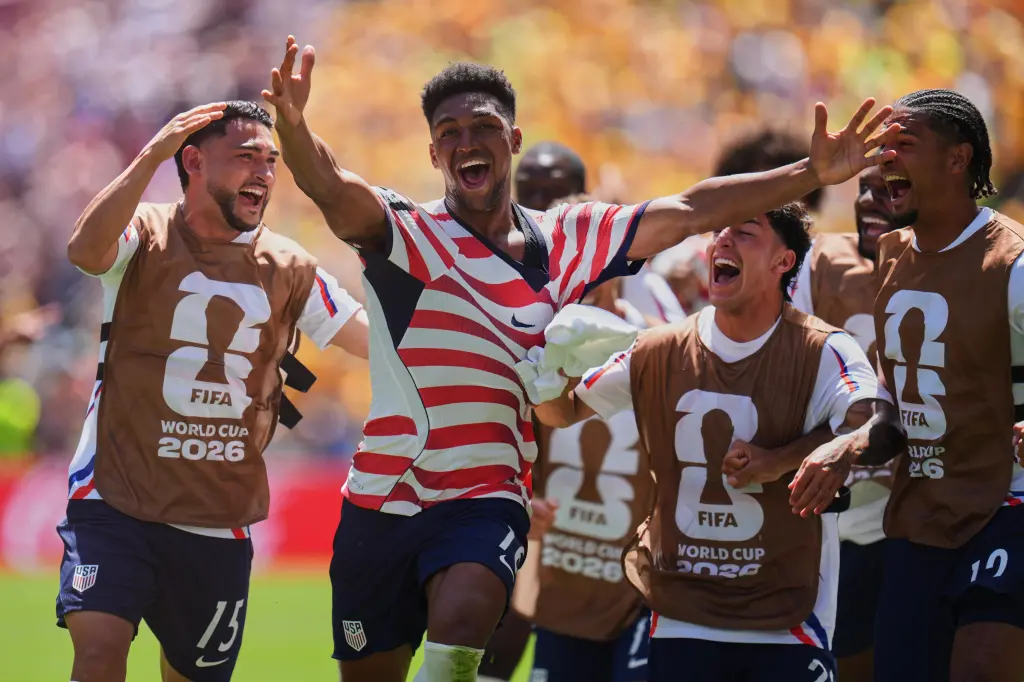
The dream continued to unfold against Australia on July 19 in the group stage of the World Cup. With Sergiño Dest’s shot hanging high in the air, Freeman reacted first. He soared upward and his header found the back of the net. The flag went up. Celebration turned into uncertainty. Then came the agonizing VAR review.
Finally, the goal; a monumental goal that came nearly 30 years after his father caught an 81-yard bomb from Brett Favre to help the Packers beat the Patriots in the Super Bowl.
“I think for me, it just shows how great the family tree is,” Freeman said after scoring in the 2-0 win against Australia. “And I think that just shows how (my father) can be great, but I can be great in my own way as well. And I think that just shows how amazing it is to have a dad who’s successful and that could mentor me to be able to be ready for moments like these.”
The celebration of the moment lasted only seconds.
The journey took years.
Years spent in Orlando. Years spent trusting a process. Years spent with coaches refusing shortcuts.
Perhaps the most emotional moment of all came before the tournament even began.
After officially making the U.S. World Cup roster, Freeman was in New York for U.S. Soccer’s “The Call” campaign as part of Team USA’s roster reveal. Freeman didn’t call a celebrity. He didn’t call his parents.
He called Javier Carrillo — his youth coach.
“It was such a special moment,” Carrillo says now, “because you spend so much time with the kids trying to make them better, trying to teach them things on and off the field. When one of those kids makes it to the very top and shows how grateful he is to his youth coaches, you can see the holistic development of the player has been a success.”
Carrillo reminded Freeman during the call to keep being the same humble young man off the field who had earned everyone’s respect on it. Freeman thanked the coach who had believed in him long before the world knew his name.
Those moments rarely make highlight reels, but they’re every bit as important as goals.
Which brings us back to Orlando.
No, FIFA didn’t award this city World Cup matches. And, yes, that’s still a sore spot among civic leaders.
But cities don’t become soccer capitals simply because FIFA schedules games there. They become soccer capitals because they produce players the world wants to watch.
Orlando City deserves enormous credit — not only Carrillo, but Pareja, former general manager Luiz Muzzi, the academy staff, Orlando City B coaches and everyone who patiently developed Freeman instead of rushing him. They resisted shortcuts. They built a professional.
Now the rest of the world is applauding the finished product.
Orlando didn’t get the World Cup.
But we still own a piece of it.
And when Alex Freeman celebrated with teammates after that goal against Australia — laughing, overwhelmed, living every child’s dream — he wasn’t just carrying the hopes of the United States.
He was carrying proof that one of American soccer’s most important development stories wasn’t written in Los Angeles. Or Miami. Or New York.
It was written right here.
In Orlando.
Email me at [email protected]. Hit me up on social media @BianchiWrites and listen to my radio show “Game On” every weekday from 3 to 6 p.m. on FM 96.9, AM 740 and 969TheGame.com/listen.
Read more 1994 World Cup: Players look back in disbelief on Orlando heat that sapped the soul