
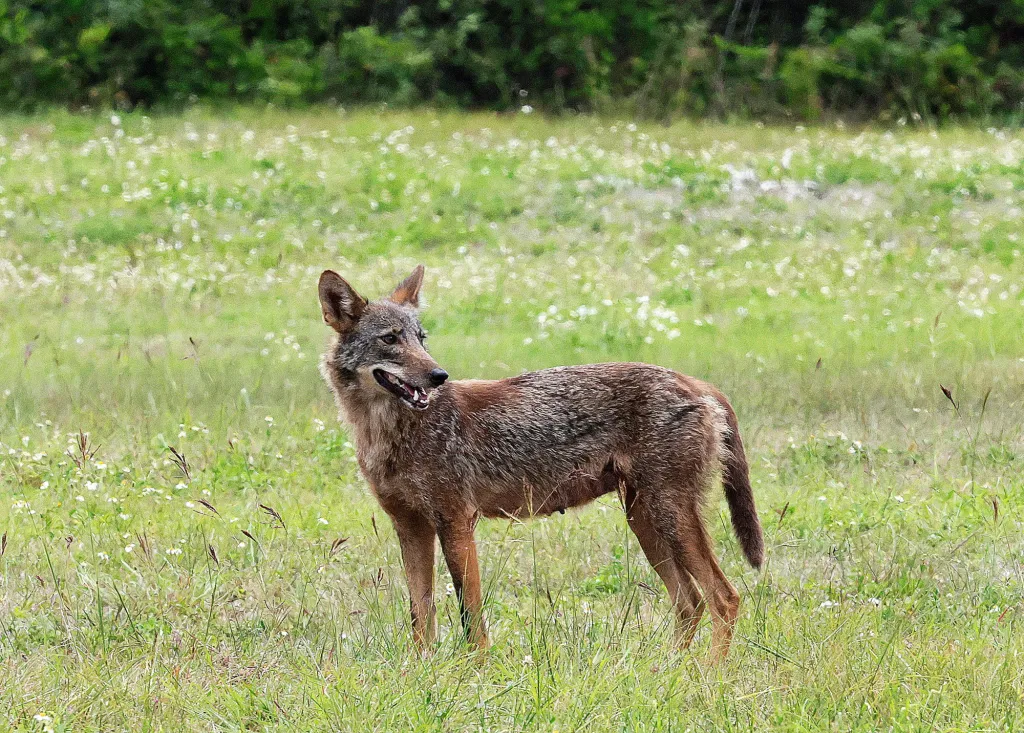
When Mark Kraus came across copious amounts of coyote poop on the trails of Montgomery Botanical Center, south of Miami, he couldn’t help but start dissecting it.
Read more Boy’s death in hot car is third in Florida this year, a tragic reminder of risks
Kraus, a retired chair of the natural sciences department at Miami-Dade College, was particularly curious about coyote survival because they’re from the Great Plains, but have been thriving in South Florida suburbia for the past 15 years, changing the ecology.
Montgomery Botanical Center, with its fruit trees, lush open lawns and dense tropical thickets, offers plenty of coyote food: raccoons, possums, gray squirrels and Norway rats all reside there, as do hordes of invasive green iguanas and non-native peacocks.
Iguanas were brought to Florida from Central America as exotic pets. Peacocks, native to Southeast Asia, came to South Florida to be flaunted as living lawn ornaments for the wealthy of the 1920s and ’30s.
Kraus wanted to find out what coyotes choose to eat, given the broad menu. Piles of coyote scat later, Kraus found the answer, revealed in a new study.
He teamed up with researchers from the University of Florida and set about collecting scat samples over the course of a year.
He also set up trail cameras at different strategic spots — near mango and avocado trees when they ripened, near a new iguana burrow and near a suspected coyote den.
Though he hasn’t witnessed a coyote killing an iguana or peacock — they tend to hunt at night, once humans leave — he had a hunch it was happening. His trail cams revealed what went on in the dark.
Before long he had images of adult coyotes carrying iguanas back to a suspected den location during pupping season. “I assume it was to either feed pups, or probably as likely, train pups on how to to deal with an iguana,” he said.
The trail cams also revealed the coyotes digging up iguana nests, presumably to get to the eggs. “I’m pretty sure that’s the case,” he said.
In a period of less than a month, from July 13, 2024, to Aug. 6, 2024, the cameras captured images of adult coyotes carrying large iguanas on six separate occasions.
Peacocks forage on the ground when the sun’s up but roost in trees at night, safe from coyotes, but hens nest on the ground, said Kraus.
He found a peahen carcass with breast meat eaten, and nearby was a nest with the eggs eaten. “There’s really no other large animal at least in this part of Miami-Dade County that would be taking on something that big,” he said. Though not absolute proof, “that’s all real strong indication that coyotes are killing those animals as prey,” said Kraus.
Separating scat from fiction
The real proof was in the scat.
Kraus found feathers in scat that were too large for any local songbirds, but the right size for a young peacocks. Bird bones offered clues as well. “They were not turkey-size bones. They were smaller. My working assumption is that they were the pea chicks. But they were most assuredly larger than songbirds, you know, cardinal, mockingbird, morning doves.”
Iguanas remains were in the scat as well.
He found an entire leg — claws and all — of a juvenile iguana in the scat, and plenty of iguana skin.
“They couldn’t digest iguana skin very well, so I found a lot of it. That was really direct evidence that they were eating iguana,” said Kraus.
But the coyotes mixed it up, with land crab shells, egg shells (presumably from peacocks) and plenty of seeds and grass.
Though most fruits would have been fully digested, he found fragments of mango, sapodilla, and water chestnut in some of the scat, and the trail cams revealed coyotes often loitering around fallen fruits.
A seasonal menu
When Kraus looked at scat content over the course of the year, he found that coyotes consumed animals more frequently in winter and more fruits and grasses during the wet season.
“Green iguanas were a staple dietary item, especially during cooler months,” said the study.
There also was a surprise in the scat. Despite raccoons, possums, squirrels and Norway rats living on the property — all mammals that coyotes kill and eat elsewhere — there was no mammal fur in an entire year’s worth of coyote scat at Montgomery Botanical Center.
Read more Florida school grades: More As and Bs on the 2026 report card
A large iguana can weigh more than a racoon or possum. Kraus wonders if the coyotes are choosing the lizards because they’re easier to kill and offer plenty of meat.
The coyote’s journey
Though coyotes are relatively new to Florida, first entering from the north in the 1970s, according to the Florida Fish and Wildlife Conservation Commission, they’re not invasive — they’re simply expanding their range with the help of humans.
Back in the 1700s, coyotes were limited to the Rockies and Great Plains, according to the Urban Coyote Research Project.
European settlers eradicated wolves and bears and turned forests into crop and pastureland, giving coyotes fewer predators and more open space.
They expanded their range from Southern Mexico to Alaska, east to Nova Scotia and south to Florida. The FWC says the predators are now present in all 67 Florida counties — even in the Keys, where the first sighting occurred in 2011.
The suburbs of Broward and Palm Beach counties have become coyote habitat as well.
How did the coyotes get to the Montgomery Botanical Center?
To get to the center from the closest open space or wilderness, the coyotes would have had to travel through a good 12 miles of dense urban and suburban development, possibly slinking along canal banks.
They also could have come in from the south — a quick swim over a canal connects Everglades National Park and Biscayne National Park to the string of preserved land where they live.
The combination of various preserves, botanical gardens, parks and mangrove buffer areas creates a six-mile stretch of undeveloped land for the coyotes.
“I think we have a general population that goes from at least the Deering Estate to the south and to Fairchild Tropical Gardens to the north. This is just good habitat for them,” said Kraus.
They’re not only taking a dent out of non-native iguana and peacock populations, they also may be pushing other predators to new areas.
Kraus has lived a few miles from the Montgomery Botanical Center since 1996 and has seen gray foxes decline on the Montgomery grounds. A gray fox can weigh between 7 and 13 pounds, whereas adult coyotes typically weigh 30 pounds, with larger males weighing 40 pounds.
He has a suspicion, unproven, that the influx of coyotes has pushed the smaller foxes out of prime habitat, and into areas more altered by humans, such as his backyard, where he now sees them.
Kraus said that coyote diets in other parts of the state are likely quite different.
A 2025 study of coyote scat in Boyd Hill Nature Preserve, a 245-acre preserve surrounded by housing developments and gold courses in St. Petersburg found that coyotes there ate plenty of insects and plants, and the predominant mammals were marsh rabbits, raccoons and cottontail rabbits — not an iguana or peacock in any of the scat.
The area is at the northern fringe of the green iguana’s range in Florida, according to the FWC, and there are no peacocks in the preserve.
Though coyotes may have left behind prey such as cottontail rabbits and prairie dogs when they came to South Florida, they have also found new food sources, and have been adaptive enough to exploit it.
Humans, with their farms and fields, suburbs and exotic pets, have lent them a hand.
Bill Kearney covers the environment, the outdoors and tropical weather. He can be reached at [email protected]. Follow him on Instagram @billkearney or on X @billkearney6.
Read more ‘Indiana Jones’ and ‘Braveheart’ actor Michael Byrne dies at 82