
Florida students posted record-high scores on the state’s annual reading and math tests this year, a promising gain that experts said should be viewed with cautious optimism until more data is available.
Read more Editorial: On reflection, everyone out of the pool
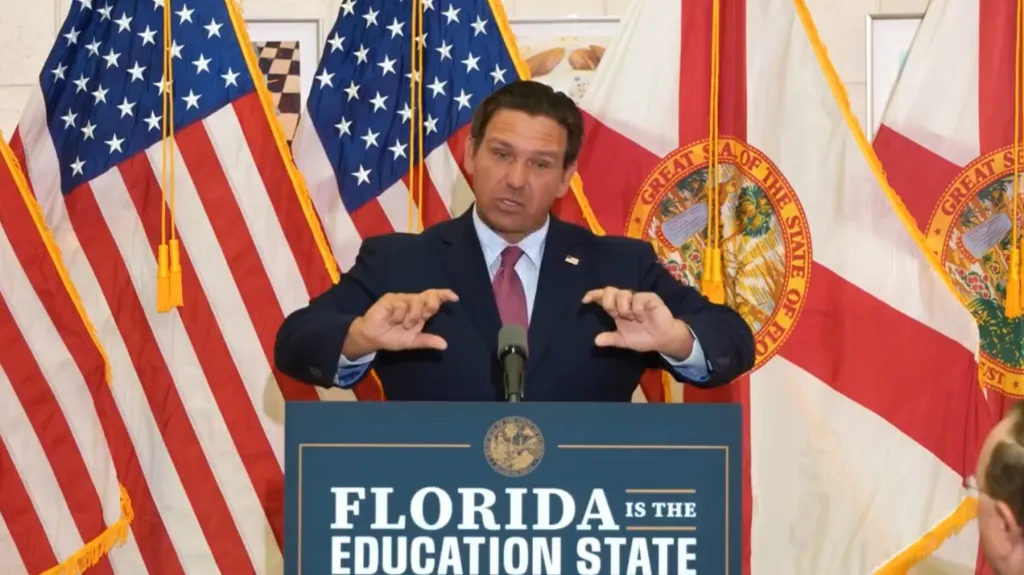
Last week, Gov. Ron DeSantis announced that this year, for the first time ever, 60% of Florida’s students tested at or above grade level in reading and math. The increases represent continued gains from last year and a sharp jump, especially in reading, from where Florida stood just three years ago when only about half of students read at or above grade level.
But those better test scores came as Florida’s public schools lost students this past academic year, including immigrant students still learning English — a group that typically struggles on standardized reading exams.
Such demographic changes could impact test performance but likely do not alter the “positive story” of Florida’s 2026 scores, said Andrew Ho, a professor at Harvard University’s Graduate School of Education whose research aims to improve the use of test scores in education.
The raw decline in enrollment and test takers likely wasn’t enough to erase the size of the gains Florida saw this year, he said.
“If you look at that magnitude of the gains in Florida, which I would say are notable … there’s essentially no chance that the gains are due to an out‑migration of low‑scoring students alone,” Ho added.
But Ho, who previously served on the governing board of the National Assessment of Educational Progress, or NAEP, said upcoming results from national tests administered to a sampling of students nationwide should more clearly show the scope of Florida’s improvements.
Florida’s 2024 scores on NAEP, dubbed the “nation’s report card,” showed the state hitting 20-year lows in both math and reading, with students still struggling academically after the COVID-19 pandemic.
In 2023, Florida introduced a new standardized test, the Florida Assessment of Student Thinking, or FAST. These are “progress-monitoring tests,” meaning students take them three times a year.
The first two tests aim to show what students know and what they still need to learn. The third test, taken in the spring, is more consequential. It was those scores the state released last week for schools and districts.
That third test is high-stakes, with the scores used to help make promotion and graduation decisions for students and to grade public schools A-to-F.
At his June 26 press conference, DeSantis credited the state’s shift to the FAST test for student’s academic improvement.
“This innovation was the right way to go. I believed in it, it made sense, thought it would be good for students, and now we’re seeing that this is really paying off,” DeSantis said.
School districts in Lake, Orange, Osceola and Seminole counties mirrored the state’s improvements in reading and math scores.
Read more In first look, new Winter Park Playhouse wows
Those gains led to more A’s and B’s on Florida’s annual school report card, which the state released Wednesday.
This year, 76% of all Florida schools earned an A or B, up from 71% last year. Though the number of schools graded fell slightly to 3,428, the percentage earning top marks jumped sharply, from 44% receiving A’s last year to 51% this year.
There were very few F grades statewide in 2026, and just two in Central Florida, both given to charter schools in Osceola.
The state also grades school districts. The school districts in Orange, Seminole and Lake counties maintained their A ratings, and Osceola kept its B grade this year.
This year, thousands fewer students took FAST exams compared to last as enrollment declined statewide and in most Central Florida school districts. Officials attribute the drops to the expansion of Florida’s voucher program, which provides scholarships for private schools and homeschooling services, as well as a decline in birthrates and the Trump administration’s immigration crackdown.
In 2026, for example, 11,300 fewer third graders took the state reading test compared to a year ago, and the students tested this year had a passing rate that was 3 percentage points higher than in 2025. On the Algebra exam, taken by middle and high schoolers, there were about 7,000 fewer test takers this year, and the passing rate was also up 3 percentage points.
Statewide, enrollment in Florida public schools dropped an estimated 63,000 students in the 2025-26 school year. In a January report, state demographers blamed enrollment losses in part on the “chilling effects” of President Donald Trump’s immigration policies.
There are no specific estimates for how many immigrant students have left Florida’s public schools, but the number of students statewide taking English for Speakers of Other Languages classes has dropped by more than 17,000 this year, according to the report by Florida’s Office of Economic and Demographic Research, offering one measure immigrant exits.
“Average achievement scores can be influenced by changing the pool of students who are tested,” said Brian Jacob, a professor at the University of Michigan researching urban school reform and standards and accountability initiatives. “If kind of typically lower achieving students leave the state, or any one district, that would lead to higher average scores, even if there was no change in the skill level of students who stayed,” he said.
Florida has a long history of helping young students make gains in reading dating back to 2002, Jacob said. The state showed tremendous growth on the NAEP from 2002 until 2017, when scores began to fall off.
The latest improvements could represent real change, he said, but he too wants to see NAEP scores.
Because testing populations can change, and state exams often cause schools to teach to the test, Jacob said NAEP scores will provide the clearest view of Florida’s current academic progress. He called the NAEP a “much better measure of underlying student ability.”
Read more July 4th Must-Know BBQ Hacks
The next round of NAEP results is scheduled to be released in January.