
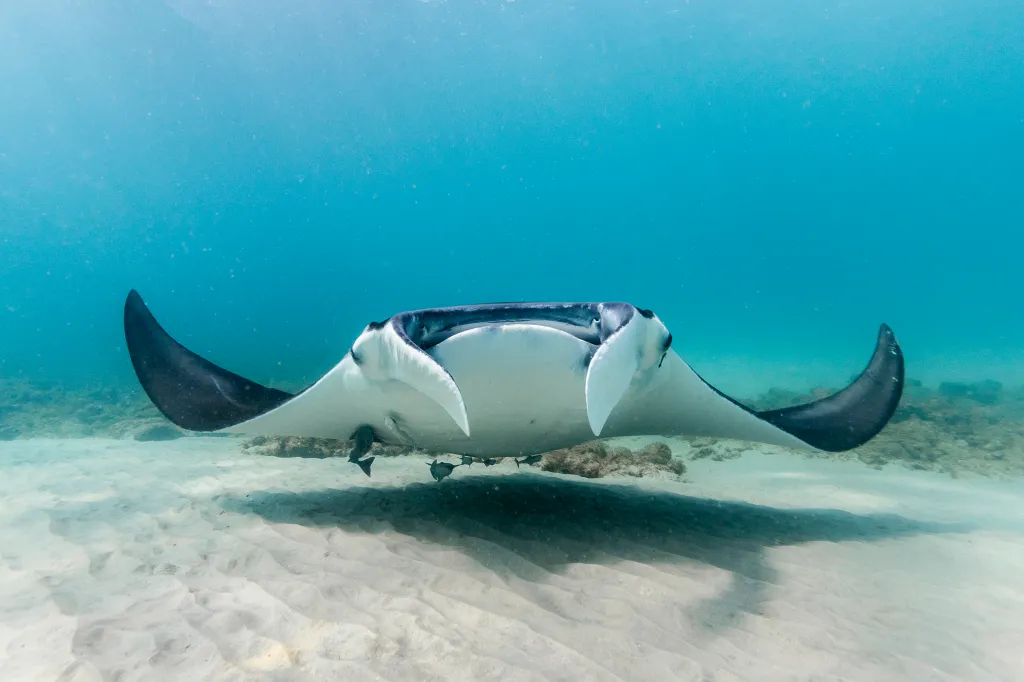
Florida’s wildlife commission is ending a controversial policy that allowed the capture of wild manta rays — a federally threatened species — for overseas aquariums.
Read more Primrose Lanes’ new skating rink: Fun, funky and bright with same repurposed vintage bowling decor
But the commission will still allow U.S. companies to seek approval from Florida’s wildlife officials if they want endangered marine wildlife for their displays.
The new rules, adopted at a commission meeting Wednesday, effectively end an open permitting program for the capture of certain federally threatened Florida wildlife for educational purposes. Now, if a company seeks an animal on the endangered species list for their exhibitions, like a manta or queen conchs, it will require approval from wildlife commissioners instead of staff issuing permits.
The reforms come after a viral video last summer showed men hauling a netted manta ray onto their boat off Panama City. Florida’s wildlife agency eventually confirmed it had approved the capture for a SeaWorld in Abu Dhabi.
The footage and resulting backlash shed light on the state’s little-known marine permitting program and spurred calls for change from a bipartisan coalition of Florida lawmakers. As the Orlando Sentinel reported last year, Florida is the only U.S. state that allows the harvest of giant manta rays.
Most of the 25 state permits — nearly 3 out of 4 — issued since 2019 that granted manta ray captures were for overseas aquariums, according to an analysis of public records obtained by the nonprofit Animal Legal Defense Fund.
More than half were for aquariums in either China or the United Arab Emirates, the records show.
During the meeting Wednesday, the governor-appointed wildlife commissioners took issue with exporting Florida-caught manta rays to aquariums abroad.
“I do believe that we should not export the manta rays internationally or to other countries. I believe that they should be here, in America,” wildlife commission chairperson Rodney Barreto said. He thanked both “the internet” for raising issues with the state program and lawmakers who asked for reforms.
A spokesperson for SeaWorld did not immediately respond to a request for comment.
Read more Disney World: Florida-resident tickets as low as $65 per day this summer
Wildlife staff on Wednesday said that without any future international exports, there’s just one domestic company that meets the requirements to house a manta ray in captivity throughout its lifespan: the Georgia Aquarium, whose Ocean Voyager tank holds 6.3 million gallons of water or nearly 10 Olympic sized pools.
If a manta ray died in its tank, and the aquarium wanted a new one, “we have the ability to help them get one. We should leave that ability open. I think that ability should come to the commission, though, and not just somebody getting a permit,” Barreto said.
State Rep. Lindsay Cross, a St. Petersburg Democrat, has been calling for a total ban on manta ray captures alongside federal and other state lawmakers. She also introduced a bill during this year’s legislative session that would have reformed the Special Activity Licenses program.
While her bill never gained traction, Cross said Wednesday that the reforms were commonsense steps toward protecting Florida’s marine wildlife. Requiring commissioners’ approval will also improve public transparency, she said.
“It was clear from all of the Commissioners that sending Florida’s marine wildlife out of the country for private profit is incredibly unpopular,” Cross wrote in a text message to the Times.
“It’s also clear that advocacy and public pressure works,” she wrote.
Some environmental advocates who had called for a total ban of wild manta ray captures for aquariums, domestically or abroad, said the decision Wednesday was still a welcome change.
“While Defenders of Wildlife continues to believe these vulnerable marine species should not be captured from the wild for exhibition, today’s decision represents meaningful progress,” said Katherine Sayler, the southeast representative for the nonprofit Defenders of Wildlife.
Sayler continued: “Requiring public review and Commission approval introduces greater transparency, accountability and oversight into a process that has lacked sufficient safeguards.”
Read more Orlando Fringe Festival reviews: AI, first lady, gay romance and sexy death