
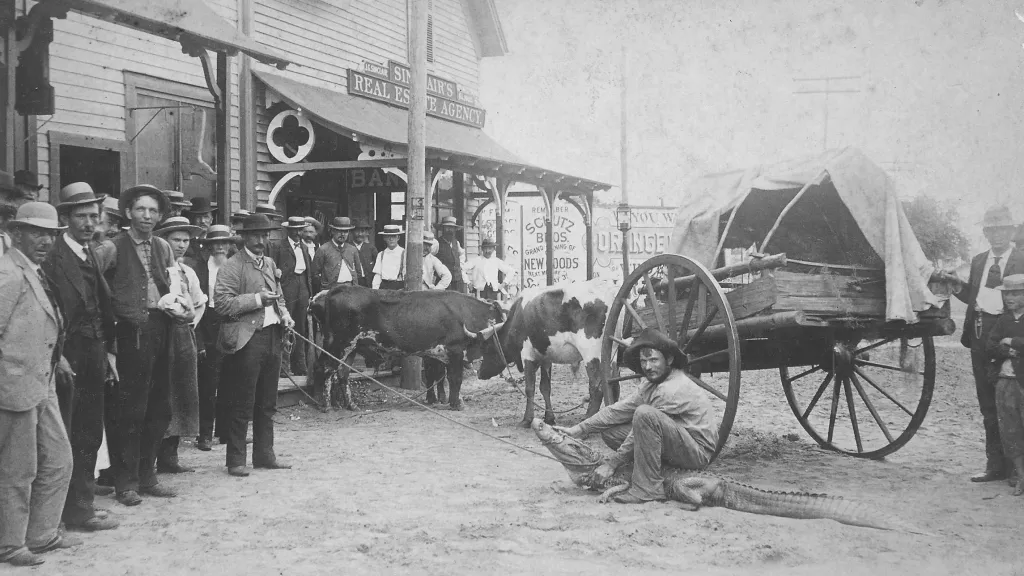
When Orlando first incorporated 151 years ago — just one year before Rufus A. Russell founded an Orlando Sentinel predecessor called the Orange County Reporter — there were few signs the cow and citrus town of 85 residents would one day become one of the world’s most recognizable destinations.
Read more Lukas Nursery Butterfly Encounter: Oviedo attraction’s natural wonders span 20+ years
Twenty-two registered voters decided to form the town, centered on the courthouse that once stood at present-day Magnolia Avenue at Heritage Square. The new municipality’s boundaries spanned just one mile north, south, east and west.
Today, Orlando has grown to be Florida’s fourth-largest city and the center of one of the nation’s largest metropolitan areas. Its borders sprawl for miles to the south and east, tens of thousands have moved here from all over the world, and hundreds of millions more have vacationed at resorts and theme parks known around the globe.
But historians fear that continuing, explosive growth could endanger the buildings and landmarks — some of which date back to the city’s founding — at the very place it all started, downtown Orlando.
Origins
The first settlers were drawn here by the presence of military bases from the Seminole Wars. A trail – what is today Magnolia Avenue in downtown – connected Fort Gatlin in south Orlando and Fort Mellonville in what is now Sanford.
The village soon became the center of business and political life – even becoming the county seat over Sanford, which as a port city was more consequential. In the 1856 election to determine the seat of government, local boosters drew in soldiers from nearby forts to vote for the soon-to-be Orlando with the promise of a picnic dinner.
Later, Jacob Summerlin, a cattle rancher, citrus farmer and Orlando forefather, outmaneuvered General Henry Sanford at a meeting of the county commissioners in 1875 by offering to pay to build a new courthouse for $10,000 after Sanford tried to lure the government north.
“I think between stealing the county seat in 1856 and that trail coming through, it kind of determined that this was going to be the downtown City of Orlando,” said the city’s Historic Preservation Officer Jennifer Fritz-Hunter.
Two years prior, Summerlin had purchased roughly 200 acres of land for 25-cents per acre, fronting a scenic lake. Today, even one acre of vacant downtown land could cost $20 million, according to data from the Orlando Regional Realtor’s Association.
Jacob’s son, Robert Summerlin, ultimately named the body of water Eola after a friend of the family.
In 1883, Jacob Summerlin donated a strip around the water to the city if it agreed to plant trees and add a driveway around the perimeter to create a park.
Pine Street
In the generations since, downtown has grown into Central Florida’s Central Business District, where more than 23,000 live and nearly 100,000 work, data shows. It’s home to professional sports franchises, a world-class performing arts venue, high-rise buildings with more than 12 million square feet of office space, a commuter rail line and a one of the nation’s busiest highways.
But walking Pine Street can still give you a taste of the early days if you know where to look.
The striking green Queen Anne-style Rogers-Kiene Building built in 1886 is today home to CityArts. It was originally home to The English Club, where early Orlandoans sipped spirits, and once was home to a predecessor of the Sentinel.
Walking west, the Robinson Building – now home to the aptly named The Robinson cocktail bar – and the neighboring Lartigue Building were built in 1884 after a fire destroyed four of the area’s wood buildings.
On East Pine Street, the old Magnolia Hotel still stands as the oldest building in downtown Orlando, Hunter said, though it’s not in its original location.
The brick building with marble accents, now home to Allure Restaurant & Lounge, was first built by “Big Tom” Shine on the west side of Orange Avenue between Central and Pine Streets, according to historian Eve Bacon’s book, “Orlando: A Centennial History.” But later it was moved by Elijah Hand to make way for his embalming business, Hunter said.
Continuing west, the train tracks today follow the same path as the original South Florida Railway, which ignited the first population boom and put the city on the map.
In 1880, the city’s first railway was completed, connecting Sanford to what became called The Phenomenal City, creating a new, much quicker gateway for settlers to find Orlando. With that, “Orlando’s days as a pioneer town were numbered,” Bacon wrote.
Prior to the train, a new settler headed for Orlando would usually take a riverboat down the St. John’s River from Jacksonville to Sanford, and walk, ride a horse or take a carriage on a two-day trek to Orlando.
But when the South Florida line opened, early schedules show the trip was shortened to under two hours, Bacon wrote.
“It put us on the map, it got our goods out and it truly helped us become the orange capital of the world,” Hunter said.
The results were immediate. In 1880, the city’s population totaled about 200. By 1890, it had grown to 2,856.
A train depot which opened on Church Street in 1890still stands on the east side of the tracks. In recent years it housed a series of restaurants, but has sat unused since the last one, Ferg’s Depot, closed in 2018.
Business is booming
The early downtown economy was built on two things: citrus and cattle. Pineapples were widely grown, and oranges and various hybrids soon followed.
But real estate and retail also took off. By 1884, a map of the Central Business District shows hotels, saloons, dry goods shops, cigar manufacturers, and stores selling everything from shoes, to jewelry and even a winemaker.
“The commercial areas develop near the courthouse because that’s where people came to do business,” said local historian Joy Wallace Dickinson.
As decades progressed, neighborhoods began to form around the numerous lakes dotting the map surrounding downtown.
At Lake Lucerne, just south of downtown, an English settler named Charles Lord bought four swans to put on the lake – a pair of Royal Mutes and a pair of Australian Black Swans – including one who became the city’s first iconic bird, Billy.
Billy The Swan ultimately proved to be a territorial bully and the two Australians had to be moved to nearby Lake Eola for their safety in 1922, kicking off more than a century of the birds being synonymous with what became the city’s signature park. Billy The Swan ultimately died in 1933 and is taxidermied at the Orange County Regional History Center.
A flock of swans remains at Lake Eola, though it’s expected its days are numbered. Earlier this year, after a bout with the avian flu and criticisms that conditions at the lake weren’t appropriate for the fowl, city officials announced they’d be moving the birds away and suspending their swan program.
At least some of the birds that live at the lake are wild – the majority are owned and maintained by the city – and will remain if they choose to.
The 20th century
In the booming 1920s, Orlando’s population tripled in the course of one decade to about 30,000.
The ’20s also brought Orlando’s first three skyscrapers. The 11-story Angebilt Hotel was built in 1923, and a year later, two more 10-story skyscrapers were built in the Orlando Bank & Trust Co. building and the State Bank of Orlando.
While the Great Depression slowed development, it didn’t completely come to a halt it like in other parts of the country.
“You see the number of building permits or the cost of construction going way down, but it does not stop,” said Richard Forbes, the city’s former historic preservation officer. “Some places in the north, it just stopped. Here it just kind of kept going.”
World War II brought a revival of Orlando’s economy, as manufacturing plants and businesses contributed to the war effort and more than 9,000 assault ships were produced in Orlando, according to the Florida Archive.
“People who came to Florida to serve in the military and people who were stationed in Florida at that time, after the war they decided to come back and settle,” Dickinson said.
Much like rail opened Orlando up to rapid growth, so did the opening of Interstate 4 in the early 1960s, which brought highway traffic right through the heart of downtown.
Progress came at a price, however. More than 500 homes and businesses in the historically Black neighborhood of Parramore were taken through eminent domain and bulldozed to build the interstate.
The highway brought people to Orlando from across the country – and is credited in part with the region’s most important new business.
“When [Walt] Disney was flying over the area because it was new – the roads were brand new at the time, the Turnpike and I-4 – he said, ‘that’s it,’” Forbes said.
Read more Today in History: July 5, Hormel introduces the world to Spam
And in 1965, Walt Disney announced his vast theme park plan at the Cherry Park Hotel on Central Boulevard, at the southeast corner of Lake Eola. Today, it’s the site of a World of Beer.
Decline
Before the rise of the suburbs, downtown had been the region’s commercial capital. Department stores anchored Orange Avenue, including rival giants Dickson & Ives and Ivey’s.
The two stores faced each other across Orange Avenue – but during the holidays, they came together to hang a giant light-up star between them.
In 1957, one of the oldest business still remaining downtown, Labelle Furs, moved to its current location at 351 N. Orange Avenue. Arthur Labellman, 81, ran the shop started by his grandfather in 1919 for more than 50 years, selling mink coats and other products at the height of downtown’s retail era. His son, Alex, runs the fourth-generation family business today.
The 1960s were good for business, Labellman said, as jet travel opened Orlando up to the world.
“It didn’t matter if you lived in Orlando and it was November and it was 85 degrees … you could get on a plane and be in Colorado, or North Carolina to ski,” he said.
As a child in the 1950s, he remembered taking the bus to a downtown movie theater with his friends, and could be out of the house for hours.
“The Saturday matinee would be seven or eight cents. A bag of popcorn was a nickel. A coke was a nickel,” he said. “You’d be gone from your house from 10 a.m. to 3 p.m. – and I know a lot of mothers appreciated that.”
Soon, however, downtown retailers began to lose ground to newer, more modern shopping centers such as Colonial Plaza and Western Way.
The key to their success was to capitalize on one of downtown’s weaknesses: parking.
“Parking has always been an issue downtown,” Dickinson said. “So when Colonial Plaza was built in 1956 and built this big parking lot where you could park for free, ultimately that was the start of downtown being weakened as a commercial center.”
In 1963, the head of a redevelopment board called downtown business owners “out of touch” for not wanting to subsidize free parking downtown.
Amid the decline, Dickson & Ives closed in 1965 and Ivey’s followed in 1976, shortly after the Fashion Square Mall opened. Now, long after the stores have gone, the City of Orlando itself hangs the renamed Jack Kazanzas Star each year.
But the solution for the city’s future, it turned out, was rooted in the past.
Church Street
In 1974, entrepreneur Bob Snow opened what became one of downtown Orlando’s all-time most famous attractions by converting a deserted rail station into Church Street Station, a collection of bars and venues that grew to attract millions to one of the city’s oldest streets.
Its hip, retro venues included Rosie O’Grady’s Good Time Emporium, the Cheyenne Saloon, Apple Annie’s Courtyard, Lili Marlene’s Aviator’s Pub and Phineas Phogg’s Balloon Works. Snow built the famous Church Street Station bridge over the road that resembled a train car.
He was first drawn to the abandoned historic site while on a business trip to Orlando, ultimately buying seven parcels for $22 million. Visitation peaked at 3.5 million, Snow told the Orange County Regional History Center in a 2020 article before his death in 2025.
One of the most famous escapades at Church Street took place in 1997. NBA legend Charles Barkley, who was in town for a preseason game, was drinking with friends and teammate Clyde Drexler at Phineas Phogg’s when a patron threw a cup of ice at them. Barkley grabbed him and threw the 120-pound man through a plate-glass window, police said at the time.
“The guy threw a drink at me, and I threw him through a window,” Barkley said weeks later. “I’m not going to plead guilty. I’m going to fight it.” Ultimately, he settled the charges outside of court.
Barkley was in town to square off with the Orlando Magic, who kicked off play in 1989 at the Orlando Arena, built for $110 million using entirely public money. The facility, later called the Amway Arena, was on West Amelia Street on what is now Creative Village.
Orlando’s current 9-story City Hall was opened in 1992 – and soon after, footage of the dynamite-demolition of the old municipal headquarters was used in the opening scene of the Mel Gibson blockbuster Lethal Weapon 3. The city inked a $50,000 contract with Warner Brothers to offset demolition costs.
Triple Crown
Orlando Mayor Buddy Dyer first ran in 2003 on a platform of revitalizing downtown and building a new performing arts center. He said he soon realized that the Magic’s arena was in need of steep renovations – or a new building altogether – and the then-Citrus Bowl also needed modernizing to remain a premier bowl game destination.
In a 2006 speech, he dubbed the effort the “Triple Crown for Downtown.”
The next year, a $1.1 billion package was approved with a mix of funding sources ranging from Tourist Development Taxes, property taxes and private donations.
Dyer, mayor for 23 years, says to this day the deal was the most complicated he’s undertaken.
“It had more moving pieces than anything I’ve ever been involved with,” he said.
Ultimately, the $480 million Amway Center, now the Kia Center – nearly twice the size of its predecessor – was built on a city block at Church Street and Hughey Avenue.
The Dr. Phillips Center for the Performing Arts opened in 2014 on 9 acres across from City Hall at a cost of $614 million. Today, it features three theaters and a jazz concert venue and has vast expansion plans across South Street on land it purchased last year for nearly $11 million.
It was a night-and-day upgrade from the city’s main performing arts facility, Bob Carr Theatre, which was built in 1927.
“I think our community could not imagine Orlando without the venues,” Dyer said.
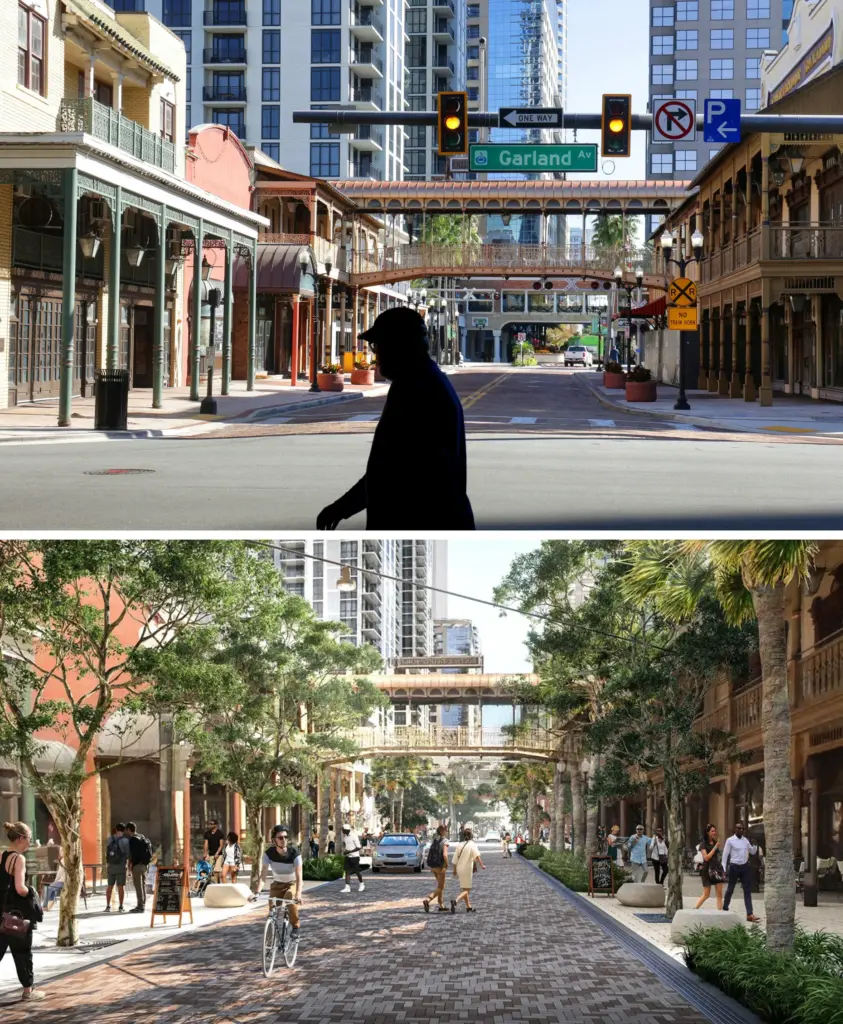 On top, a view from Garland Avenue looking east at Church Street on Jan. 9, 2026, which will be converted to a festival-style, pedestrian-only space starting later this year under the City of Orlando’s DTO 2.0 Action Plan, pictured on bottom. (Joe Burbank/Orlando Sentinel and City of Orlando)
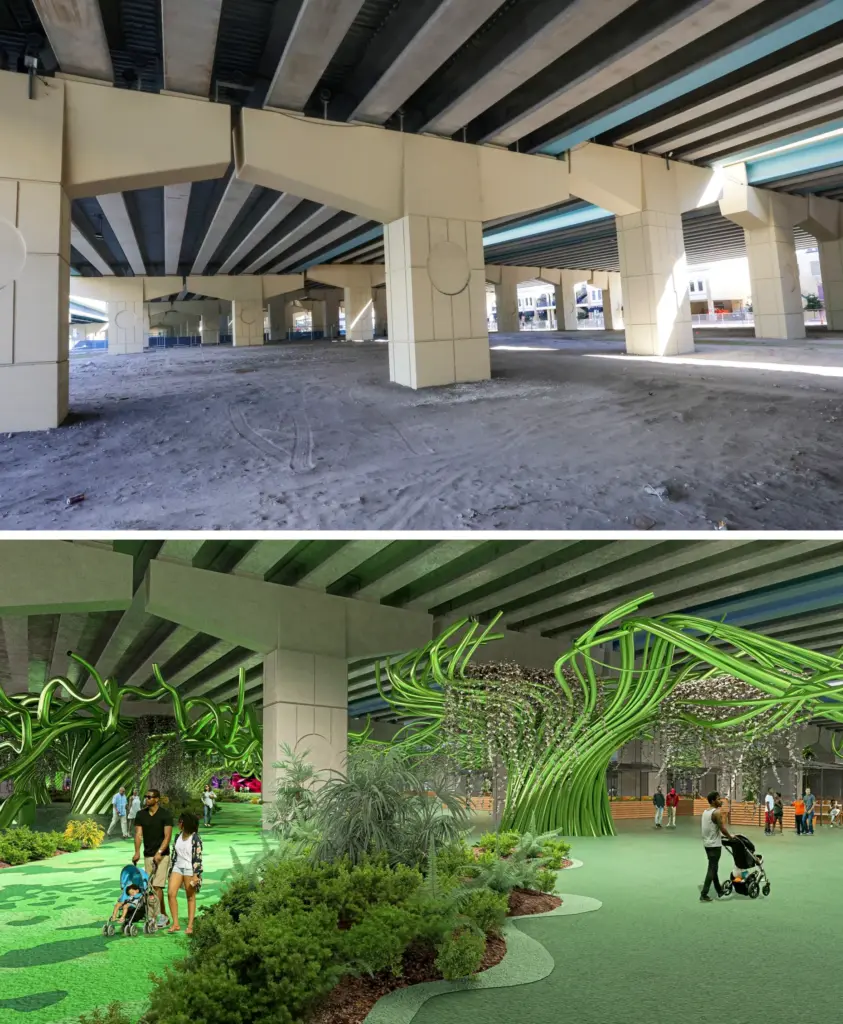 On top, a view of the planned Canopy Park space underneath Interstate 4 at Church Street and Garland Avenue on Jan. 9, 2026. The area will be developed starting in the summer into gathering spaces as a part of the City of Orlando’s DTO 2.0 Action Plan, pictured on bottom. (Joe Burbank/Orlando Sentinel and City of Orlando)
The future
By the 2000s, Church Street Station had entered a period of decline following Walt Disney World’s attempt to copy it with its Pleasure Island complex. The property changed hands multiple times, leading to the closure of its flagship Rosie O’Grady’s in 2001.
Downtown remained a nightlife haven, but COVID-era closures and a string of notable shooting incidents led city leaders to spearhead what they envision as a transformational period for the city’s urban core.
They want to convert the core streets of Magnolia, Orange and Rosalind Avenues to two-way traffic, with the goal of Magnolia going from a sleepy strip to a walkable district akin to the Magnificent Mile in Chicago.
They also have plans of converting historic Church Street into a “festival street” capable of hosting events and bringing people and businesses back to what was once a party capital.
Later this year, they intend to begin transforming the area under I-4’s hulking overpasses into a three-block urban gathering space with the nation’s largest digital mapping and projection system.
And developers intend to break ground break ground on the WestCourt development adjacent to the Kia Center, which one day will bring 200,000 square feet of office space, 125,000 square feet of retail, 16,000 square feet of meeting space, a 3,500-person live events venue, 260 hotel rooms and 273 apartments.
The past
But preservationists wonder how many of the remaining relics of Orlando’s past will remain standing.
In June, Orlando leaders rapidly advanced a plan to bypass the city’s Historic Preservation Board on building proposals within the city’s historic district, which covers the core of its Central Business District. Doing so could spark needed development of more housing, retail, and office space there, officials contended.
But the proposal triggered an onslaught of blowback from historians, preservationists and the advisory Preservation Board itself, which was first formed 50 years ago. The district, spanning eight downtown blocks, includes 66 buildings constructed between the 1880s and 1940s.
Endangered by the plan, historians contend, are buildings like Bumby Hardware, the railroad Depot, the former Slemons Department Store – which famously became part of Rosie O’Grady’s – and other early-20th century structures.
“When I travel I don’t say, ‘Gee, where are the highest economic-impact buildings in your city?’ I say, ‘Where are your landmarks?’” said Commissioner Patty Sheehan, a fierce critic of the idea. “Don’t we all do that? So how is this against economic development?”
But commissioner Roger Chapin argued the plan could deliver a downtown that “feels alive again”.
He recalled valeting cars at Church St. Station and listening to country star John Anderson sing ‘Seminole Wind’ at Cheyenne Saloon – the Apopka native’s anthem mourning the destruction of the Everglades by development interests.
“What I don’t remember is the color of the grout,” he said. “And I think that’s part of the point. I remember nickel beer night at Phineas Phogg’s. I remember the World Cup when it was downtown. It was packed with fans from around the world.”
“What made those memories special wasn’t the buildings – it was the people.”
More stories and features from the Orlando Sentinel’s 150 years of covering Central Florida can be found at OrlandoSentinel.com/150. Sign up for our free history newsletter at OrlandoSentinel.com/newsletters. Buy a copy of the Orlando Sentinel’s 150th anniversary book with 150 front pages from our 150 years. Get it OrlandoSentinel.com/150yearsbook and see more anniversary merchandise at OrlandoSentinel.com/150yearsmerch
Read more Space Coast launch schedule