
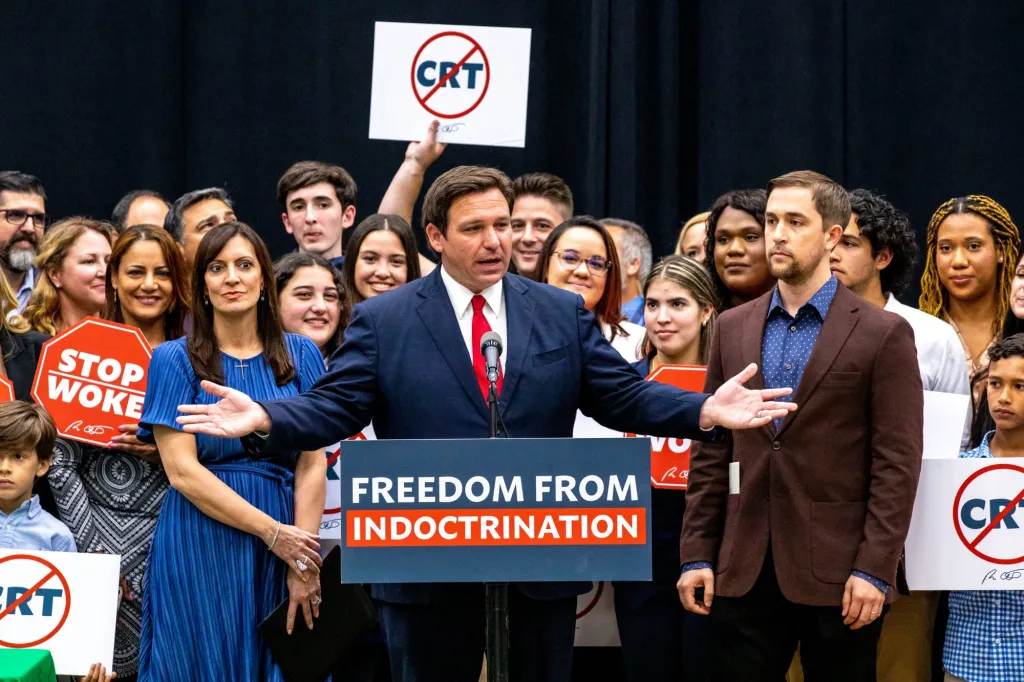
A federal appeals court ion Tuesday struck down parts of Florida’s Stop WOKE Act, calling it a “breathtaking assertion of power” that unconstitutionally censors what state university and college professors can discuss with their students about race, sex and other forms of bias.
Read more Orange County’s tourist-tax record stretches to 14 months
The 2-1 ruling by the Atlanta-based 11th Circuit Court of Appeals upheld a lower court’s injunction preventing the state from enforcing the sweeping law that sent chills through the academic community, forcing professors to alter or cancel their course curriculum especially in the fields of critical race theory and gender studies.
“Florida seeks to strip public university professors—and by extension their students—of the ability to fully engage with ideas that are, for better or for worse, very popular in some academic circles,” said Judge Britt Grant, an appointee of President Donald Trump and author of the majority opinion. “The State asks us to consider its rules a means of targeting discrimination. But hearing an idea you disagree with is not discrimination; it is an opportunity to come up with a better idea, or maybe even change your mind.”
The 2022 law, called the “Stop the Wrongs to Our Kids and Employees (WOKE) Act,” is a hallmark of Gov. Ron DeSantis’ administration. The law restricted what educators could say about discrimination, sexism and bias — and imposed penalties, including fines and termination, on faculty who violated the law by giving their own opinions or straying from the course curriculum.
It also barred private companies from providing diversity, equity and inclusion trainings. That section of the law was struck down as unconstitutional in March 2024.
The Stop WOKE act and the “Don’t Say Gay” law, which passed the same year and banned instruction about sexual orientation in elementary schools, were promoted to fight so-called woke indoctrination, which conservatives cast as a form of discrimination. The Stop WOKE Act applied not only to pre K-12 schools, where the state has traditionally had a firmer hand over educational content, but also to public colleges and universities, where the state government’s role has been more laissez-faire and faculty enjoyed an atmosphere of academic freedom.
Jonathan Cox, a sociology professor at University of Central Florida, decided to cancel two courses exploring race and media rather than run the risk of being sanctioned for violating the new law, according to a 2023 ProPublica article.
Judge Barbara J. Lagoa, appointed by DeSantis to the Florida Supreme Court before Trump elevated her to the 11th Circuit, cast the dissenting vote in Tuesday’s decision. “Our precedent is clear that states retain authority to restrict a professor’s ‘viewpoint’ in a public classroom, even if the professor’s viewpoint ‘represents his professional opinion’,” she said in her written opinion.
The governor’s office did not immediately respond to a request for comment.
The American Civil Liberties Union, which quickly filed a lawsuit in 2022 challenging the law on behalf of several state university professors, lauded the decision.
“This ruling sets a strong precedent that higher education cannot be limited to the whims of politicians,” said Leah Watson, senior staff attorney with the ACLU’s racial justice program, in a news release shortly after the ruling was announced. “All students and educators deserve to have a free and open exchange about ideas without government control. Students can’t fight racial discrimination that they don’t see; training and instruction is key to empowering future leaders to pursue racial justice.”
Since Florida’s Stop WOKE Act took effect, more than 30 states have passed similar restrictions for higher education, the ACLU said. They have been struck down in federal courts in New Hampshire and Oklahoma, the ACLU said.
Read more Man, 82, accused of setting fire to his ex after ending 42-year relationship
But this is the first time an appellate court has found such broad academic censorship laws unconstitutional, the ACLU said.
The state has two options to reverse the ruling, but both are long shots. It can seek reconsideration from the full 11th Circuit Court of Appeals, and it can appeal to the U.S. Supreme Court.
LeRoy Pernell, a Florida A&M University College of Law professor was the lead plaintiff in the lawsuit, Pernell vs. Lamb. He said in a statement that the ruling will stop ‘the erasure of topics that have real implications for our students, allowing them to learn, discuss, and develop tools for combatting the complex issue of racism in our country without being gagged by those who would dictate that only state-approved thought may be promoted.”
In the majority opinion, Grant wrote that Florida’s law imposed a broad set of speech restrictions that “bars Florida’s educators from promoting or endorsing those disfavored ideas when instructing students.”
And that violates the First Amendment and U.S. Supreme Court rulings, she wrote.
In one opinion after another, the Supreme Court has “long been clear that teaching and scholarship are due some measure of protection under the Amendment,” Grant said. “If the First Amendment offers any boundary of protection at all for public university classrooms, this statute crosses it.”
The ruling picked apart the state’s justification for the new law, arguing that when state attorneys could not find an existing case or doctrine that could support its speech ban in the university setting, it came up with the rule that “if the government pays a professor’s salary, it has total control over her classroom speech.”
She called that “a breathtaking assertion of power to ban unpopular ideas from public discourse in the very places the State’s own statutes recognize as centers of inquiry — classrooms where students are trusted to puzzle through ideas that are good and bad, easy and hard, ideally getting ever closer to the truth.”
The state wrongly relied on one past case to argue the rightness of its law, she said.
“This is not the first time that the State has tried to lead us down the garden path about the purpose and effect of a law banning speech,” she wrote, noting the court had previously rejected Florida’s views. “We do so again here.”
Read more Maxwell: Spirited nun ‘retired’ at age 76 and then worked another 12 years