
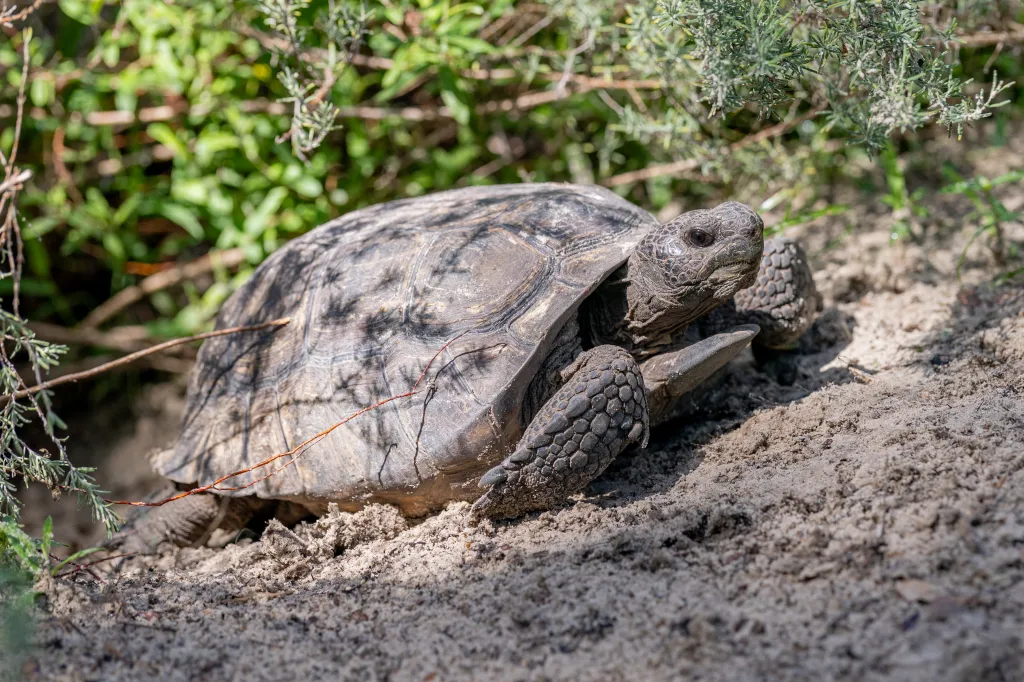
Florida’s iconic gopher tortoise is in trouble, experts say.
The keystone species, which is vital to ecosystems across six southeastern states, is now “critically endangered,” according to the International Union for Conservation of Nature’s Red List, which bumped it from “vulnerable” to the more imperiled designation this month.
Read more National media group names Sentinel’s Scott Maxwell top local columnist
Florida, a gopher tortoise stronghold, was singled out in the Red List report as having drastic declines since the 1960s. The international union bills its list as “the world’s most comprehensive information” on endangered animals.
The gopher tortoise, a “stumpy,” land dwelling reptile, has been documented in every county in the state and is common in Central Florida. The animals are state-protected and must be moved before land is cleared or developed, according to the Florida Fish and Wildlife Conservation Commission.
“The habitats to which gopher tortoises are translocated are generally of higher quality than those where they were previously found, which supports greater long-term success of populations,” wrote an FWC spokesperson in an emailed statement.
But that’s still not enough, said Elise Bennett, the Florida and Caribbean director at the Center for Biological Diversity. She argued the state’s endangered species laws don’t address to the biggest threat to gopher tortoises: habitat loss.
The species, which are foragers, can grow up to 15 inches long and favor areas like longleaf pine sandhills and coastal dunes. They dig burrows for shelter, which they also share with more than 350 other species, according to FWC.
“These burrows are these sort of life-giving forces in the southeast’s upland habitats,” Bennett said. “They are just these incredible little ecosystem engineers, and they are the foundation of our ecosystems, especially right here in Florida.”
The state agency doesn’t regulate development, the FWC spokesperson said, though its gopher tortoise management plan still aims to maintain and restore the habitats where they live. And Florida tortoises that are relocated are given health examinations, while any showing signs of disease spend time with wildlife rehabilitators.
But the state’s actions don’t always guarantee their survival, Bennett said, especially as they’re moved to smaller and smaller areas. In the face of ongoing development, she argued there’s been no political will to defend their original habitat.
“I think that reveals a true problem with our state-level conservation of tortoises and underscores why we need federal protections,” Bennett said.
Like Florida, gopher tortoises are protected by state law everywhere else they live but not always by the Endangered Species Act. Only 8% of their population — those west of the Mobile and Tombigbee Rivers in Alabama, Mississippi and Louisiana — are covered under the federal act.
The U.S. Fish and Wildlife Service in 2022 announced eastern gopher tortoise populations were stable enough to be excluded from listing. The areas not covered include parts of Alabama, Florida, Georgia and South Carolina — and account for the vast majority of the species’ range, according to the agency.
That decision prompted a lawsuit the following year, filed by the Center for Biological Diversity and environment nonprofit Nokuse Education, Inc., challenging the agency’s reasoning.
The Endangered Species Act has historically protected both listed species and their critical habitat on a national level. However, the Trump administration this month narrowed the act’s definition of “harm” to exclude habitat destruction and now requires officials to consider economic and national security impacts when designating critical habitat.
Read more For new Holocaust Center CEO, a Florida homecoming and a museum to open
“There is still a lot of value in getting them listed while we continue to fight over protecting the Endangered Species Act itself,” Bennett said.
The U.S. Fish and Wildlife Service declined to comment on the discrepancy between slim federal protections and the Red List’s grim outlook for gopher tortoises. Its website says its projections show healthy populations into the future.
The federal agency’s reasoning “very aggressively” contradicts the international group’s recent Red List findings, which estimated gopher tortoise populations in 2024 had dropped by more than 80% over the past three generations, said Hunter Howell, a coauthor of therevised Red List assessment and member of the international group’s tortoise and freshwater turtle specialist group.
“We basically have been unable to find any evidence of any gopher tortoise population anywhere in their range increasing in population growth,” Howell said.
“Even in protected areas,” added Leyna Stemle, also a coauthor of the revised assessment.
Howell and Stemle argued the federal government didn’t base its decision on the best available science.
The species can live up to around 60 years in the wild, making it difficult to document population fluctuations, Howell said. So even as some animals live for decades, the species could be experiencing long, slow declines that aren’t immediately apparent.
“We call these ghost populations,” he said. “They continue to exist despite being eventually doomed to extinction.”
Kevin Shoemaker, an associate professor of ecology at the University of Nevada, Reno, cowrote a scientific review two years ago detailing “two major, consequential errors” in the gopher tortoise population projection model used by the U.S. Fish and Wildlife Service.
When Shoemaker and the researchers fixed the errors and reran the model, he said they saw a steep drop in gopher tortoise survival, which aligns with Howell and Stemle’s Red List findings.
The federal agency, however, has not changed its decision that excludes most gopher tortoise populations, including those that call Florida home, from the Endangered Species Act.
“I can tell you these are real errors,” Shoemaker said. “It’s not a disagreement.”
Read more Tropical Storm Bertha strengthens as it nears Gulf Coast, NHC says