
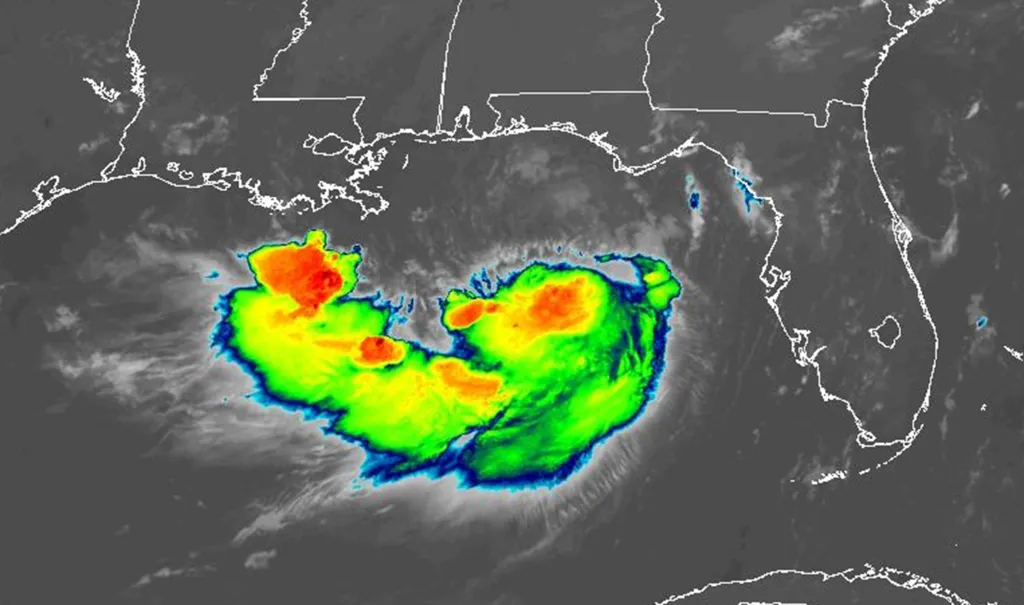
Newly formed Tropical Storm Bertha strengthened overnight as it moved closer to the Gulf Coast on Tuesday, according to the National Hurricane Center.
Read more Police seek people responsible for break-in at Eagles’ running back Saquon Barkley’s home
As of the NHC’s 5 a.m. advisory, the center of Bertha was located about 110 miles south-southwest of Panama City and 170 miles southeast of Mobile, Alabama moving northwest at 5 mph with maximum sustained winds of 50 mph and higher gusts.
Tropical-storm-force winds extend outward up to 80 miles from Bertha’s center.
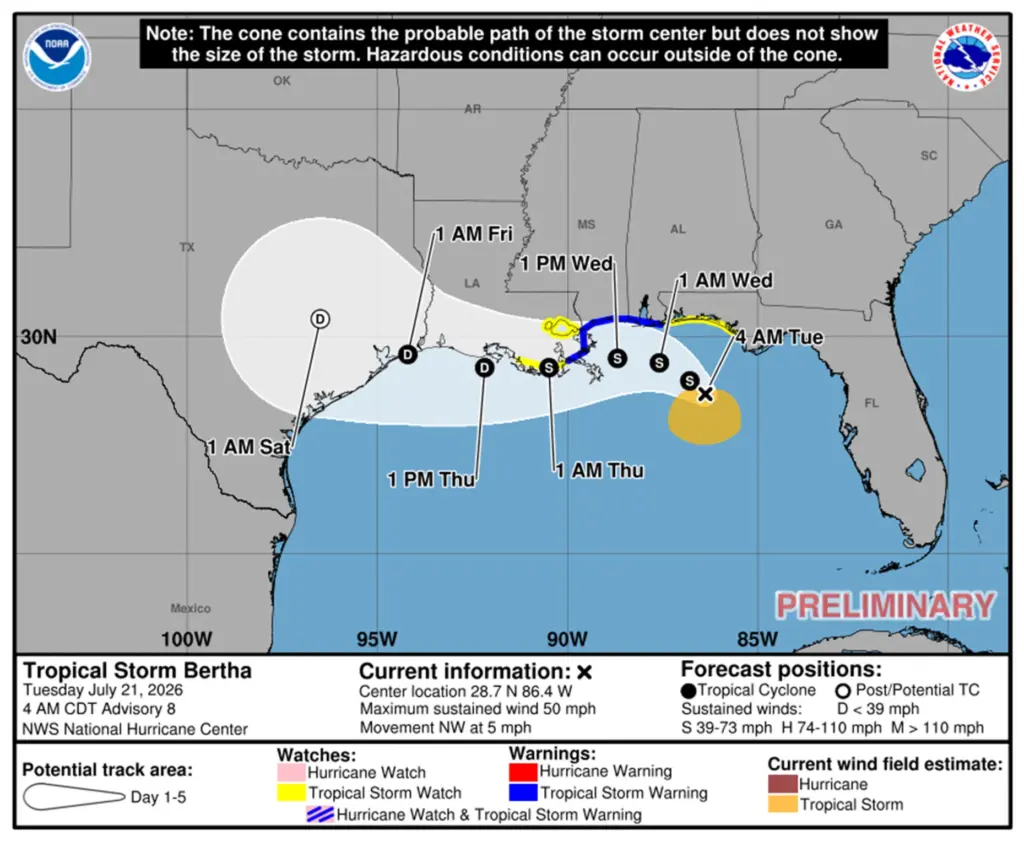
“A slow northwestward to west-northwestward motion is expected today followed by a turn westward by the middle part of this week,” said NHC senior hurricane specialist Philippe Papin. “On the forecast track, Bertha will move near or along the northern Gulf Coast during the next several days.”
The NHC issued a tropical storm warning for the coast from the Alabama/Florida border west to the Jefferson/Plaquemines Parish border in Louisiana while a tropical storm watch remains in Florida from the Bay/Gulf County line west to the Alabama border.
7/20 10pm CDT Key Messages for Tropical Storm #Bertha:
A Tropical Storm Warning is now in effect for portions of the Alabama, Mississippi, and Lousiana gulf coast.
Latest advisory at https://t.co/jigeOJBJ7U pic.twitter.com/TmlCWpfZMQ
— National Hurricane Center (@NHC_Atlantic) July 21, 2026
A tropical storm watch has also been issued for west of the Jefferson/Plaquemines Parish border to Morgan City, Louisiana and metropolitan New Orleans, Lake Pontchartrain, and Lake Maurepas.
And a storm surge watch remains in effect for the Alabama/Florida border to the mouth of the Mississippi River.
Tropical Storm Bertha tracking map: Here’s the latest forecast path
What had been the second tropical depression of the Atlantic hurricane season spun into a named storm by 8 p.m. Monday with 40 mph winds, but had picked up steam by 11 p.m.
Papin said it may intensify to as much as 60 mph sustained winds today, but models show it could fall apart within 48 hours.
“While sea-surface temperatures are plenty warm, nearby dry air could be imported by this shear into Bertha’s center,
disrupting its structure,” he said. “While periodic bursts of deep convection will likely continue to occur over the next 24-48 hours, the latest NHC intensity forecast only shows a slight additional intensification today before the shear becomes prohibitively strong.”
Read more Today in History: July 21, Bosnian war crime fugitive arrested in Belgrade suburb
Tropical-storm conditions are expected within the warning area later Tuesday and into Wednesday while conditions are possible in the watch area in the Florida Panhandle later Tuesday.
A storm surge of 1-3 feet could hit the Florida coast from Indian Pass to Chassahowitzka while surge could hit 2-4 feet from the mouth of the Mississippi River to the Alabama-Florida border, and 1-3 feet from Morgan City, Louisiana to the Mississippi and Lake Pontchartrain.
In addition, rainfall of 2-4 inches through Thursday, with some areas seeing up to 6 inches, is forecast along the Gulf Coast and adjacent inland locations from western Florida into southern Louisiana, including southern portions of
Alabama and Mississippi, with a threat of flash flooding.
Swells along the coast could cause life-threatening surf and rip current conditions.
Short-lived Tropical Storm Arthur was the season’s first named storm that developed in the Gulf and brought floods to Texas and Louisiana in June.
Cristobal is the next name on the hurricane season list followed by Dolly.
The season officially began June 1 and runs through Nov. 30. The height of hurricane season runs from mid-August into October.
The National Oceanic and Atmospheric Administration expects this season to be below normal with the official forecast released in late May calling for 8-14 named storms, of which 3-6 would become hurricanes. Of those, 1-3 would become major hurricanes reaching Category 3 status or above.
An average season has 14 named storms, seven hurricanes and three major hurricanes.
Read more Road deaths have declined globally since 1990 except in poorer countries, study finds